

Key facts
- NASA describes the Solar System as containing one star and eight planets.
- A NASA exploration page lists at least 290 moons, more than 1.3 million asteroids and about 3,900 comets; another summarizes those populations as hundreds and thousands.
- NASA says IMAP launched on September 24, 2025, to help study the heliosphere’s boundary.
- SDO studies the solar atmosphere and the Sun’s influence on Earth and near-Earth space.
- New Horizons explored Pluto and its five moons up close, then made a close exploration of the Kuiper Belt.
Related records
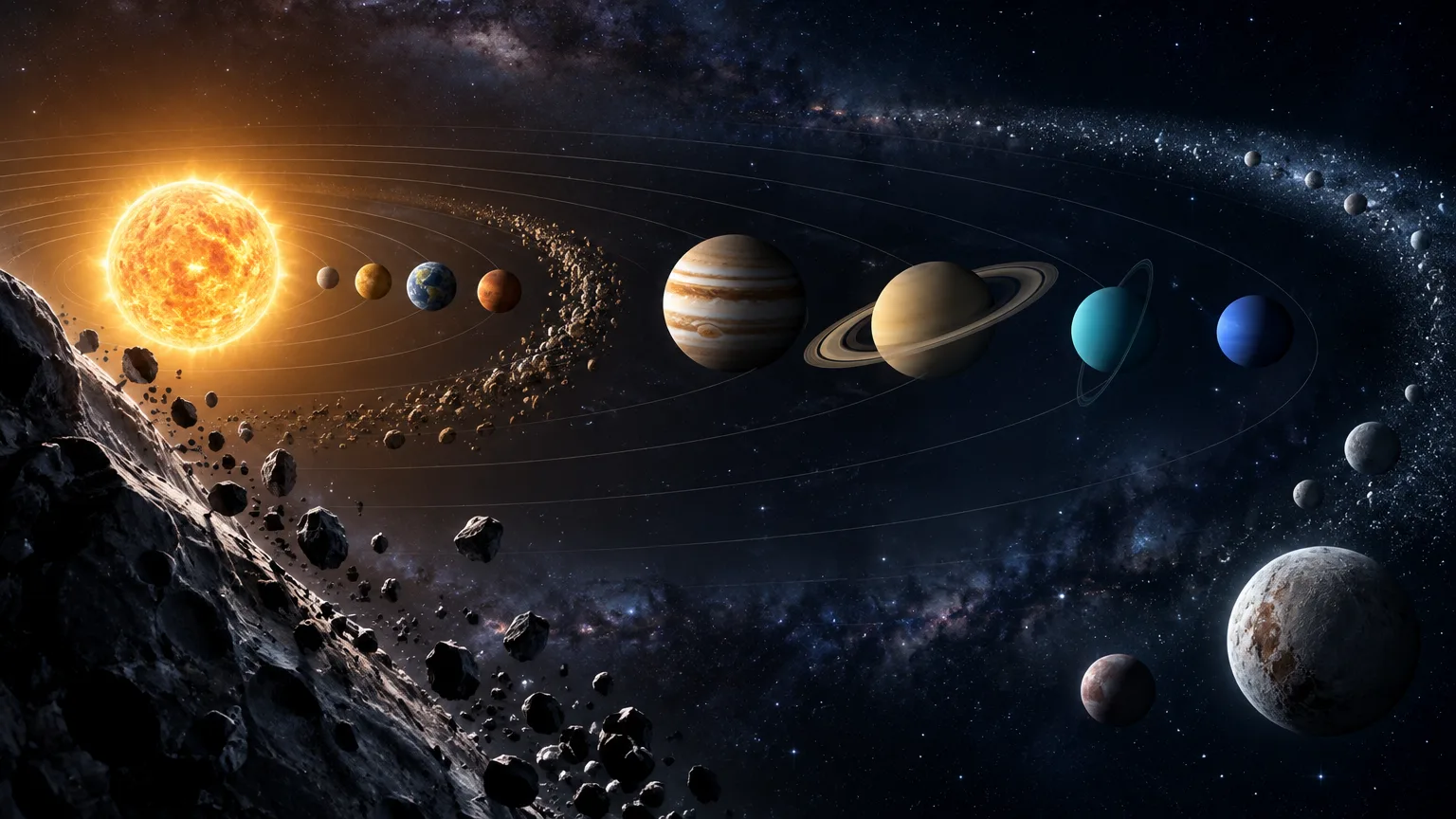
The Solar System is the space environment whose star is the Sun. NASA lists eight planets, five officially named dwarf planets, hundreds of moons, and thousands of asteroids and comets among its members. The agency also emphasizes that the known inventory is extensive and that exploration is not limited to planetary worlds: studying the Sun and the space it influences is part of the same effort.
A system with many kinds of bodies
The familiar picture of a Solar System made up of the Sun and a line of planets is incomplete. According to NASA’s Solar System Exploration page, it contains one star, eight planets, five dwarf planets, at least 290 moons, more than 1.3 million asteroids and about 3,900 comets. Another NASA page summarizes the numbers as hundreds of moons and thousands of asteroids and comets, and refers to five officially named dwarf planets.
These categories describe different populations of objects, but the material provided here does not explain the technical criteria used to classify them. Nor should the counts be understood as a definitive list of every existing body: NASA presents a known inventory and, for moons, explicitly gives a minimum. Asteroids and comets are numerous populations, not collections whose catalogues are closed.
What the numbers show—and what they do not
NASA’s published figures give a sense of the Solar System’s scale, but the available information does not include a cutoff date, counting method or detailed definition for each category. It is therefore more precise to read “more than 1.3 million” and “about 3,900” as public-facing figures attributed to the page consulted, not as a complete and permanent census. The agency’s facts page uses broader terms—“hundreds” and “thousands”—which are consistent with that overall picture but less specific.
The information gathered here also does not allow changes in those counts to be attributed to a particular discovery. Astronomical inventories depend on which objects have been identified and how each source presents them; without dates and methods, it is not possible to measure how much the counts have changed. The cautious conclusion is that the Solar System contains many kinds of bodies and that the quoted numbers are NASA’s public-facing counts, with explicit or implicit limits.
The Sun and the bubble around its influence
The Sun also shapes the environment that missions investigate. NASA describes the heliosphere as a huge bubble created by the Sun and says the IMAP mission will help researchers better understand its boundary. Exploring the Solar System therefore means more than observing individual objects: it also involves studying the extent and edges of the environment associated with our star.
NASA reports that IMAP launched on September 24, 2025. That is a mission milestone, not a scientific result about the heliosphere. The available description explains its broad purpose—to contribute to a better understanding of the bubble’s boundary—but provides no measurements, findings or conclusion about the exact location of that boundary.
Missions studying the Sun and distant worlds
The Solar Dynamics Observatory (SDO) is designed to help researchers understand the Sun’s influence on Earth and near-Earth space. The mission description emphasizes its study of the solar atmosphere on small scales of space and time. That goal connects research on the star to its effects in the nearby environment, although the information available here does not specify particular SDO results.
Farther out, New Horizons was the first spacecraft to explore Pluto and its five moons up close; it later made the first close exploration of an object in the Kuiper Belt, NASA says. The agency’s supplied description does not identify that object, so it is not named here. The James Webb Space Telescope, meanwhile, studies different stages in the history of the universe, including the formation of solar systems capable of hosting planets. Its work provides context for how other systems form, but the cited page does not supply a specific discovery that can be attributed to it in this account.
An open exploration, with clear limits
Together, these sources show several scales of investigation: the inventory of Solar System bodies, the Sun’s influence, the heliosphere’s boundary and close exploration of distant worlds. The missions do not all address the same question, and a description of their goals should not be mistaken for an established result. IMAP is associated with studying the heliospheric boundary; SDO with the Sun’s influence; New Horizons with close exploration; and Webb with cosmic history and the formation of planetary systems.
The most reliable picture that can be drawn from the available information is therefore broad but cautious: NASA describes a system with eight planets and many populations of smaller bodies, while its missions investigate both the central star and distant regions. The figures are not accompanied here by a detailed cutoff date or methodology, and no new results from IMAP or SDO are provided. These limits do not make exploration less interesting; they show which questions remain open and what information would be needed to answer them.
Sources: Solar System Exploration, NASA; Solar System Facts, NASA; NASA Science; SDO; New Horizons; James Webb Space Telescope.