

Key facts
- NASA identifies robotic surface and orbital systems within its Artemis scientific approach.
- The agency links that approach to the Moon, Mars, and human explorers.
- The provided primary source is the Spanish-language NASA Ciencia portal.
- The evidence does not detail individual robots, dates, budgets, or scientific results.
Related records
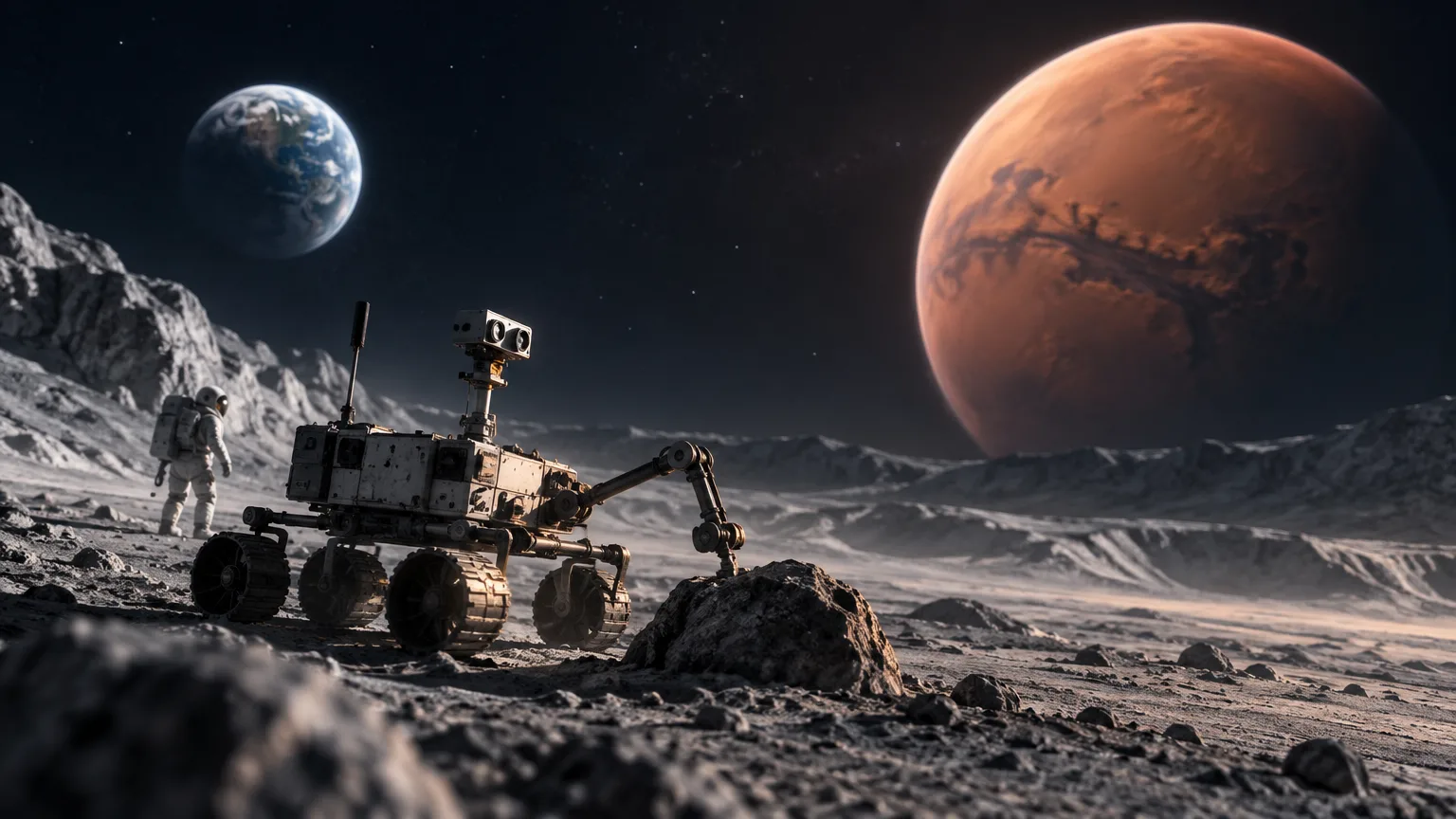
Robotics is among the technologies that make it possible to investigate environments that cannot be routinely accessed from Earth. In space, the term can include systems working on a celestial body and others operating around it. The official NASA information supplied for this article places both settings—robotic surface and orbital systems—at the heart of its scientific approach to the Moon and Mars.
This does not amount to an inventory of vehicles, instruments, or specific operations. It does establish an essential point: NASA approaches research associated with the Artemis program through a combination of human explorers and robotic capabilities. The agency says Artemis will address high-priority scientific questions, focusing on those that human explorers can best pursue in person on the surface and in the vicinity of the Moon and Mars, using robotic surface and orbital systems.
Artemis as a framework for scientific exploration
Artemis is the program NASA names as the setting for this strategy. Rather than presenting robotics solely as a technology demonstration, the available description connects it to scientific objectives. That distinction matters: a robotic system may matter not only because of its design or autonomy, but because of its role in obtaining observations, extending the reach of exploration, or contributing to work in particular locations and orbits.
The agency’s wording also links the program to two destinations: the Moon and Mars. The evidence does not specify which questions are priorities, which instruments will answer them, or which mission will perform a particular task. It is therefore not possible to infer operational schedules, scientific results, or a fixed sequence of activities from these materials. What is established is the combined approach: priority science, human explorers, and robotic systems.
Two settings: surface and orbit
The explicit reference to surface and orbital systems helps explain why space robotics is not a single category. A surface system works in the immediate environment of a celestial body; an orbital system operates around it. These are different positions and can therefore be integrated differently into a scientific campaign. The source assigns no specific functions to either type, but naming both indicates that the strategy considers operations in more than one environment.
This dual presence also provides context for the human explorers cited by NASA. The agency emphasizes questions people can best address in person on the surface and in the vicinity of the Moon and Mars. At the same time, it includes robotic surface and orbital systems. The available evidence does not describe how activities will be divided between people and machines. Claims about remote control, autonomy, sample collection, mobility, or maintenance would go beyond what is documented here.
What robotics means in this case
In this context, “robotics” should be understood as a capability integrated into exploration, not as a broad promise that machines will solve scientific challenges on their own. NASA Ciencia’s own description links robotic systems with the work of human explorers. The relationship between those two elements is therefore the strongest informational core of the supplied evidence.
It is also important to separate this information from headlines about other plans, companies, or missions. The supplied search results include journalistic references to robotic initiatives and lunar-landing proposals, but they are not primary sources and do not provide sufficient grounds to attribute them to NASA’s Artemis program. This article confines itself to the available official explanation and does not turn those secondary references into confirmed facts about Artemis architecture.
How to follow official information
The primary source provided is the Spanish-language NASA Ciencia portal. There, the agency presents Artemis science and also notes a special episode of its NASA Curious Universe podcast devoted to a journey through the Artemis II mission. The supplied description gives no date, independently verifiable operational status, or technical details for that mission. For that reason, the podcast should be treated here as context communicated by the agency, not as independent proof of specific milestones.
For readers interested in space robotics, the most careful approach is to distinguish three levels: a declared agency strategy, published details for individual missions, and results actually obtained. The collected evidence clearly supports the first level. It does not establish the other two.
A conclusion bounded by the evidence
The available information supports the statement that NASA envisages robotic surface and orbital systems as part of its Artemis scientific approach to the Moon and Mars, in connection with human explorers and high-priority scientific questions. This is a meaningful indication that robotics forms part of the space-research architecture described by the agency.
However, that conclusion has limits. No robot specifications, budgets, schedules, performance data, or discoveries have been provided. Nor do these materials support comparisons between programs or predictions of results. For now, the news is the official framework: in Artemis, robotics is presented as a research tool operating both on the surface and in orbit, coordinated with human exploration.