

Key facts
- Astronomy.com published the anniversary article on September 23, 2026; the event it recalls took place in 1846.
- After Uranus was discovered in 1781, astronomers were puzzled by irregularities in its orbit.
- Urbain Le Verrier in Paris and John Couch Adams in Cambridge independently calculated the likely location of another planet.
- NASA says Johann Gottfried Galle observed the new planet at the Berlin Observatory between September 23 and 24, 1846, using a Fraunhofer telescope.
- NASA places the planet one degree from its calculated position.
Related records
The story recalled by Astronomy.com begins with a question about Uranus. After the planet was discovered in 1781, astronomers noticed irregularities in its orbit. According to the anniversary article’s description, the perturbations could not be explained by applying Newton’s laws to Uranus’ known path. One possible explanation was that another planet was exerting an influence on it.
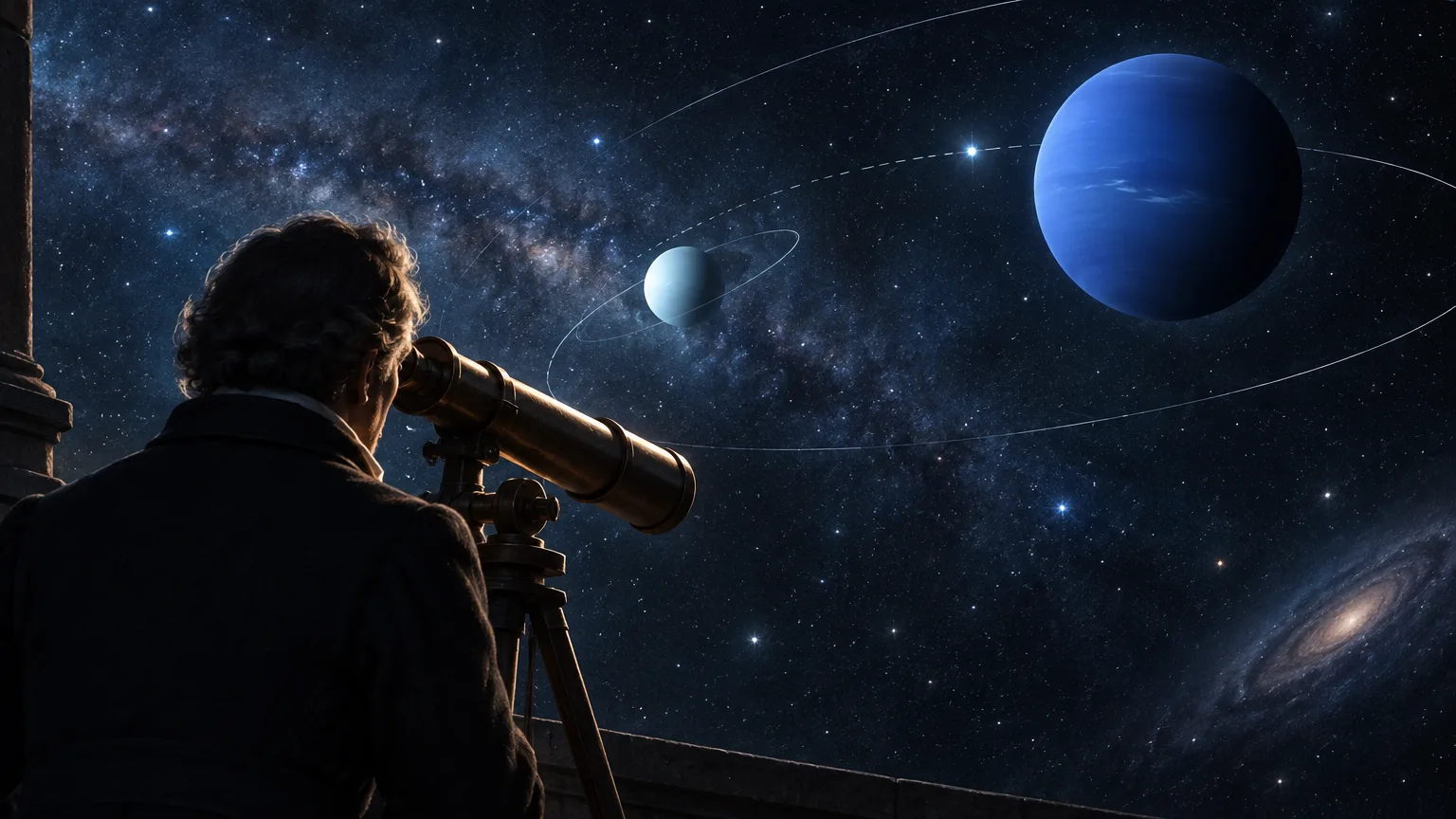
The anniversary matters because it marks the step that connected that mathematical hypothesis to a telescopic observation. Rather than merely noting that Uranus’ motion did not fit expectations, two astronomers independently calculated the likely location of the body that might explain the anomalies. Astronomer Johann Galle then made the first observations of the new planet from the Berlin Observatory. NASA dates those observations to September 23–24, 1846.
The anomaly in Uranus’ orbit
An orbit describes the path of one body around another. For a planet, its observed position over time can be compared with the path expected under a model. Astronomy.com’s account says that, for decades after Uranus was discovered, differences between its motion and expectations puzzled astronomers. It calls them irregularities or perturbations, but the information available here does not specify their size or how they changed.
The idea of an additional planet offered one way to address the problem: an object not yet observed might alter Uranus’ path. That does not mean a discrepancy alone proved that another planet existed. The clue had to be turned into a testable prediction: if the body was real and the explanation was right, it should be found in a particular region of the sky. That is what made calculating its likely position significant.
Two independent calculations
Urbain Le Verrier, an astronomer working in Paris, and John Couch Adams, an astronomer in Cambridge, England, independently calculated where the planet might be. Astronomy.com summarizes the result as a likely location, but the information provided does not describe their methods, input data, or the precision of either calculation. Nor does it allow a comparison of how closely their predictions agreed with each other.
The independent nature of the calculations is central to the context, but it should not erase the distinction between predicting a position and observing an object. The calculations indicated where to look; they were not, by themselves, an observation. The next step depended on pointing a telescope at the suggested region and determining whether a body that could be identified as a planet was there. The sequence therefore combined an inference based on Uranus’ orbit with an observational check.
The observation from Berlin
NASA reports that Johann Gottfried Galle used a Fraunhofer telescope at the Berlin Observatory and made the first observations of the new planet between September 23 and 24, 1846. According to the same reference, the object appeared only one degree from its calculated position. That figure describes the closeness between the prediction and the observed location; it does not mean the planet was one degree from Earth, nor does the information here establish other details about the search.
The anniversary headline’s date, September 23, thus refers to the beginning of an observing sequence that NASA describes as spanning two days. Astronomy.com titled its article “Sept. 23, 1846: Johann Galle discovers Neptune,” while NASA refers to the first observations of the new planet. The distinction is useful: the fact documented in the available material is Galle’s observation on those dates, not a complete account of every step that led to it.
What can be said—and what remains open
On the evidence available, it is fair to say that irregularities attributed to Uranus’ orbit prompted the hypothesis of another planet; that Le Verrier and Adams independently calculated a likely location; and that Galle observed the new planet from Berlin in September 1846, close to the calculated position. NASA identifies the instrument as a Fraunhofer telescope and places the difference at one degree.
The material consulted does not provide enough detail to reconstruct the calculations, explain earlier or later observations, or resolve possible nuances in the historical attribution of the discovery. It also does not establish each astronomer’s specific contribution beyond the facts summarized here. This account therefore presents the episode as a combination of theoretical prediction and observation, without adding a dispute or conclusion unsupported by the supplied sources.
A historical anniversary published in 2026
The information behind this article was published by Astronomy.com on September 23, 2026, according to the supplied details. The article’s publication date is current; the event it describes took place in 1846. Astronomy.com’s text is a historical anniversary piece, not an announcement of a contemporary astronomical finding. That distinction matters: what is new is the publication of the retrospective, not a recent observation of Neptune.
The story summarizes one way astronomy advances: a path that does not fit expectations can point to a cause that remains unseen; calculations can turn that suspicion into a location that can be tested; and a telescope can check whether an object is there. In this case, the sources place Galle at the final step in that chain and report that Neptune was observed close to where the calculations indicated.