

Key facts
- NASA published a review of research conducted on the ISS during 2025 on January 16, 2026.
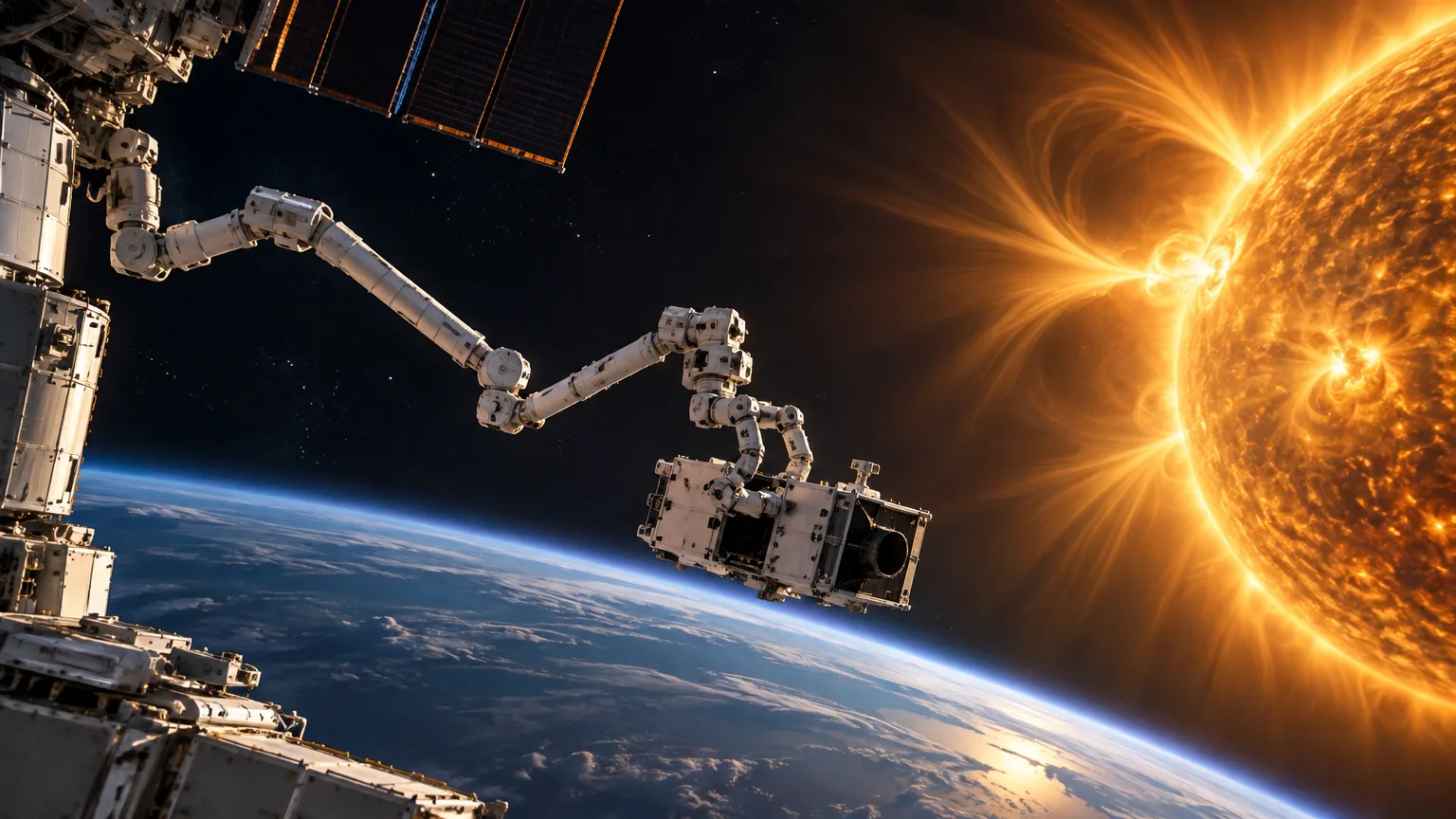
- According to NASA, Dextre, attached to the Canadarm2 robotic arm, carries CODEX.
- CODEX blocks the Sun’s bright light to reveal the corona and measures the temperature and speed of the solar wind.
- NASA reported images of the Sun’s outer atmosphere and described CODEX as a tool for studying what heats and accelerates the solar wind.
- The agency says these observations may help explain the effects of solar activity on Earth and space technologies.
Related records
The International Space Station (ISS) is an orbital laboratory that hosts experiments and technology demonstrations. In an article published on January 16, 2026, NASA reviewed some examples of research conducted aboard the station during 2025. These included observations of the Sun with CODEX, and NASA explained that Dextre, attached to the Canadarm2 robotic arm, carries the instrument.
This example shows how robotics can contribute to space research through a support task. NASA attributes the transport to Dextre and identifies it as attached to Canadarm2. The images and measurements of the Sun come from CODEX: the arm and Dextre are not the instruments that record those observations. This division of roles makes it possible to understand what each component contributes to the activity described.
An instrument for studying the corona
CODEX is short for Coronal Diagnostic Experiment. The corona is the Sun’s faint outer atmosphere. NASA describes CODEX as a coronagraph that blocks the Sun’s bright light to reveal this fainter region.
In addition to imaging the solar atmosphere, CODEX measures the temperature and speed of the solar wind. NASA’s description notes that this flow originates in the corona. The instrument therefore makes it possible to observe the region where it originates and study properties of the wind flowing from it.
The agency’s review places these observations alongside those of earlier experiments focused on the corona’s density. According to NASA, CODEX also makes it possible to study what heats and accelerates the solar wind. The agency presents this work as a way to build a more complete picture of how energy moves through the Sun’s atmosphere.
What Dextre does and what Canadarm2 does
The relationship between the components is specific: Dextre is attached to Canadarm2 and carries CODEX. Canadarm2 is the ISS robotic arm; Dextre is attached to it, and CODEX is the scientific instrument that obtains the images and measurements described by NASA.
The distinction matters because the account brings robotics and solar research together, but assigns each a different task. Dextre carries the instrument, while CODEX makes the observations. Thus, the example shows how robotics supports science in orbit without confusing equipment transport with data collection.
What NASA reported about the observations
NASA reported that a solar coronagraph aboard the ISS captured its first-of-their-kind images detailing the Sun’s outer atmosphere while measuring the temperature and speed of the solar wind. The agency emphasized that the observations make it possible to investigate which processes heat and accelerate this wind, and provide a more complete picture of energy movement in the solar atmosphere.
NASA’s description of the result defines its scope: CODEX makes it possible to study these processes. The announcement links the images and measurements to research into the origin and evolution of the solar wind and to understanding activity in the Sun’s atmosphere.
Why the solar wind is studied
NASA says the observations may help explain how solar activity affects Earth and technology operating in space. Examples it cites include satellites, communication networks, and electrical systems. CODEX is therefore of interest for studying the solar environment and its potential effects on our planet and space technologies.
NASA’s robotics page provides a broader context for understanding the use of machines in space: the agency explains that it uses robotic systems to assist astronauts on the ISS, explore other planets and objects in the solar system in preparation for crewed missions, and study the universe. It also includes autonomous systems capable of operating in dynamic environments without external control. The CODEX example illustrates robotic support on an orbital station: Dextre carries the instrument, attached to Canadarm2; CODEX observes and measures.
NASA’s review of ISS research in 2025 · NASA’s robotics overview