

Key facts
- NASA describes the existence of Planet X or Planet Nine as theoretical.
- In 2016, Caltech astronomers Konstantin Batygin and Mike Brown proposed the Planet Nine hypothesis.
- The proposal stems from the apparent clustering of some orbits of icy Kuiper Belt objects; the team did not directly observe the planet.
- The hypothetical planet would have between 5 and 10 times Earth’s mass, an average distance from the Sun between 20 and 30 times Neptune’s, and an orbital period of between 10,000 and 20,000 Earth years.
- NASA says long-period Kuiper Belt objects are, on average, tilted by about 20 degrees relative to the planets’ orbital plane.
- Some researchers propose, as an alternative, that the unusual orbits could be explained by the random distribution of the objects.
Related records
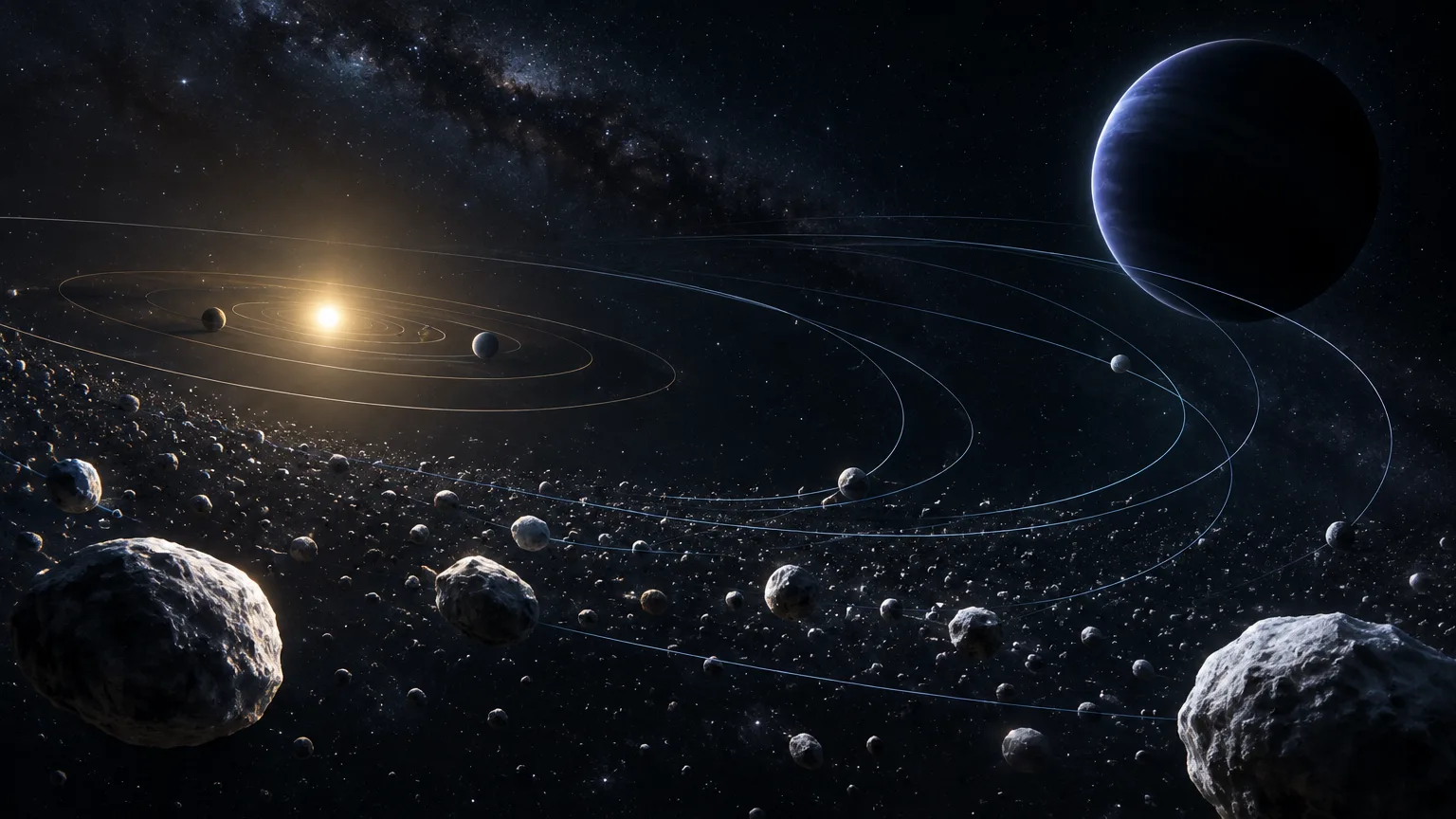
The Planet Nine hypothesis starts with an indirect clue: the motion of some small, icy bodies beyond Neptune. On its page about the hypothetical Planet X, NASA explains that certain Kuiper Belt objects appear to have clustered orbits. Based on an analysis of these paths, Konstantin Batygin and Mike Brown, astronomers at the California Institute of Technology (Caltech), proposed in 2016 that a large, still-unknown planet might exist far beyond Pluto.
The orbital pattern that gave rise to the proposal
The Kuiper Belt is a region of icy remnants extending beyond Neptune’s orbit. It contains dwarf planets and other small bodies. NASA notes that some appear to follow clustered orbits, a pattern that led the Caltech researchers to consider whether the gravity of a distant planet might influence their movements.
The proposal seeks a cause that could explain these unusual orbits. The team did not directly observe the planet when it announced the hypothesis: the idea is based on gravitational patterns in the outer solar system that, according to the researchers’ interpretation, could be consistent with the presence of a distant world. The characteristics attributed to Planet Nine therefore describe a hypothetical scenario, not measurements of a detected object.
Estimated characteristics of Planet Nine
In NASA’s description, the hypothetical planet would have a highly elongated orbit, far beyond Pluto. Its mass could be between five and ten times Earth’s mass. Its average distance from the Sun would be between 20 and 30 times Neptune’s average distance from the Sun, and it would complete one orbit around our star in between 10,000 and 20,000 Earth years.
These values are part of the hypothesis proposed by Batygin and Brown. They describe what the planet would be like in that scenario; they are not properties measured through direct observations. NASA summarizes the idea as the possible existence of a planet comparable in size to Neptune, although the specific mass and orbit remain the estimates described in the hypothesis.
Other patterns the hypothesis might help explain
The clustering of some orbits is one of the phenomena the scenario seeks to address. NASA says that a planet of this kind could help explain why long-period Kuiper Belt objects are, on average, tilted by about 20 degrees relative to the plane in which the planets orbit the Sun. This refers to the average inclination of that population, not to a value assigned to every individual orbit.
NASA’s page also notes that the hypothesis could help explain the existence of a distant population of trans-Neptunian bodies with steep inclinations. In these cases, the wording is conditional: if the planet exists, its gravitational influence could contribute to interpreting these patterns. These are features consistent with the proposed explanation, not direct observations of the planet.
Planet X and Planet Nine: related terms
The names are sometimes used interchangeably, but they have different scopes. “Planet X” has been used for more than a century to refer to the general idea of a large, still-unknown planet in the outer reaches of the solar system. NASA notes that searches for it have relied on different lines of evidence over time. “Planet Nine” refers to the specific prediction associated with the hypothesis published by Batygin and Brown in 2016.
The name “Nine” is connected with Pluto’s history: before the International Astronomical Union changed the definition of a planet, Pluto was considered the ninth major planet. It was later classified as a dwarf planet. The nickname used for the hypothesis does not change Pluto’s classification or determine the name a planet would receive if discovered; NASA notes that the formal designation would have to be approved by the International Astronomical Union.
An explanation that remains open
NASA describes the existence of Planet X—or Planet Nine in the context of the Caltech proposal—as theoretical. The same page notes an alternative proposed by some researchers: that the unusual orbits of these Kuiper Belt objects might be explained by the random distribution of the objects themselves.
The debate, then, centers on how to interpret the orbital patterns: as the result of a possible gravitational influence from a distant planet, or as a consequence of the distribution of the observed bodies. NASA’s information presents both possibilities. Planet Nine is a specific hypothesis about a distant world and the effects its gravity might have on the outer solar system; the proposed explanation depends on how these patterns are interpreted.