

Key facts
- In most locations, the partial phase lasts more than an hour, according to NASA’s explanatory script.
- The diamond ring occurs when sunlight passes through valleys along the lunar edge; low valleys also let light through to form Baily’s beads.
- Totality can be observed only within the corresponding path and can last up to four and a half minutes, according to NASA.
- Eclipse glasses or a safe solar viewer are needed during the partial phases and flashes; direct viewing without protection is limited to complete totality within the path.
- Solar viewers must meet ISO 12312-2. Cameras, binoculars, and telescopes require their own solar filters installed at the front of the instrument.
- NASA describes pinhole projection and the holes in a colander as indirect viewing methods; it also recommends skin protection during extended outdoor viewing.
Related records
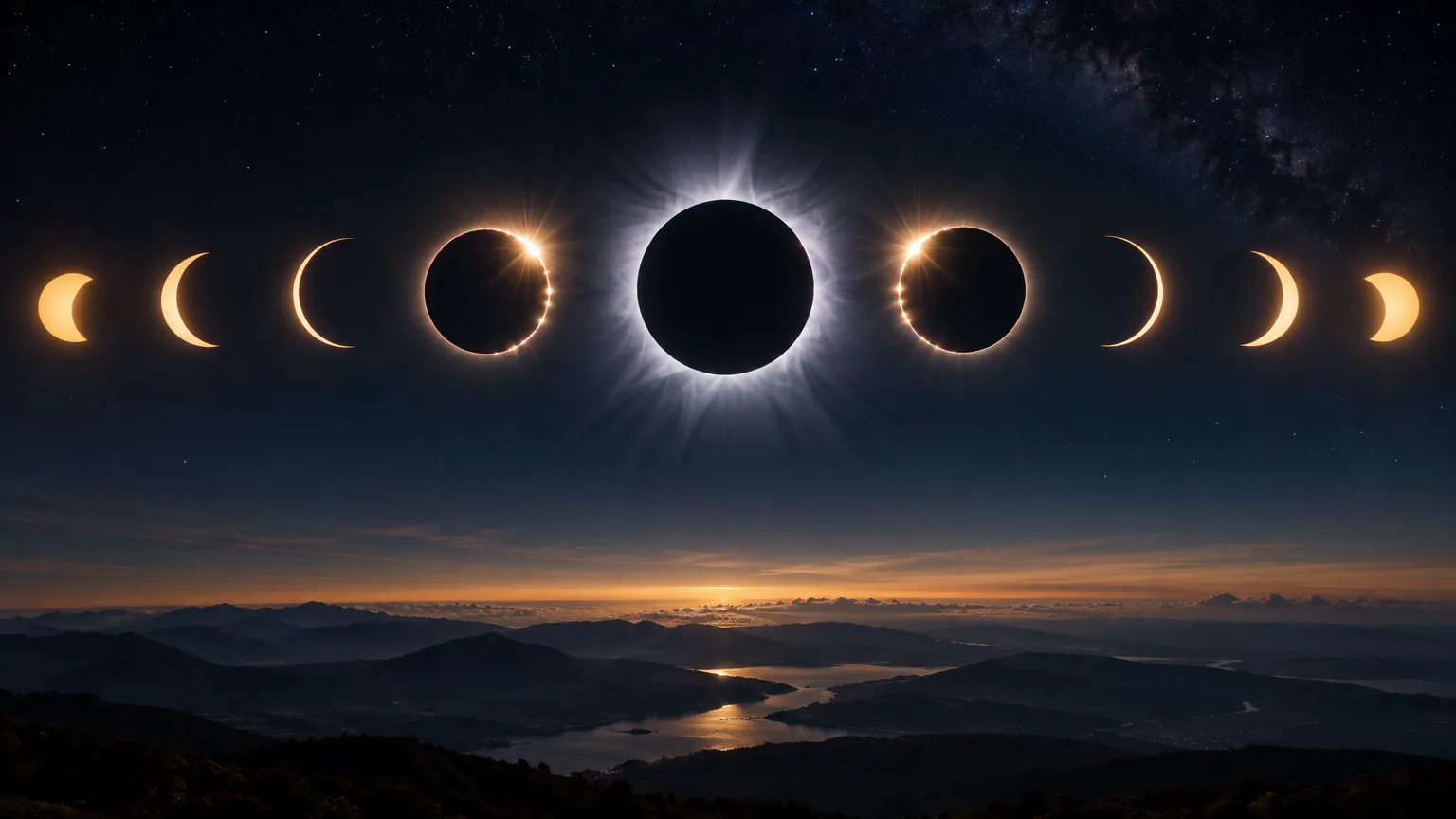
A solar eclipse occurs when the Moon passes between the Sun and Earth and blocks some or all of the sunlight. In a total eclipse, the coverage advances in phases: first, part of the Sun’s bright face remains visible; then, sunlight passing through valleys along the lunar edge produces flashes; and only within the path of totality does the Moon completely hide the Sun’s bright face. This sequence matters both for understanding what is being observed and for knowing when eye protection is needed. NASA published a safety guide on February 15, 2024, updated on April 4 of that year, with recommendations for each phase and alternatives for indirect viewing.
Partial phases and the path of totality
During the partial phase, the Moon covers only part of the solar disk, leaving a bright area visible. NASA’s explanatory script notes that, in most locations, this phase lasts more than an hour. To look directly at the Sun during this interval, you need glasses designed for solar viewing or a safe handheld solar viewer. Ordinary sunglasses are not suitable for viewing the Sun, no matter how dark they appear.
Totality begins when the Moon completely covers the Sun’s bright face. It can be observed only from within the path of totality, the area where this complete coverage occurs. NASA says this phase can last up to four and a half minutes; this is a maximum, not a duration that should be assumed for every observation. Totality cannot be seen through eclipse glasses either. NASA recommends checking local information to find out when the total eclipse begins and ends at the chosen location.
The diamond ring and Baily’s beads
In the final seconds before totality, the diamond ring may appear: sunlight passing through valleys along the Moon’s edge produces bright flashes. The phenomenon is a sign that totality is approaching, but the Sun is not yet completely covered. NASA therefore recommends keeping specialized eye protection on during these flashes.
The so-called globs or beads of Baily may also be visible. For a few moments, low valleys along the lunar edge let sunlight through. This phase must also be viewed with eye protection. Changes in the Sun’s appearance help indicate the eclipse’s progress, but the criterion for brief direct viewing without protection is that the Moon has completely covered the Sun’s bright face.
When to remove your glasses and when to put them back on
The exception to the rule of wearing protection is limited to the period of complete totality and to people viewing from within the corresponding path. NASA offers a practical way to recognize this moment: no part of the Sun should be visible through the eclipse glasses or solar viewer. If you are outside the path of totality, do not remove your glasses.
As soon as even a small bright part of the Sun reappears, immediately put your eclipse glasses back on or use a safe handheld solar viewer. NASA’s script describes the final stages as the appearance of another diamond ring, followed by a crescent-shaped Sun. Specialized eye protection is needed again during these phases. In short: wear glasses or use a viewer during the partial phases and flashes; look directly without them only during complete totality within the path; and protect your eyes again as soon as the bright Sun reappears.
Suitable glasses and optical instruments
Safe solar viewers are thousands of times darker than ordinary sunglasses and must meet the international standard ISO 12312-2. Inspect them before use: if they are broken, scratched, or otherwise damaged, they should be discarded. NASA also recommends supervising children who use them. ESA notes that safe glasses should carry the ISO 12312-2 reference and, where applicable, the CE mark.
Cameras, binoculars, and telescopes require specific solar filters securely attached to the front of the instrument. Eclipse glasses are not a substitute for these filters. You must not look at the Sun through an optical device while wearing eclipse glasses either: concentrated light can pass through and burn the glasses’ filter, risking serious injury. NASA advises consulting a specialist before using solar filters with these devices.
Viewing by projection and protecting your skin
People without eclipse glasses or a solar viewer can follow the event using an indirect technique that does not involve looking directly at the Sun. A pinhole projector, for example, uses a small hole in a card to project the solar image onto a nearby surface. View the projected image with the Sun behind you; never look at the Sun through the hole. During the partial phases, the circular holes in a colander can also project crescent shapes onto the ground.
NASA also reminds viewers that the Sun remains very bright during the partial phases. Extended viewing may leave someone in direct sunlight for hours; for this reason, it recommends using sunscreen, a hat, and protective clothing to prevent skin damage. The guide therefore includes two distinct precautions: protect your eyes according to the phase and protect your skin while spending time outdoors.