

Key facts
- Firefly Aerospace’s Blue Ghost Mission 1 landed on March 2, 2025, at 3:34 a.m. EST.
- The landing was near Mons Latreille, within Mare Crisium, a basin more than 300 miles wide in the northeastern quadrant of the Moon’s near side.
- The mission carried NASA science and technology payloads.
- CLPS enables NASA to purchase lunar delivery services from commercial providers to send science and technology payloads.
- NASA presents CLPS as support for long-term lunar exploration and as an opportunity to test and refine technologies and integrate systems.
- In its description of Artemis, NASA envisions human explorers and robotic surface and orbital systems.
Related records
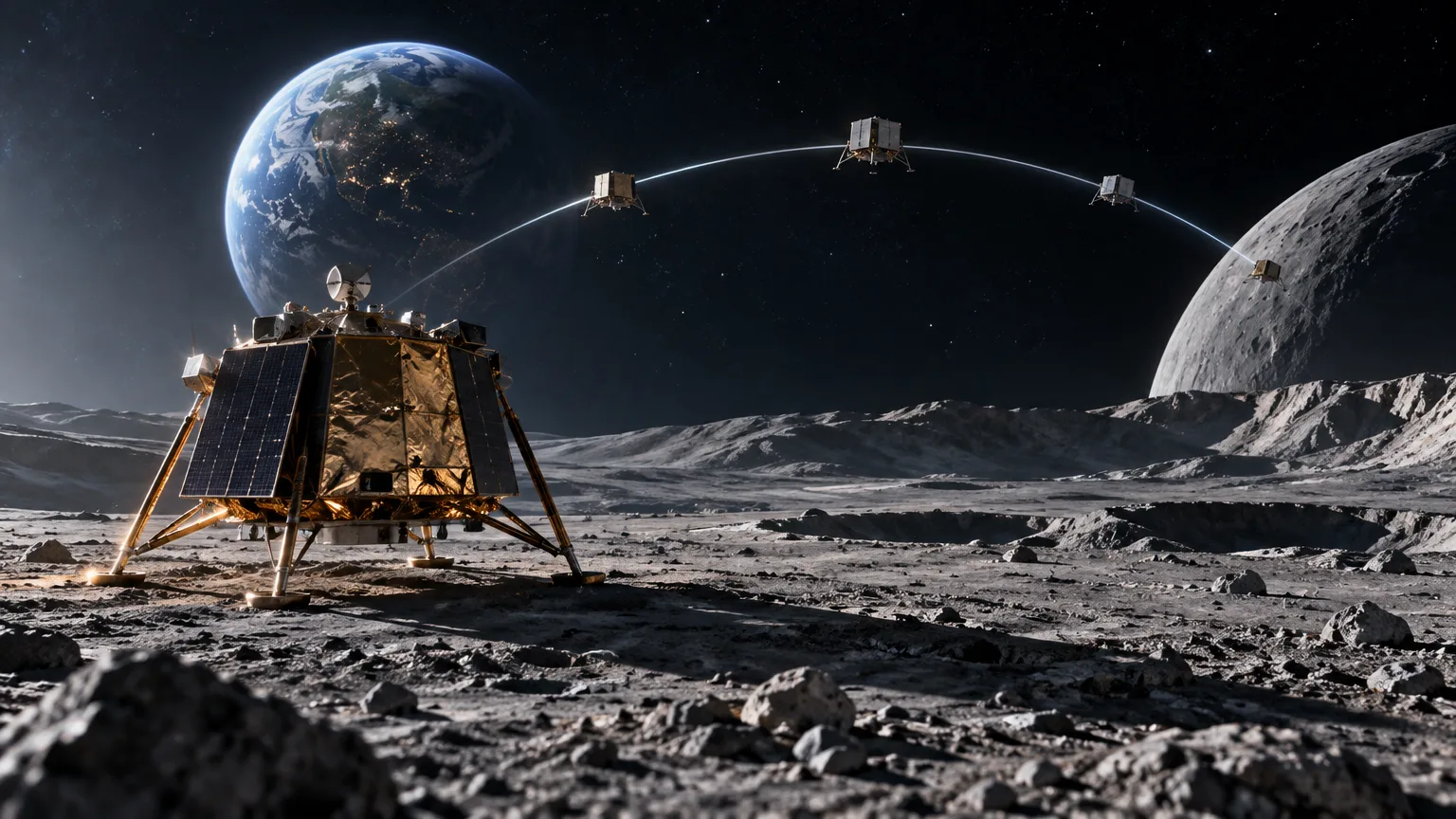
On March 2, 2025, at 3:34 a.m. EST, Firefly Aerospace’s Blue Ghost Mission 1 landed near Mons Latreille, a volcanic feature located within Mare Crisium, on the Moon’s near side. The spacecraft carried NASA science and technology payloads. The case helps explain how the agency organizes some of its lunar deliveries and relates them to its exploration plans.
The distinction matters: NASA describes Blue Ghost 1 as a Firefly Aerospace mission that carried agency payloads and reached the lunar surface. Separately, in describing Artemis, NASA mentions the use of robotic systems on the surface and in orbit. The context of robotic exploration is part of the broader lunar strategy, but there is no need to attribute a feature to Blue Ghost 1 that the source does not specify.
The landing in Mare Crisium
NASA places the landing near Mons Latreille, within Mare Crisium. The agency describes Mare Crisium as a basin more than 300 miles wide, in the northeastern quadrant of the Moon’s near side. The location makes it possible to pinpoint the event: this was not simply an arrival at the Moon, but a landing near an identified volcanic feature within a specific basin.
The mission was carried out by Firefly Aerospace and transported a series of NASA science and technology payloads. The available information describes them in general terms, without listing their instruments or experiments here. What it does establish is the lunar transport function that connects the mission to CLPS: a commercial company carried agency payloads to the surface.
What CLPS is and what it offers
Commercial Lunar Payload Services (CLPS) is a NASA initiative to purchase lunar delivery services from commercial providers. According to the agency, it makes those services available quickly and enables NASA science and technology payloads to be sent to the Moon. Blue Ghost 1 is a concrete example of the type of relationship the program establishes between a commercial provider and the transportation of agency payloads.
NASA attributes goals to CLPS that go beyond transportation: supporting industry growth and long-term lunar exploration. The agency also presents the model as an opportunity to test and refine technologies and integrate systems. These are purposes and opportunities described by the agency; they do not mean that each delivery, by itself, has completed all those tasks.
For Blue Ghost 1, the specific facts NASA provides are the mission’s name, the responsible company, the presence of the agency’s science and technology payloads, and the location and time of the landing. The explanation of CLPS provides the institutional context: NASA turns to commercial providers to take its payloads to the Moon and links this mechanism to its goals for sustained exploration.
How robotic exploration fits into Artemis
Artemis is NASA’s program to send astronauts to explore more areas of the Moon, make scientific discoveries, and establish a foundation for future crewed missions to Mars. In its description of lunar science, the agency says the Moon preserves clues about the evolution of Earth, the planets, and the Sun. It also says that, through Artemis, it will address priority scientific questions with human explorers on the Moon and Mars and through robotic surface and orbital systems.
This approach positions robotic exploration as one of the strategy’s tools, alongside human exploration. CLPS and Artemis are related within NASA’s lunar activity, but they serve distinct functions in the agency’s description: CLPS organizes commercial services to deliver payloads; Artemis is the exploration framework that envisions crewed missions and the use of robotic systems. NASA says that the work of testing and refining technologies and integrating systems under the CLPS model can inform future crewed missions to the Moon.
Thus, Blue Ghost 1 helps illustrate the commercial side of lunar delivery, while the mention of robotic systems describes a broader component of Artemis. Keeping the two statements separate makes it possible to explain their connection without confusing the type of service CLPS provides with the robotic elements NASA mentions when outlining its strategy.
The scope NASA attributes to the initiative
NASA’s wording is prospective on one key point: the testing, technological refinement, and systems integration offered by CLPS may inform future crewed missions. The agency also links the initiative to industry growth and support for long-term lunar exploration. These aims explain why a commercial delivery can be part of a broader strategy, but the information presented does not turn those possibilities into results already achieved by Blue Ghost 1.
In short, Firefly Aerospace’s landing on March 2, 2025, shows a concrete example of commercial lunar delivery: a mission carried NASA science and technology payloads to a location near Mons Latreille, in Mare Crisium. CLPS is the service mechanism that frames that delivery. Artemis, for its part, brings together NASA’s lunar exploration goals and includes both astronauts and robotic systems. The relationship between the two programs lies in the agency’s exploration horizon and in the possibility, as NASA states, that CLPS activities may inform future human missions.