

Key facts
- NASA describes black holes as huge concentrations of matter compressed into a very small space.
- Tracking stellar orbits and ESO observations over 15 years supported the presence of a supermassive black hole at the centre of the Milky Way.
- NASA said different telescopes searched for supermassive black holes in 2025.
- The interpretation of GLIMPSE-17775 proposes a supermassive black hole surrounded by partially ionized gas; the source presents it as a model.
- Roman could detect more events in which black holes interact with stars, but the source presents this as a future possibility.
Related records
Black holes occupy a distinctive place in astronomy: they are difficult to study directly, yet they can leave traces in stars, gas and radiation. The sources reviewed here show several ways of searching for them, from measuring orbits in our own galaxy to analysing signals observed by space telescopes. Not all such clues carry the same degree of certainty, and some reports describe interpretations that still need to be treated with care.
What is a black hole?
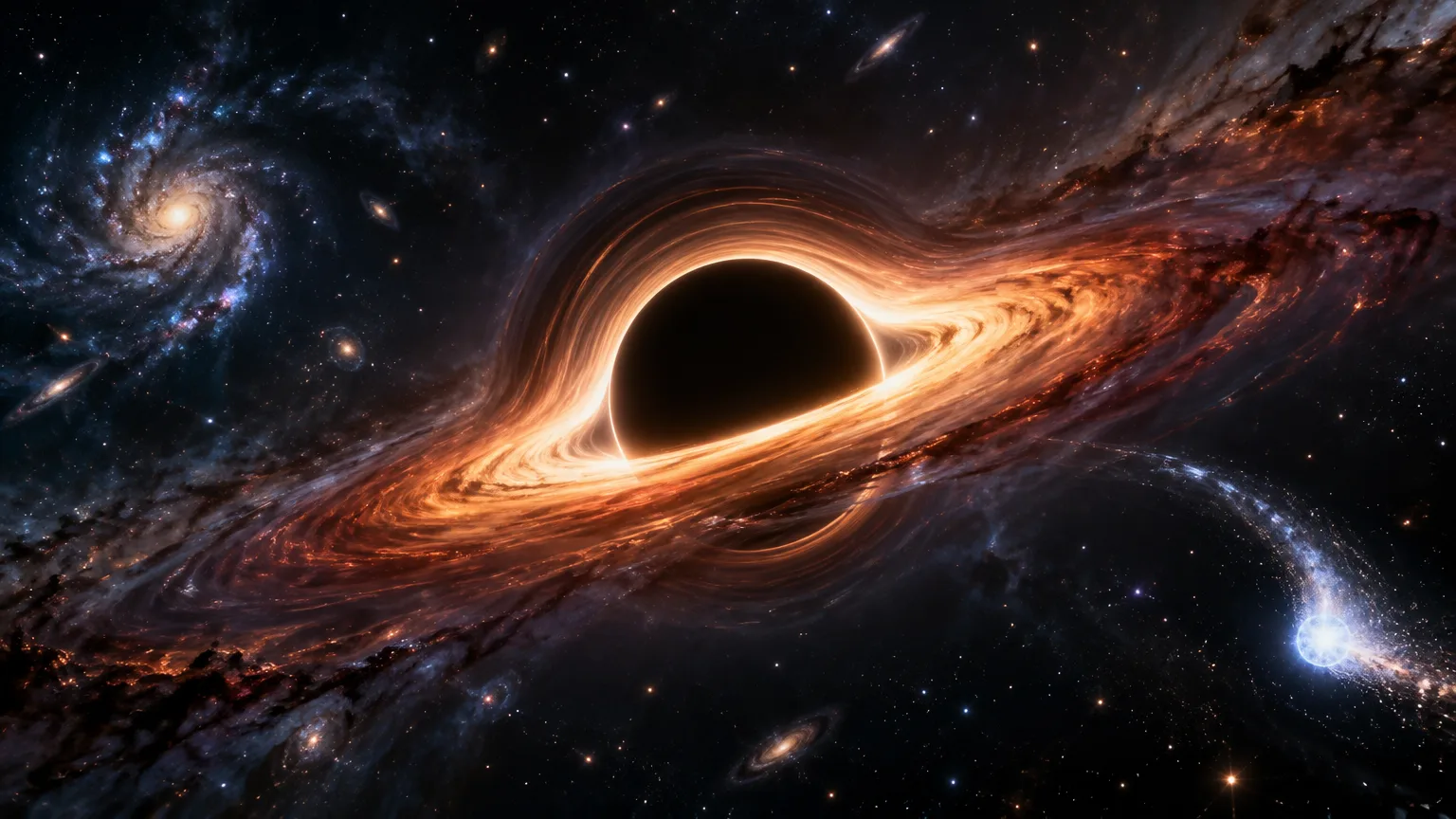
NASA explains that these objects are not holes in the everyday sense. They are huge concentrations of matter compressed into a very small space. Their density is so great that the gravity at the boundary known as the event horizon defines an important part of how the object is described. The agency’s educational page identifies this boundary as an essential feature of a black hole.
This definition helps explain why astronomers often look for indirect effects rather than trying to observe a black hole as if it were a shining star. The clues mentioned in the sources include stars moving around a central region, X-ray emissions and signals from distant objects. Each method provides different information; none should automatically be confused with a direct image of the compacted matter.
Evidence at the centre of the Milky Way
One of the more fully described lines of evidence concerns the centre of the Milky Way, the galaxy that contains our solar system. NASA says astronomers tracked the orbits of several stars close to the galactic centre. The stars’ motion enabled them to show that a supermassive black hole is there: one with extraordinarily large mass compared with the stellar-mass black holes mentioned in other observations.
The European Southern Observatory (ESO) describes complementary work. After 15 years of regular monitoring of the galactic centre with ESO telescopes at the La Silla-Paranal Observatory, scientists obtained conclusive evidence that a black hole lies at the heart of the galaxy. The length of that monitoring matters because orbits are reconstructed from repeated observations, not from a single, isolated look.
Together, these results show how scientists can reach a strong conclusion without presenting the black hole as an object conventionally visible to the eye: they study what happens around it. The evidence described here specifically concerns the centre of the Milky Way; on its own, it is not enough to describe every black hole or every galaxy.
What space telescopes are looking for
Recent observations mentioned by NASA illustrate that the search extends beyond our galaxy. According to the agency’s page, different NASA telescopes helped scientists search the sky for supermassive black holes in 2025. The available summary does not name all the instruments or detail the results of each observation, so it cannot support attributing a specific discovery to that campaign.
Another NASA report says the James Webb Space Telescope revealed a black hole that formed before its galaxy. Webb is a space observatory used by astronomers around the world. The report’s title communicates an interpretation about the order in which the two objects formed, but the summary available here does not explain the methods, measurements or margins of uncertainty. The claim should therefore be attributed to that report rather than expanded with details absent from the evidence provided.
NASA also describes a first investigation of the physical environment of cyclic X-ray eruptions. These eruptions are recurring episodes of radiation; the summary does not specify their source, duration or precise relationship to a black hole. Scientific interest lies in the possibility that observing the surroundings and their changes can offer clues about processes accompanying these objects, although the brief information available does not allow those processes to be explained in detail.
Suggestive signals and explanations still to be tested
A NASA report about the object GLIMPSE-17775 illustrates why observation and interpretation must be kept distinct. It says that careful analysis of the object’s spectrum offers the strongest evidence to date for one interpretation: that it is a supermassive black hole surrounded by a dense cocoon of partially ionized gas. The description itself presents this explanation as a model, not as a direct observation of a black hole.
The word “model” matters. A spectrum makes it possible to analyse received light and compare its features with possible explanations; the source says those features support a particular interpretation. However, the material provided does not include the spectrum, the data or an independent assessment. It would therefore be inappropriate to treat the identification as absolute certainty or to add a more specific physical description of the object.
NASA has also reported three black holes caught “eating” massive stars in NASA data. The journalistic wording sums up events in which a black hole interacts with a star; the available summary gives no further details about the three cases. The report adds that the Nancy Grace Roman Space Telescope, scheduled to launch by 2027 and potentially as early as fall 2026, could uncover many more such events. This is a forecast, not a result already obtained by Roman.
What we can say—and what remains unknown
The sources support a cautious picture. NASA’s educational definition describes black holes as extremely compacted matter; tracked stellar orbits in the Milky Way provide evidence for a supermassive object at its centre; and telescope observations allow scientists to investigate other candidates and the phenomena around them. The sources also show that a finding may be presented as evidence, as an interpretation supported by a model, or as a possibility for future observations: these are different levels of knowledge.
By contrast, the summaries available do not provide all the information needed to assess each claim separately. They do not detail the methods behind the reports on Webb and GLIMPSE-17775, the properties of the cyclic X-ray eruptions, or each event involving a star. It is therefore not possible to settle those questions here or turn headlines into broader conclusions.
The central idea is straightforward: although a black hole is not an ordinary object that can be recognised by its own visible light, its surroundings may reveal its presence. Tracking stars, studying radiation and comparing explanations with data are complementary ways to investigate it. The observations cited strengthen this field of research, but specific interpretations must retain the limits stated in the sources.