

Key facts
- NASA describes panoramas taken by Curiosity beside the Martian ridge “Chocolatal”; the first cited image was taken on August 30, 2026 at 9:56 a.m.
- A 2026 paper on Bennu samples links regolith production with collisional disruption on near-Earth asteroids.
- HEASARC announced an AMS-02 particle-rates catalog on August 4, 2026; AMS-02 has been on the ISS since May 2011.
- NASA described Roman’s launch as planned for fall 2026; the evidence does not confirm it occurred.
- ESO reported a study warning that proposals to launch more than 1.7 million satellites could have “devastating consequences” for astronomy.
Related records
The institutional updates available portray astronomy as an ongoing enterprise, combining long-lived operations, laboratory analysis, and preparation for future infrastructure. They are not a complete account of space science in 2026: they are a selection of pages and excerpts from NASA and the European Southern Observatory (ESO). Even so, they identify active kinds of work and questions that remain open.
It is useful to distinguish among a mission, an instrument, a catalog, and a study. A mission can produce images or collect samples for years; an instrument generates measurements that are later organized into catalogs; and a scientific study interprets specific data. These stages are not interchangeable: the existence of an image, paper, or launch announcement alone does not establish a broader conclusion beyond what the source says.
Curiosity continues to observe the Martian landscape
NASA’s recently published news page says that the Curiosity rover was parked beside a sand ridge nicknamed “Chocolatal.” From there, it used its black-and-white navigation cameras to capture panoramas at two times of day. The first cited image was taken on August 30, 2026, at 9:56 a.m.
Curiosity is a NASA rover exploring Mars. The supplied evidence does not specify the second observing time, the scientific purpose of comparing the panoramas, the ridge’s geographic location, or what the images showed. What can therefore be verified is the continuation of an observing operation in the Martian environment, rather than a geological or atmospheric interpretation of those views.
From a Bennu sample to the history of its regolith
Another NASA entry, in its laboratory astrophysics publications list, records the paper Physical analysis of Bennu samples reveals regolith production by collisional disruption on near-Earth asteroids. The citation credits R.-L. Ballouz, A. J. Ryan, R. J. Macke, and other authors, and places the work in The Planetary Science Journal, volume 7, article 87, in 2026. The listing includes DOI 10.3847/PSJ/ae4fad.
The title states the central scope: physical analysis of Bennu samples links regolith production to collisional disruption on near-Earth asteroids. Regolith is loose material on the surface of a body without an atmosphere or geology comparable to Earth’s. The excerpt does not provide the analytical procedure, amount of material examined, uncertainty level, or extent to which the result applies to other asteroids. Those elements should not be assumed.
AMS-02: a catalog for cosmic-ray research
NASA’s HEASARC archive announced on August 4, 2026 the release of the AMS-02 All Particle Rates Catalog. According to the available description, it records incident rates for all particle species measured by the Alpha Magnetic Spectrometer, AMS-02. The instrument is a cosmic-ray particle detector installed on the International Space Station (ISS) in May 2011.
Cosmic rays are particles arriving from space. A catalog is not necessarily an explanation of their origin or properties; it is an organized set of measurements that can support subsequent analysis. The evidence does not state the data time span, catalog format, calibration criteria, or scientific results derived from it. It does establish that an AMS-02 data resource was released in August 2026.
Observatories and images: Roman, Webb, and an interacting galaxy system
NASA’s astrophysics page presented the Nancy Grace Roman Space Telescope as a mission planned to launch in fall 2026 and said it would open an unprecedented window onto the universe. That is an institutional expectation before launch, not evidence that the telescope had launched or returned data. The supplied evidence contains no confirmed launch date, technical status, or first observations.
Other NASA pages contain two additional references. An astronomy page says NASA’s DART mission changed asteroid Didymos’s orbit around the Sun and notes that tiny dust could yield major answers under the gaze of the Webb telescope. The science news page also describes an August 25, 2026 image of the II Zw 096 system, in which two galaxies merge at a furious rate. The excerpts provide neither observing data nor timescales; they therefore cannot quantify Didymos’s orbital change or the pace of the galactic merger.
Ground-based skies and satellite constellations
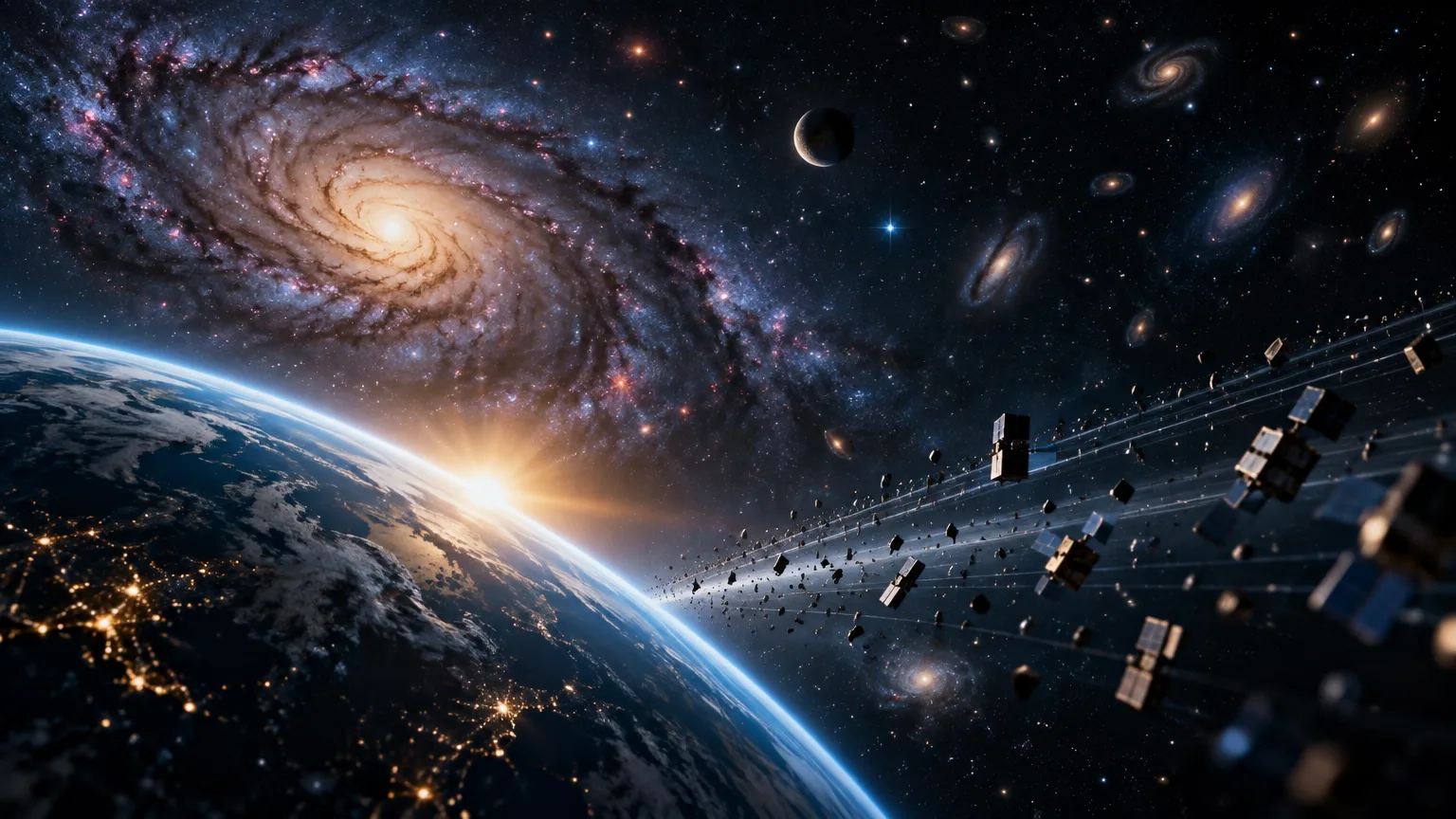
ESO’s press-release page reported on July 1, 2026 on a study of current proposals to place more than 1.7 million satellites in orbit, including extremely bright satellites. According to that excerpt, the study found that such proposals would have “devastating consequences for astronomy.”
The visible text also begins an incomplete statement about no more than 100,000 faint satellites. Because the condition, method, and end of that sentence are absent from the supplied evidence, the number cannot be presented as a complete threshold or operational recommendation. What can be said is that ESO publicized an assessment linking proposed mass deployment of satellites to severe effects on astronomy, and explicitly identified satellite brightness as part of the issue.
What is known, and what remains unresolved
These items show a chain of activity: Curiosity records Martian panoramas; researchers analyze Bennu samples; AMS-02 supplies a particle-rate catalog; NASA prepares Roman and reports observations connected with Webb, DART, and II Zw 096; and ESO warns about the pressure that orbital constellations can place on astronomical observing. NASA also includes a July 2026 image of the COSI detector assembly—COSI stands for Compton Spectrometer and Imager—being raised from a table by UC Berkeley personnel and engineers. The description does not specify its mission phase or a subsequent schedule.
The chief uncertainty is documentary. The evidence consists of short search-result descriptions and institutional pages, not the full text of every study or the data files themselves. This overview therefore avoids inferring causal mechanisms, instrument performance, or unconfirmed dates. Assessing each result would require consulting the complete publications, releases, and datasets linked by the responsible institutions.