

Key facts
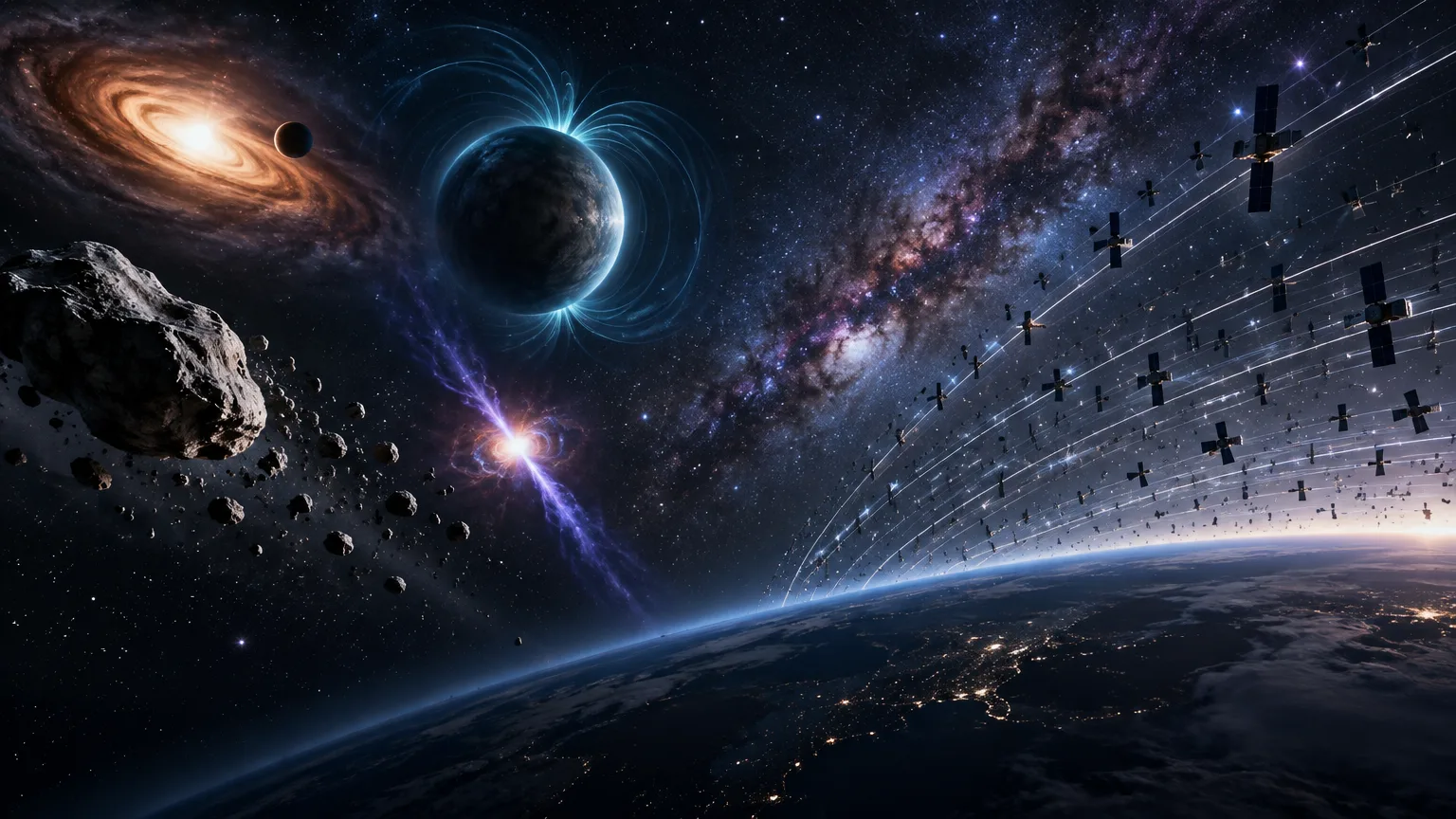
- ESO warns that proposals for more than 1.7 million satellites, including extremely bright ones, would have devastating consequences for astronomy.
- Hubble found evidence that a small comet slowed and reversed its rotation.
- A Bennu-sample study examines regolith production through collisional disruption.
- ESO reports especially strong evidence that some exoplanets may be magnetic.
- AMS-02 released a catalogue of rates for all recorded particle species.
Related records
Astronomy studies objects and phenomena beyond Earth’s atmosphere, from dust and small bodies in the Solar System to galaxies and high-energy particles. Recent information from scientific organizations points to activity on several fronts: the physical evolution of comets and asteroids, the search for properties of planets beyond the Solar System, infrared observations of regions where stars form, and the release of cosmic-particle catalogues.
These investigations share a material requirement: the ability to observe the sky. A study released by the European Southern Observatory (ESO) warns that current proposals to launch more than 1.7 million satellites into orbit, including extremely bright ones, would have “devastating consequences for astronomy.” The warning places protection of the observing environment alongside discovery as a central issue.
An ESO study warns about satellite constellations
ESO is a European astronomical organization that operates observing facilities and communicates research results. According to the summary of its study published on 1 July 2026, launch proposals exceed 1.7 million satellites. The text specifically highlights extremely bright objects and describes the possible effect of those proposals as devastating for astronomy.
This does not mean that all those satellites are already in orbit, nor does it provide a quantified forecast for every observatory, instrument or observing mode. The supplied evidence also does not detail the study’s full methodology or scenarios. It does establish clearly that ESO regards the projected growth in orbital objects as a far-reaching risk for astronomical work.
Comets and asteroids: small bodies, dynamic processes
Small bodies can preserve physical processes that are not obvious to the unaided eye. NASA’s Astrophysics Division reports that observations with the Hubble Space Telescope found evidence that a small comet’s spin slowed and then reversed direction. NASA describes the result as a striking example of how volatile activity can affect the spin and physical evolution of small bodies in the Solar System.
Separately, a paper listed by NASA’s laboratory astrophysics publications examines samples from Bennu. Published in The Planetary Science Journal, it identifies regolith production through collisional disruption on near-Earth asteroids. Regolith is loose material covering a solid surface. Together, these lines of evidence portray changing objects: a comet can alter its rotation through activity, while an asteroid can create surface material through collisions.
Signs of magnetism beyond the Solar System
ESO also reports that a team of astronomers has found the strongest evidence yet that some planets outside the Solar System may be magnetic. The result used ESO’s Very Large Telescope and the Gemini North telescope. An exoplanet is a planet orbiting a star other than the Sun; the word “may” matters here: the release describes strong evidence, not definitive confirmation of magnetic fields on all exoplanets.
The announcement illustrates the kind of physical property astronomy seeks to infer at a distance. The evidence does not provide planet names, a measurement mechanism or magnetic-field values. It is therefore not possible from this material to identify which specific worlds are magnetic or to generalize the finding to the entire population of extrasolar planets.
From stellar dust to cosmic rays
NASA’s James Webb Space Telescope captured an infrared image of part of the Carina Nebula, a star-forming region, on 6 August 2026. The observation connects astronomy with the study of environments where stars form. NASA also reported the release on 4 August 2026 of the AMS-02 All Particle Rates Catalog. The catalogue records incident rates for all particle species obtained by the Alpha Magnetic Spectrometer experiment, or AMS-02.
AMS-02 is a cosmic-ray particle detector installed on the International Space Station in May 2011. Cosmic rays are particles from space that reach Earth’s environment. Releasing a catalogue is not, by itself, a specific discovery: it makes a record of measurements available for analysis.
Missions, data and an observing window
The European Space Agency’s Gaia mission was seen for the last time this bright by astronomers on Earth before the spacecraft quickly returned to its usual orientation, according to ESA. That item, together with imagery from Webb and Hubble, is a reminder that astronomical results depend on geometry, instruments and observing conditions.
NASA also highlights that the DART mission changed asteroid Didymos’s orbit around the Sun. The supplied evidence gives no detail here about the size of that change, the method involved or its relationship to other planetary-defence research, so those points remain open.
What is established, and what remains uncertain
The sources support saying that a small comet has been reported to slow and reverse its rotation; that Bennu samples have been used in an analysis of regolith; that especially strong evidence has been reported for possible magnetism on some exoplanets; that a new infrared image of the Carina Nebula exists; and that AMS-02 has released a particle-rate catalogue. They also support saying that ESO considers proposals involving more than 1.7 million satellites extremely serious for astronomy.
Important uncertainties remain. The extracts do not include complete data, methodological detail or the limitations of each study. They also do not turn signs of magnetism into a general certainty, nor do they permit a precise calculation of the effect of every proposed satellite. The most cautious conclusion is twofold: the ability to extract information from the universe continues to expand, but preserving the conditions that make observation possible has become inseparable from the scientific challenge.