Discovery and identity
1I/ʻOumuamua was discovered on 19 October 2017 with Pan-STARRS1 in Hawaii. The International Astronomical Union introduced the letter I for interstellar objects and recognised the designation 1I/2017 U1. The Hawaiian name chosen by its discoverers evokes a messenger arriving first from far away. This is not 3I/ATLAS: both are interstellar visitors, but they belong to different discoveries and observing campaigns.
Trajectory and origin
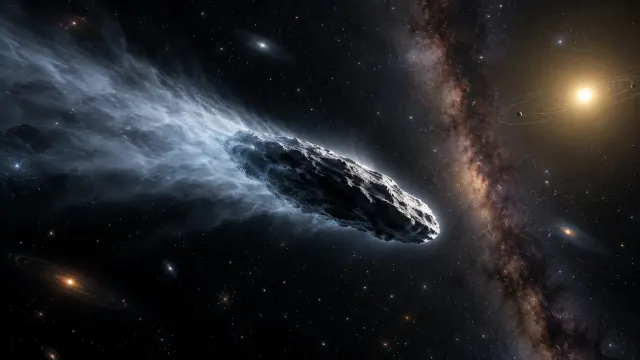
The hyperbolic trajectory and incoming velocity support an origin outside the population previously bound to the Sun. It passed perihelion in September 2017, before discovery. Its apparent incoming direction lay in Lyra, near Vega on the sky; this does not demonstrate an origin at Vega, because stars change position over an interstellar journey. The Milky Way provides the galactic context here, not an identified birth star or a demonstrated orbit around a particular object.
Brightness, size and shape
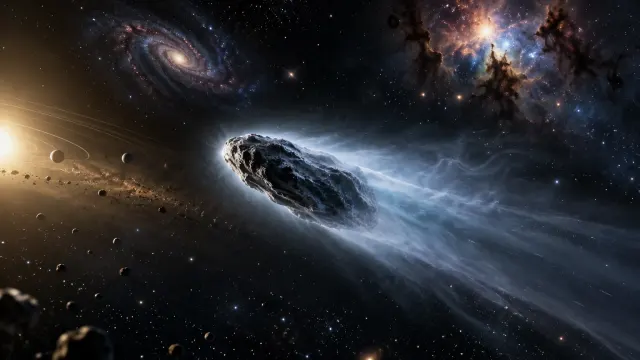
Telescopes recorded large changes in brightness and a reddish colour. The early interpretation described by NASA and ESA favoured a highly elongated shape, with proportions potentially around ten to one; NASA discussed a length of up to approximately 400 metres. These are model-dependent estimates affected by how the surface reflects light. The reviewed sources contain no image resolving its outline. Elongated illustrations are representations, not photographs or proof of a unique, precisely known geometry.
The additional acceleration
The study presented by NASA in June 2018 found a small deviation from motion calculated using only solar and planetary gravity. Its authors considered gas release a plausible explanation for this acceleration. Nevertheless, no obvious dusty coma had been observed. This distinction matters: an explanation consistent with the motion is not the same as imaging jets or determining the interior composition with certainty. The absence of detectable dust also does not, by itself, establish that all volatile material was absent.
Knowledge and remaining uncertainty
ʻOumuamua is not an object without physical information: astrometry, photometry and models exist from a short observing campaign. What remains limited is the precision and the ability to distinguish between interpretations. The sources reviewed establish neither a birth star, a complete composition nor an exact shape. Distances and speeds reported during the encounter describe historical circumstances, not current positions. Its importance lies in opening a new observational population, without warranting conclusions about every interstellar object from this single example.