orbital launch vehicle

Falcon Heavy

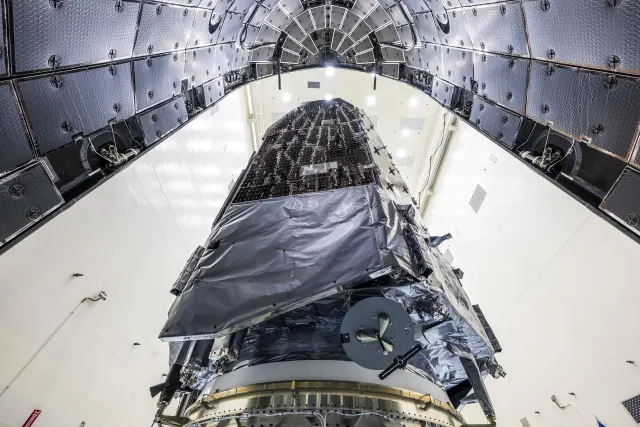
Falcon Heavy is a SpaceX heavy-lift launcher with three booster cores and 27 Merlin engines at liftoff. Its first flight took place on February 6, 2018.

Active Verified 2026-10-07

Overview

Identity and history

Falcon Heavy is a SpaceX launcher based on Falcon 9 architecture. Its first flight left Kennedy Space Center’s Launch Complex 39A on February 6, 2018. During that demonstration the side boosters returned to land; the centre core failed to land on the ocean platform. The test payload headed into an orbit around the Sun.

Configuration and performance

The first stage combines three cores and 27 Merlin 1D engines; the upper stage uses a Merlin Vacuum. SpaceX’s May 2025 technical guide specifies 22,819 kN of liftoff thrust. The vehicle is about 70 m tall and 12.2 m wide overall; each core is approximately 3.66 m in diameter. Published capacities of 63,800 kg to low Earth orbit and 26,700 kg to geostationary transfer orbit are design figures, not guaranteed payloads for every mission.

Data scope

These values describe a reference configuration. The historical catalogue count is not presented as a current flight total. LV-FALCON-HEAVY is an internal archive key.

Essential data

Key fact
SpaceX
Key fact
2018-02-06
Key fact
70
Key fact
3.66
Key fact
12.2
Key fact
22819
Key fact
63800
Key fact
26700

Physical properties

Measurement
70 m
Diameter
3.66 m
Measurement
1420.788 t
Measurement
63800 kg
Measurement
26700 kg
Measurement
22819 kN
Measurement
12.2 m

Dates and timeline

Historical year
2018

Sources and references

  1. GCAT launch vehicle catalogue — snapshot 2026-09-15 Jonathan McDowell GCAT
  2. Falcon Heavy — official technical profile SpaceX
  3. 5 Years Ago: First Flight of the Falcon Heavy Rocket — NASA NASA
  4. Falcon User’s Guide — SpaceX (May 2025) SpaceX
  5. SpaceX prospectus, 5 June 2026 — Falcon Heavy technical overview SpaceX

Context