

Key facts
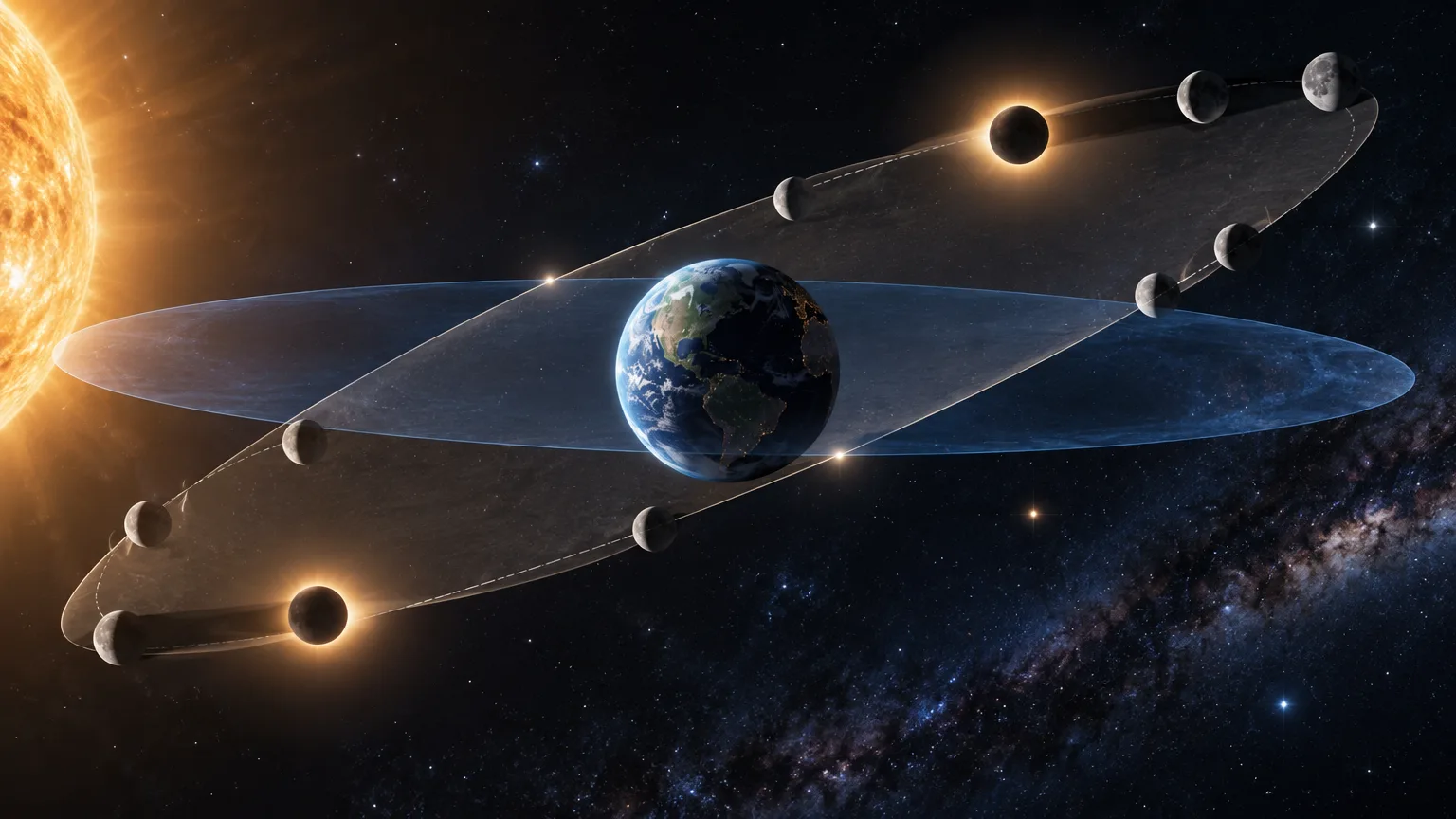
- The lunar orbit is tilted by about 5 degrees relative to the plane of Earth’s orbit.
- NASA indicates that between four and seven eclipses occur each year.
- Solar eclipses occur at new moon and lunar eclipses at full moon; the Moon must be near a node for alignment to be possible.
- According to Helioclipse, eclipse seasons last approximately 31 to 37 days and recur about every 173.3 days.
- The eclipse year defined by the CSIC lasts 346.62 days; the line of nodes completes one revolution every 18.6 years.
- The CSIC gives the Saros cycle as about 6,585.78 days, or approximately 18 years and 11.3 days; the two approximations used to describe it are not identical.
Related records
If there is a new moon and a full moon every month, why isn’t there also a solar eclipse and a lunar eclipse every month? The answer lies in orbital geometry. The lunar phase indicates the Moon’s general position relative to Earth and the Sun, but for an eclipse to occur the bodies must also be aligned with sufficient precision.
NASA notes that Earth, the Moon and the Sun align closely enough to produce between four and seven eclipses a year. The tilt of the lunar orbit helps explain why this does not happen during every phase cycle: the Moon usually passes above or below the alignment line.
A tilted orbit and two nodes
The Moon’s orbit is tilted by about 5 degrees relative to the plane of Earth’s orbit around the Sun. At new moon, the Moon lies between Earth and the Sun, but it often passes above or below the exact direction that would allow its shadow to reach Earth. At full moon, Earth lies between the Sun and the Moon, but the Moon usually passes above or below Earth’s shadow.
The CSIC Virtual Museum of Science explains that if the two planes coincided, a solar eclipse could occur at every new moon and a lunar eclipse at every full moon. Since they do not coincide, the phases alone do not guarantee an eclipse.
The lunar nodes are the two points where the Moon’s tilted orbit crosses the plane of Earth’s orbit. The line joining these points is called the line of nodes. Its orientation matters: when it points in the direction of the Sun, a new or full moon occurring near a node can place the three bodies in the configuration required. The Sun, Earth and Moon do not have to approach the nodes; it is the Moon’s position and the orientation of the line of nodes that make the alignment possible.
The phase indicates the type of eclipse
In a solar eclipse, the Moon passes between Earth and the Sun. It can occur only at new moon. If the alignment allows the lunar shadow to reach an area of Earth’s surface, the Sun is hidden totally or partially from there.
In a lunar eclipse, Earth passes between the Sun and the Moon, and its shadow darkens the satellite. This phenomenon occurs at full moon. In both cases, the Moon must be near a node so that the tilt of its orbit does not displace the alignment. Thus, the phase establishes which arrangement can occur, while the nodes help determine whether that arrangement can produce an eclipse.
Visibility also differs. According to NASA, a lunar eclipse can be observed from half of Earth. During a solar eclipse, the Moon’s shadow on Earth’s surface is about 480 kilometers wide. The umbra is the area where the Sun is completely hidden; the penumbra is where it is partially dimmed. That is why a total solar eclipse can be seen only along a narrower band than the regions from which a partial eclipse is visible.
Eclipse seasons
An eclipse season is a period when the Sun is close enough to a lunar node that, if the appropriate phase coincides, an eclipse can occur. The explanation published by Helioclipse places its approximate duration at between 31 and 37 days, with seasons separated by about 173.3 days. Since a season can span more than a month, lunar phases favorable for a solar eclipse and a lunar eclipse can occur during it.
The CSIC describes another related measure: the eclipse year, defined as the interval between two consecutive times when the Sun and a lunar node are again in the same direction. It lasts 346.62 days. According to the museum, the line of nodes slowly rotates opposite to the Moon’s motion and completes one revolution every 18.6 years. These motions help explain why alignment opportunities recur periodically.
The Saros: cycles that nearly match
The time between two new moons, called a synodic month, is 29.53 days. Because this duration and the length of the eclipse year are not exact multiples of one another, the return of a phase and a favorable configuration does not immediately reproduce the same position. The CSIC explains that the relationship between the two periods gives rise to the Saros cycle, which lasts about 6,585.78 days, or approximately 18 years and 11.3 days.
The museum’s explanation compares 19 eclipse years—19 × 346.62 = 6,585.78 days—with 223 synodic months—223 × 29.53 = 6,585.19 days. These intervals are very close, but not identical. The Saros describes an approximate recurrence of the configuration of the Sun, Earth and Moon, not an exact reproduction of all observing conditions.
Orbital tilt explains why an eclipse does not accompany every new or full moon; the nodes and the orientation of their line indicate when alignment can occur. Seasons and cycles, in turn, describe how these opportunities return. Phase, lunar position and orbital geometry are distinct parts of the same explanation.