

Key facts
- The set of Hubble and Webb images was released on October 29, 2026; NASA posted a page about the Webb mid‑infrared view on October 30.
- The Cat's Head Nebula is a small star‑forming region within the Carina Nebula, about 7 500 light years from Earth.
- Warm dust emission and carbon‑based molecules outline globules and filaments, especially to the left of the pillar.
- The luminous source to the right of the pillar could be a young star embedded in dust; the image does not allow one to determine whether a filament that appears to cross it is physically related.
- The shape was likely sculpted by ultraviolet radiation and massive‑star winds; the description indicates that the denser pillar material resists erosion for now.
Related records
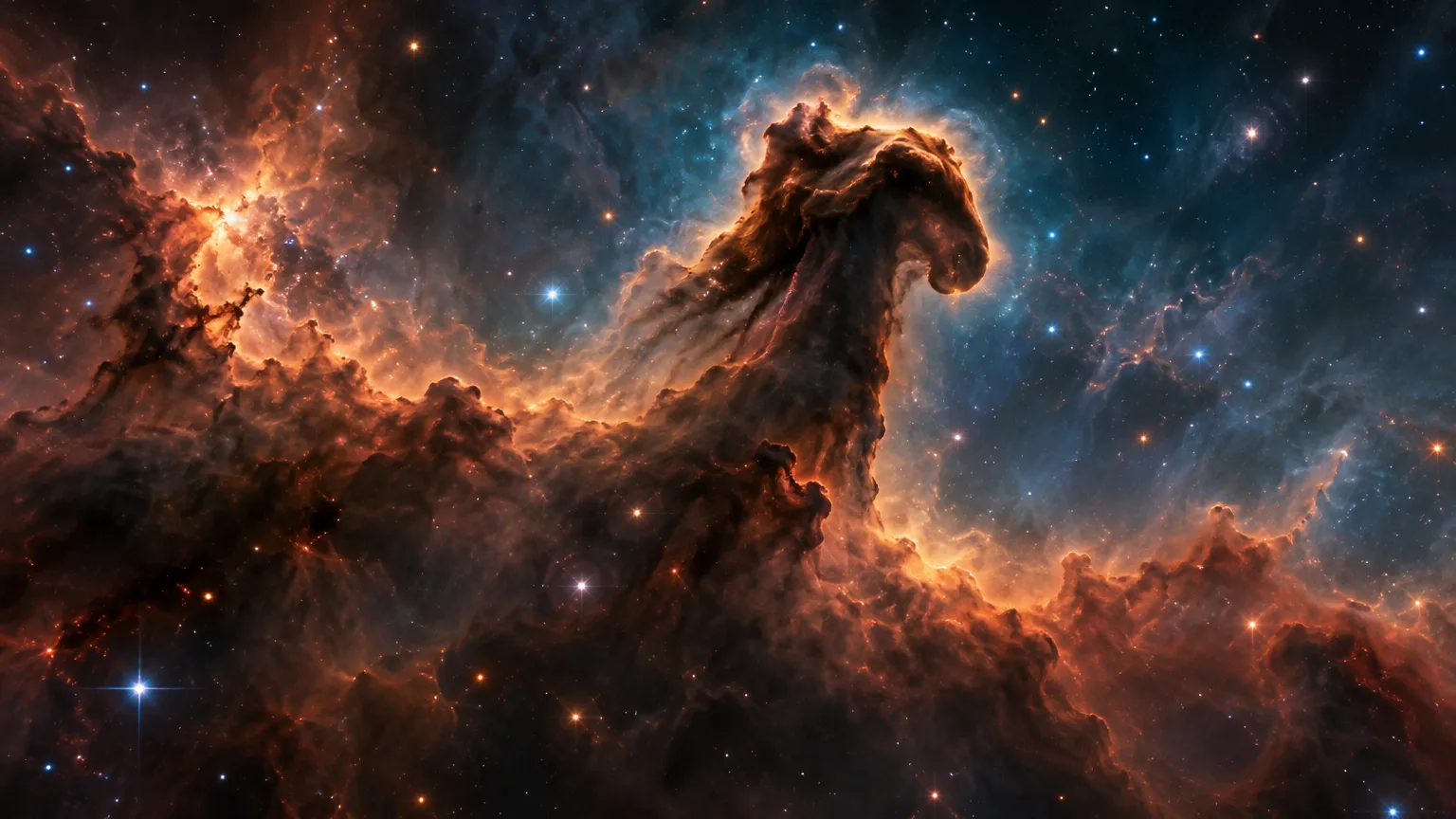
The Cat's Head Nebula is the nickname of a small region observed within the Carina Nebula, a vast cloud of gas and dust located about 7 500 light years from Earth. The area gets its name from its silhouette: it resembles a cat sitting on its back, head turned to the right.
On October 29, 2026 ESA released a set of views of this region taken by the Hubble Space Telescope and the James Webb Space Telescope. It included visible‑light observations from Hubble and near‑infrared and mid‑infrared observations from Webb. NASA posted an image page about the Webb mid‑infrared view on October 30; that image was already part of the announcement the day before.
Warm Dust and Filaments in Mid‑Infrared
In Webb's mid‑infrared view, the emission from warm dust and carbon‑based molecules outlines intricate structures. The delicate globules and filaments to the left of the feline‑shaped pillar stand out especially. Color and brightness variations reflect changes in local conditions and composition.
To the right of the pillar a yellow luminous source appears against reddish emission from surrounding material. The image description suggests it could be a young star still embedded in dust. It also notes a narrow filament that seems to cross it, but warns that the image alone does not allow one to determine whether the two are physically related.
What Other Views Contribute
Hubble observes in visible light, while Webb captures infrared. In Hubble's visible image the nebula appears as a dark, opaque dust pillar; the cat’s reddish eye could indicate a young star partially covered by dust. In Webb's infrared images the filament becomes more transparent and surface details become apparent. The near‑infrared view also reveals numerous stars and other features hidden by dust.
The observations are complementary: each wavelength allows one to distinguish different aspects of the region. The shape of the nebula was likely sculpted over time by intense ultraviolet radiation and stellar winds from massive stars in Carina. According to ESA’s description, that influence erodes surrounding gas and dust, while the denser material of the pillar resists erosion for now.
Hubble is a cooperation project between ESA and NASA. Webb is an international collaboration among NASA, ESA, and the Canadian Space Agency (CSA). ESA contributed to Webb’s launch and provided the NIRSpec spectrograph and 50 % of the mid‑infrared instrument MIRI.