

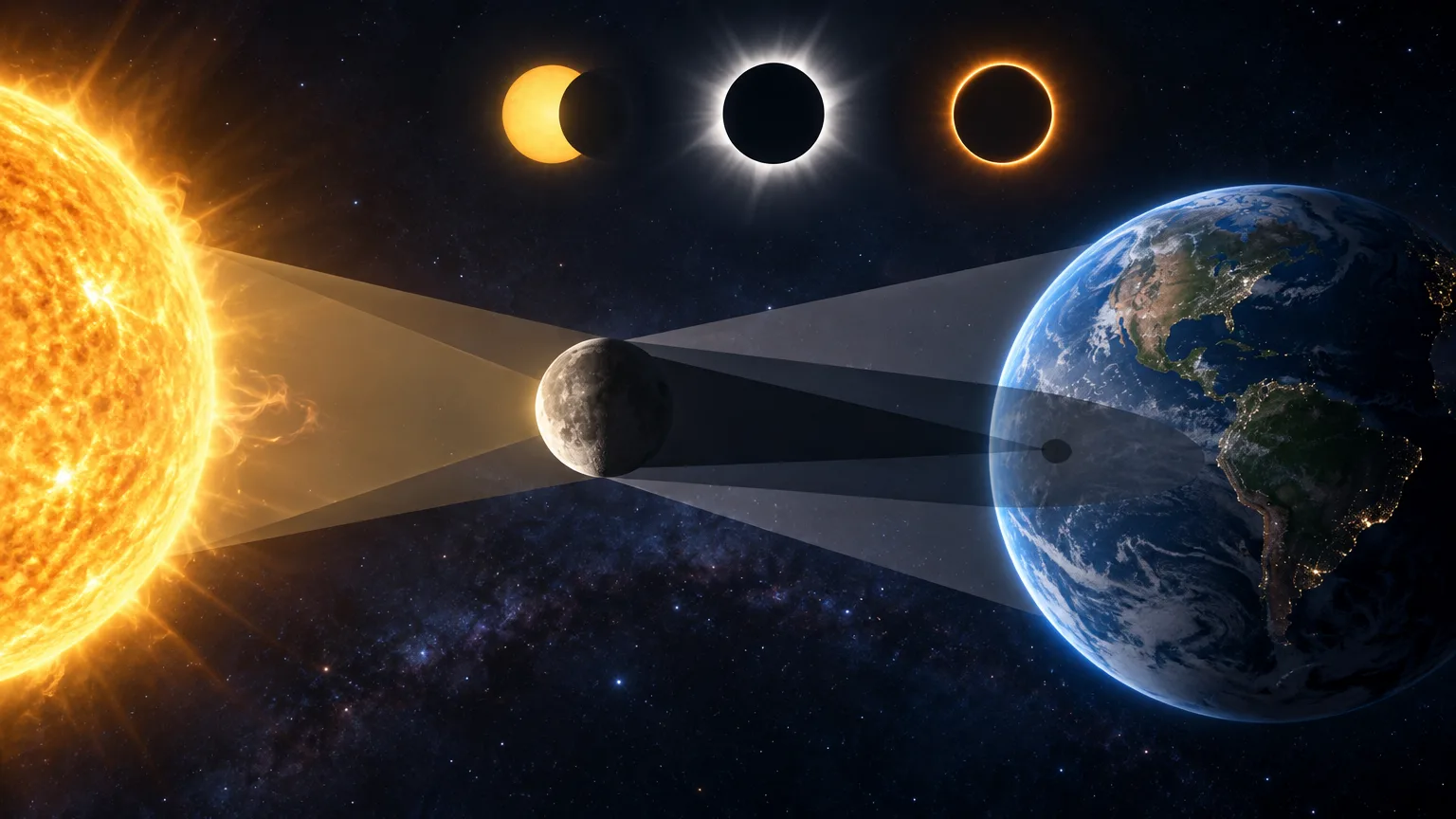
Key facts
- A solar eclipse occurs when the Moon passes between the Sun and Earth and casts its shadow on the planet.
- During a partial eclipse, the lunar umbra does not touch Earth, and the penumbra covers the viewing area.
- During an annular eclipse, a ring of light remains around the Moon; during a total eclipse, the Moon completely hides the solar disk during totality.
- According to the Exploratorium, the path of annularity is about 93 miles wide; the path of totality is about 100 miles wide and 10,000 miles long.
- NASA says eclipse glasses or an indirect method are needed to view the partial phases; looking directly at the Sun is safe only during complete totality.
Related records
A solar eclipse occurs when the Moon passes between the Sun and Earth, blocks our view of the star completely or partially, and casts a shadow on the planet. It is a daytime phenomenon: how we see it depends on how much of the solar disk the Moon covers and where we are in relation to its shadow. As a result, the same eclipse can look different to observers in different places.
The Moon’s shadow has two important parts
To understand these differences, it helps to distinguish two regions of the Moon’s shadow. The umbra is its darkest part; the penumbra is the broader, partial shadow. According to the Exploratorium, during a partial solar eclipse the umbra does not reach Earth: the penumbra is projected onto the planet. Anyone observing from that region sees the Moon cover part of the Sun.
By contrast, when the umbra reaches Earth’s surface, people within it can see the Sun completely hidden by the Moon. This difference between a partial shadow and the darker shadow explains why the observer’s position matters as much as celestial alignment. The penumbra covers a much larger area than the path where totality occurs, so the partial eclipse can be seen from a wider region.
Partial, annular and total: what observers see
Solar eclipses are described as partial, annular or total, depending on how much of the Sun the Moon covers. In a partial eclipse, only part of the disk is hidden. In addition, every solar eclipse begins and ends with a partial phase: the Moon starts to cover the Sun and then moves away from it from the observer’s perspective.
In an annular eclipse, the Moon does not cover the Sun completely. A ring of light remains visible around the lunar silhouette, which is why it is sometimes called a “ring of fire.” According to the Exploratorium’s explanation, this can happen when the celestial bodies are aligned but the Moon is at the farthest point from Earth in its orbit. Because it appears smaller, it cannot hide the entire solar disk. The source says that the Moon’s distance varies by 30,000 miles along its elliptical orbit.
In a total eclipse, the Moon completely blocks our view of the solar disk, and the Sun’s outer atmosphere, called the corona, becomes visible. The phase during which the Sun is completely hidden is called totality. From within the umbra, observers see the complete occultation; from the penumbra outside it, they see a partial eclipse. Totality, therefore, is not something available from every location where the eclipse can be seen: observers must be within the corresponding path.
Apparent size and the shape of the eclipse
The Moon and the Sun are not the same size in reality. The Sun is 400 times the Moon’s diameter, but it is also 400 times farther from Earth. That relationship makes them appear similar in size in the sky, as the Exploratorium explains. This coincidence allows the Moon, when properly aligned, to cover the solar disk while leaving the corona visible around it.
The difference between a total and an annular eclipse can be seen in what remains visible: during totality in a total eclipse, the Moon completely covers the Sun’s disk; in an annular eclipse, a ring of the Sun remains around it. So it is not enough simply to imagine the bodies aligned: the Moon’s apparent size and the geometry of the shadow determine how the phenomenon will look to an observer. The Exploratorium also notes that some eclipses can be total along certain parts of their path and annular or partial along others, because of Earth’s curvature.
Viewing paths and duration
The region from which annularity can be seen is a path about 93 miles wide, according to the Exploratorium. The source says the annular phase can last from a few seconds to more than 12 minutes. For total eclipses, it describes a path of totality about 100 miles wide and 10,000 miles long. The Moon’s shadow moves across Earth at more than 1,000 miles per hour.
The duration of totality—the interval during which the Sun is completely hidden—can range from a few seconds to more than seven minutes, according to the same resource. These figures describe general ranges: how long an individual experiences the eclipse depends on their location within the path of totality. Because the penumbra extends beyond this narrow zone, partial phases can be seen across a much larger region.
Eye protection: the rule changes with the phase
The difference between phases also matters for safety. NASA says it is never safe to look directly at the Sun when it is partially covered. Eclipse glasses or an indirect viewing method must be used to observe the partial phases. The same precaution applies during a total eclipse until the moment when the Moon completely blocks the Sun.
Only during the brief period of totality is it safe to look directly at the Sun, according to NASA’s safety guide. It is essential to know when this phase begins and ends so you can look away and put your glasses back on at the right time. During an annular eclipse, the Sun is not completely covered, so glasses must be worn throughout the event, as the Exploratorium warns. In short, the shadow determines where and how the eclipse is seen; recognizing the phase makes it possible to observe it safely.