

Key facts
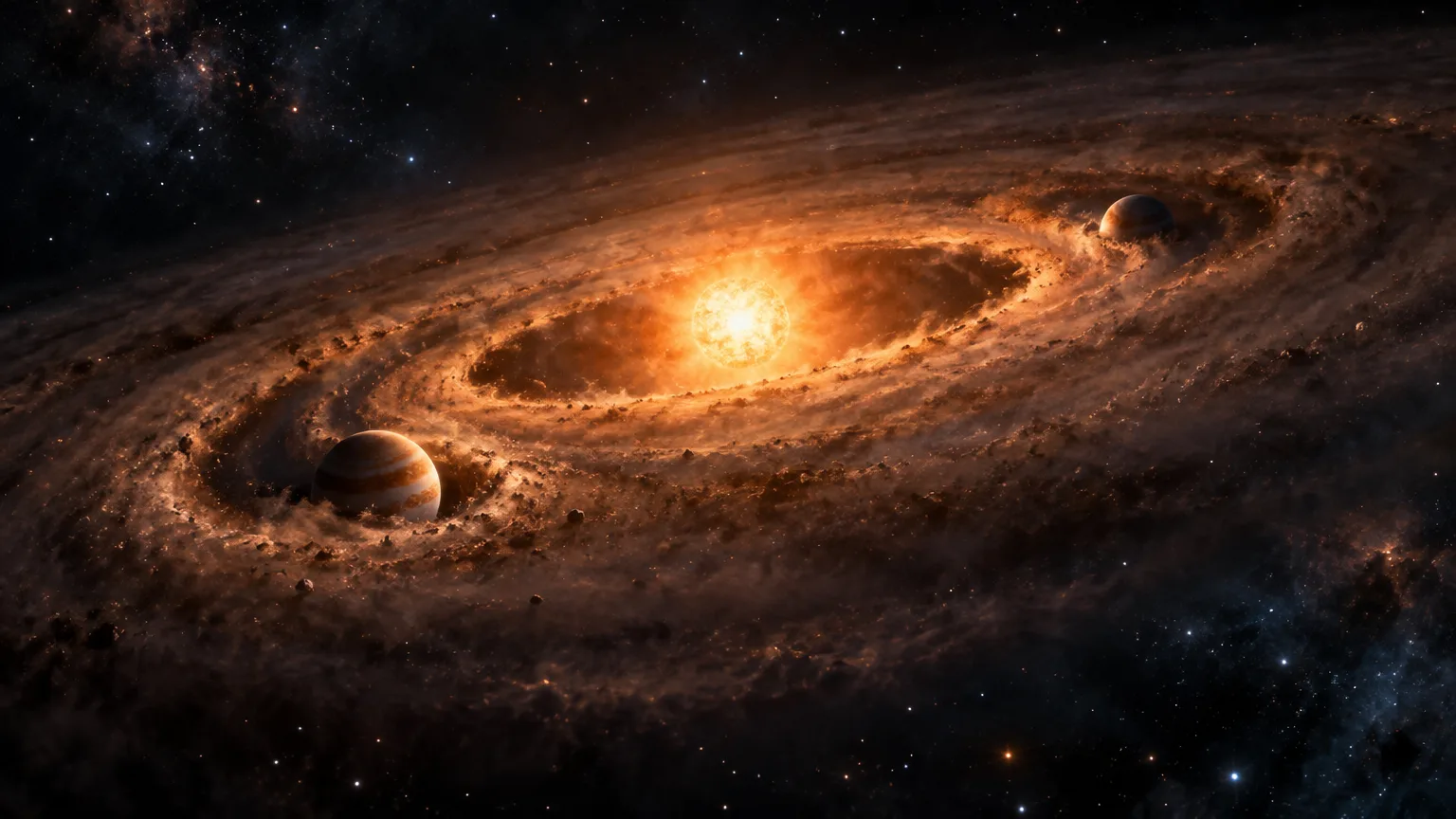
- On 24 March 2026, ESO reported two planets forming in the disc around the young star WISPIT 2.
- According to the notice description, one planet had already been detected and ESO telescopes enabled the confirmation of another.
- The available material does not state the instruments, confirmation method or planetary properties.
- NASA entries mention images of II Zw 096 and the Carina Nebula but provide no detailed scientific analysis.
Related records
A press notice from the European Southern Observatory (ESO) highlights an observation of planet formation around WISPIT 2, a star described as young. According to the available summary, astronomers have observed two planets forming in the disc around it. The team had previously detected one planet; after using ESO telescopes, it now says it has confirmed the presence of another. This information comes from a brief description of the notice, not its full text. The scope of what can be stated here is therefore limited.
The announcement matters because of the setting it describes: this is not simply a report of two planets that have already formed, but of planets observed while forming in a disc around their star. However, the supplied material includes no images, measurements or explanation of how the planets are distinguished from other structures in the disc. It also gives no masses, sizes, orbits or formation stages. Those details cannot be filled in without additional information.
What the notice says about WISPIT 2
The ESO description, dated 24 March 2026, contains three specific points: WISPIT 2 is a young star; two planets are forming in the disc around it; and, after having detected one earlier, the team used ESO telescopes to confirm another. The source is identified as an observatory press notice and can be found on its news page.
The word “confirm” matters: the summary does not present the second planet as a mere possibility, but as a presence the team says it verified. Even so, without the full article it is impossible to specify which observations support that confirmation or what analyses were performed. The summary also provides no telescope or instrument names, observation dates or collaborators. It is enough to report the central announcement, but not to independently assess the method.
Why a disc can reveal planets in formation
A disc around a young star is the environment named in the report for these forming planets. That description places the finding at an early stage in the evolution of a planetary system: the observed planets are not presented as isolated objects in a mature system, but as bodies forming within material surrounding their star. This context explains why the announcement is classified as a discovery related to planet formation.
But the evidence should not be made to say more than it does. The available material does not describe the disc’s composition, how the planets were detected or the relationship between them. It cannot establish that these are the only planets in the system, or that the observation resolves how planetary systems form in general. The announced result concerns WISPIT 2 and the confirmation of a second forming planet, not a universal rule.
Other NASA news: images, not comparable results
The supplied search results also include brief descriptions of NASA news items. One mentions an image of the galaxy system II Zw 096, dated 25 August 2026, and says two galaxies are merging at a “furious” rate. Another says the James Webb Space Telescope captured an infrared image of part of the Carina Nebula on 6 August 2026, described as a star-forming region. These are image captions or summaries: they do not contain detailed scientific analysis or, on their own, establish a new discovery.
A third entry points to a NASA page referring to an astronomy image of the day dated 18 September 2026, but provides neither its subject nor its findings. NASA is the publisher of those pages, and James Webb is the telescope named; the supplied evidence gives no further context for the observations. It would therefore be inappropriate to equate these image notes with the planet confirmation reported by ESO.
What is known and what remains uncertain
The most solid information is narrow: ESO reported that its team observed two planets forming in the disc around WISPIT 2 and that the organisation’s telescopes helped confirm the second, after one had previously been detected. The supplied data do not specify how confirmation was achieved, which instruments were involved, what properties the planets have or whether a scientific paper with full results is available. Nor do they provide enough information to compare this system with others.
- ESO notice: two planets forming in the disc around WISPIT 2; one had been detected earlier and another was later confirmed.
- NASA descriptions: an image of II Zw 096 during a galaxy merger and an infrared image of part of the Carina Nebula, with no detailed scientific results in the supplied material.
- Open questions: methods, instruments, planetary properties and the scope of the analyses.
In short, the WISPIT 2 announcement offers a specific report about planets that are still forming, but the available summaries allow us to describe the result, not examine its evidence in depth. The NASA references provide visual context about other celestial objects, but not enough information to present them as additional discoveries.