

Key facts
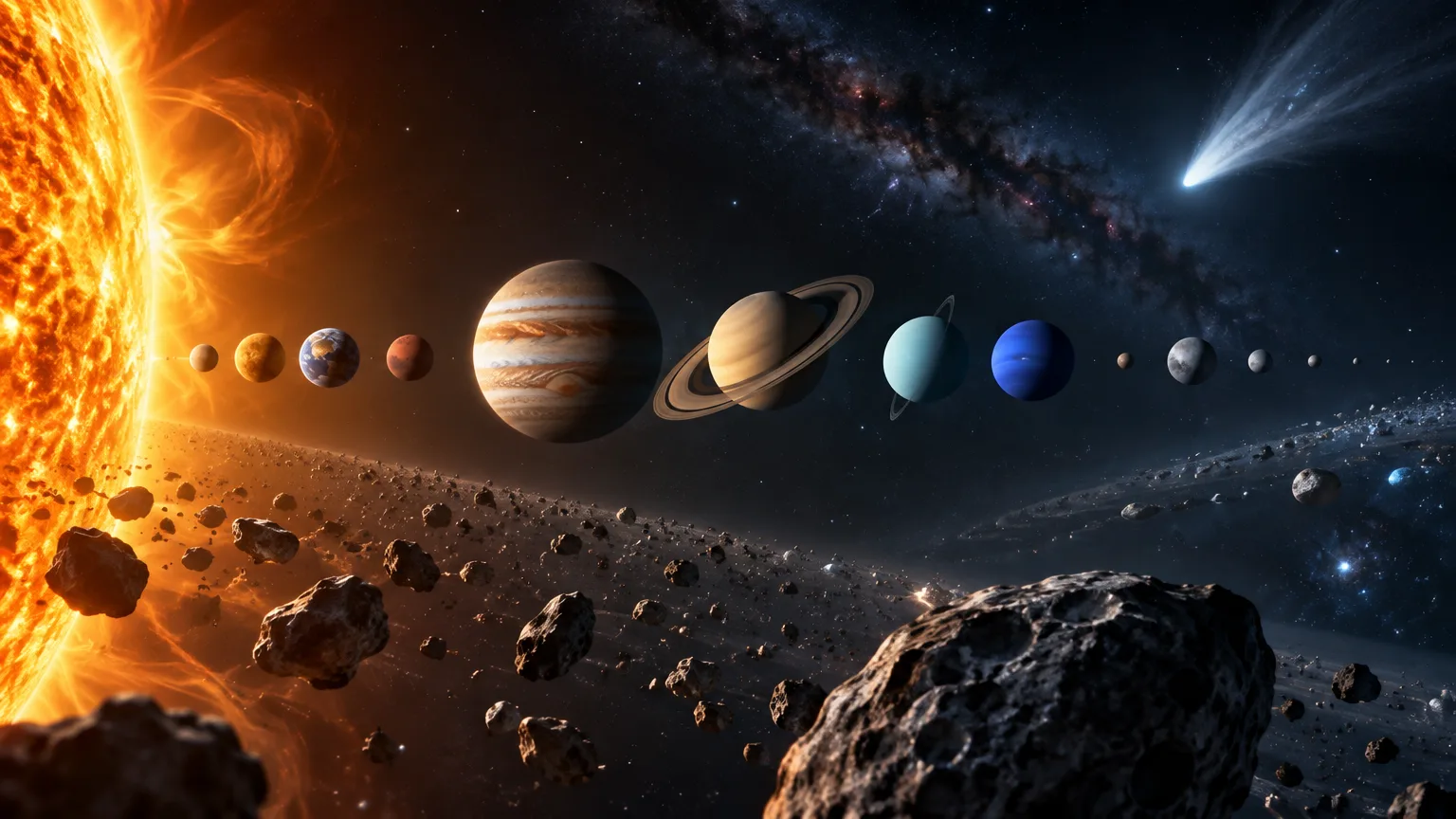
- NASA reports one star, eight planets, five dwarf planets, at least 290 moons, more than 1.3 million asteroids, and about 3,900 comets.
- PUNCH is intended to study the transition from the corona to solar wind and its development in the inner heliosphere.
- A NASA record cites a Bennu-sample study on regolith production through collisional disruption.
- A NASA page says DART changed Didymos’s orbit around the Sun.
Related records
The Solar System is the astronomical system that includes Earth. According to NASA’s Solar System Exploration page, it contains one star, eight planets, five dwarf planets, at least 290 moons, more than 1.3 million asteroids, and about 3,900 comets. That inventory gives a useful sense of scale: alongside the large planets is a vastly more numerous population of smaller objects.
The wording matters. NASA says at least for moons and about for comets. These numbers should therefore be read as counts reported by the agency, not as final, unchanging boundaries. The diversity of objects—planets, dwarf planets, moons, asteroids, and comets—also explains why Solar System research brings together different questions and methods.
A neighborhood with one star and many kinds of bodies
The single star in NASA’s inventory is the Sun. The rest of the agency’s published inventory is organized around that framework. The eight planets and five dwarf planets are the planetary categories in this overview; moons are associated with other bodies, while asteroids and comets greatly broaden the system’s variety of objects.
The figure of more than 1.3 million asteroids helps prevent an overly narrow picture of the Solar System as a place made up only of a few planets. Asteroids and comets are part of NASA’s quantitative portrait and are also scientific targets: their materials can inform the study of physical processes that cannot be inferred from observing planets alone.
The Sun as a research subject
The Sun is not only central to the inventory; its atmosphere and its influence on nearby space are research topics. NASA describes the PUNCH mission—the Polarimeter to Unify the Corona and Heliosphere—as designed to gain new insights into how the Sun’s atmosphere, or corona, becomes the solar wind, and how that wind develops while crossing the inner heliosphere.
In this context, the corona is the solar atmosphere, while the solar wind is the phenomenon whose evolution PUNCH is intended to study, according to NASA’s description. The inner heliosphere is named in that same explanation as the region through which the wind travels. The stated goal does not mean that all those mechanisms are already solved; it identifies a question the mission is intended to clarify.
NASA’s solar-science archive likewise presents PUNCH as a mission aimed at gaining new insight into the corona and the inner heliosphere. This thematic continuity shows that studying the Solar System is not limited to cataloguing bodies: it also includes understanding processes that connect the Sun with its surroundings.
Bennu: a sample for examining regolith
Another research line focuses on materials from near-Earth asteroids. NASA’s laboratory astrophysics publication list includes a study of Bennu samples whose title reports physical analysis and regolith production through collisional disruption on near-Earth asteroids. The paper is listed in The Planetary Science Journal, volume 7, article 87, with a 2026 publication date in NASA’s linked record.
Regolith is loose material on a body’s surface. The title’s wording matters because it links Bennu samples to the production of that material through collision-driven disruption. The available evidence does not include the article’s full content, so its methods, numerical findings, and the full scope of its conclusions cannot be specified beyond what that bibliographic record states.
Orbital dynamics and observation
Research also includes orbits. A NASA astronomy page highlights that the DART mission changed the orbit of asteroid Didymos around the Sun. The supplied evidence does not specify the size of that change, the measurement procedure, or the mission’s full context. The claim should therefore remain limited: NASA’s page attributes that orbital change to DART.
The same page says tiny dust could yield big answers under the Webb Telescope’s gaze. This indicates that even small particles are scientific subjects of attention. Yet the available summary does not identify which dust is under study or what those answers would be; it does not allow an expectation to be presented as a confirmed result.
What can be stated, and what remains open
- NASA reports one star, eight planets, five dwarf planets, at least 290 moons, more than 1.3 million asteroids, and about 3,900 comets.
- PUNCH is designed to investigate the link between the solar corona, solar wind, and inner heliosphere.
- A NASA bibliographic record links analysis of Bennu samples with research on regolith production by collisional disruption.
- A NASA page says DART changed Didymos’s orbit around the Sun.
These pieces are not an exhaustive account of every mission or Solar System result. They point to complementary fronts: counting bodies, solar physics, material analysis, and orbital dynamics. The supplied sources offer different degrees of detail for each.
Conclusion
The resulting picture is of a Solar System populated by very different classes of objects and still marked by active questions. NASA’s figures establish its material richness; PUNCH focuses on the connection between corona and solar wind; Bennu samples are used in regolith research; and DART appears in a report about orbital change. Caution is essential: the available sources support these specific points, but do not by themselves provide all technical details, measurements, or final conclusions for each investigation.