

Key facts
- NASA lists one star, eight planets and five dwarf planets in the solar system.
- Its exploration page gives at least 290 moons, more than 1.3 million asteroids and about 3,900 comets.
- NASA defines the astronomical unit as the Sun–Earth distance, approximately 150 million kilometres.
- The supplied evidence gives no publication date or counting methodology for the inventory.
Related records
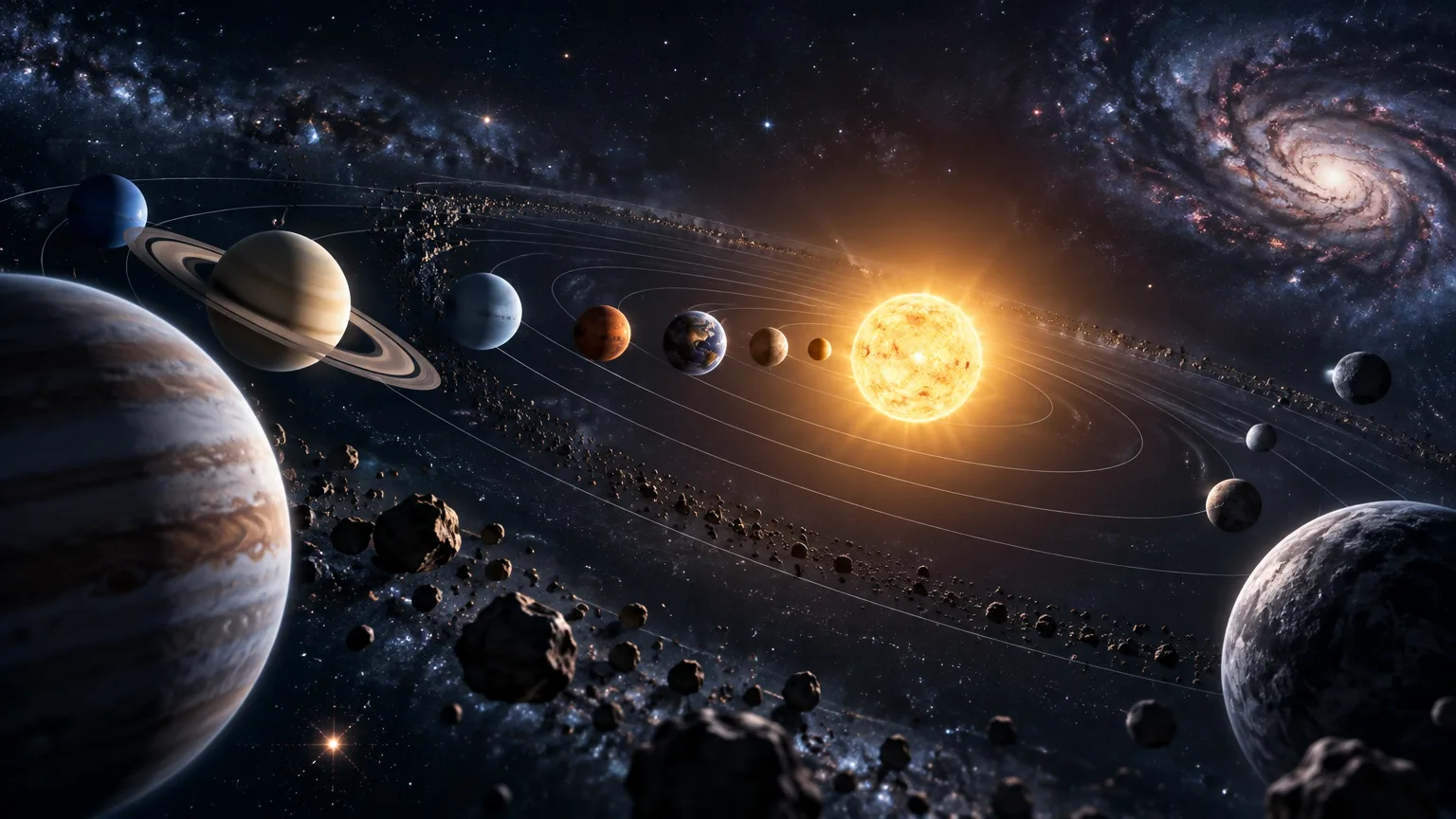
The simplest figure in the inventory is also the one that anchors its description: NASA says the solar system has one star. The page identifies the Sun as central to its subject, although the available extract does not explain the system’s physical structure or describe the orbits of its members. This overview therefore sticks to what the source lists and what can cautiously be inferred from that list.
The same inventory includes eight planets and five dwarf planets. These are separate categories in NASA’s count; the supplied information does not name them or explain the criteria used to classify them. It is best to preserve that distinction without adding definitions or details absent from the available evidence.
An inventory spanning different scales
NASA’s page also counts at least 290 moons, more than 1.3 million asteroids and about 3,900 comets. The wording does not carry the same degree of precision throughout: “at least” sets a minimum for moons; “more than” gives a lower bound for asteroids; and “about” marks the comet figure as approximate. These should not be recast as three exact totals.
The comparison shows that the inventory covers groups of very different sizes: alongside planets and dwarf planets, the page lists hundreds of moons, far larger numbers of asteroids and thousands of comets. The figures alone do not explain which objects belong to each group, how they were identified, or whether all categories were updated at the same time.
The unit linking the Sun and Earth
Another NASA fact puts distances into context: one astronomical unit, abbreviated AU, is the distance between the Sun and Earth. NASA’s solar-system facts page gives it as approximately 93 million miles, or 150 million kilometres. The AU serves here as a distance reference; the extract provides no measurements for other planets and does not allow them to be calculated.
This definition gives readers a comprehensible scale without turning the article into a map of the solar system. The figure is explicitly approximate and should remain so. Nor should the AU be confused with a count of objects: it is a unit of distance, whereas the figures for moons, asteroids and comets describe numbers of bodies.
What NASA provides—and what is missing
This summary rests on NASA science pages titled Solar System Exploration and Solar System Facts. The first provides the broad inventory; the second defines the astronomical unit and gives its approximate equivalent. The supplied material also identifies NASA as a US space and aeronautics agency and links to its official website.
The evidence provided does not identify a new report, recent discovery or specific mission. It also gives no publication date for the two science pages, inventory methodology or explanation of how the totals may change. It therefore cannot support presenting the figures as a 2026 development or claiming that they are a comprehensive record current as of a particular date.
A cautious reading of the figures
The strongest conclusion is limited but useful: according to NASA, the solar system includes one star, eight planets, five dwarf planets, at least 290 moons, more than 1.3 million asteroids and about 3,900 comets; the distance between the Sun and Earth provides the basis for the astronomical unit. Each figure has a different scope and should retain the degree of precision used in the source.
A more detailed interpretation would require information not present in the extracts: update dates, classification criteria, counting methods and sources for each figure. Until then, the inventory is best understood as an overview published by NASA—not as a complete description of every body or evidence of a recent event.