

Key facts
- NASA lists one star, eight planets, five dwarf planets, at least 290 moons, more than 1.3 million asteroids and about 3,900 comets.
- NASA says DART changed Didymos’s orbit around the Sun, but the available evidence does not quantify the change.
- Parker Solar Probe was the first spacecraft to fly through the solar corona; PUNCH is designed to study that region.
- A study cited by NASA links regolith production on near-Earth asteroids to collisional disruption.
- NASA says dust could yield answers under Webb’s gaze; ESO reports two planets forming around WISPIT 2.
Related records
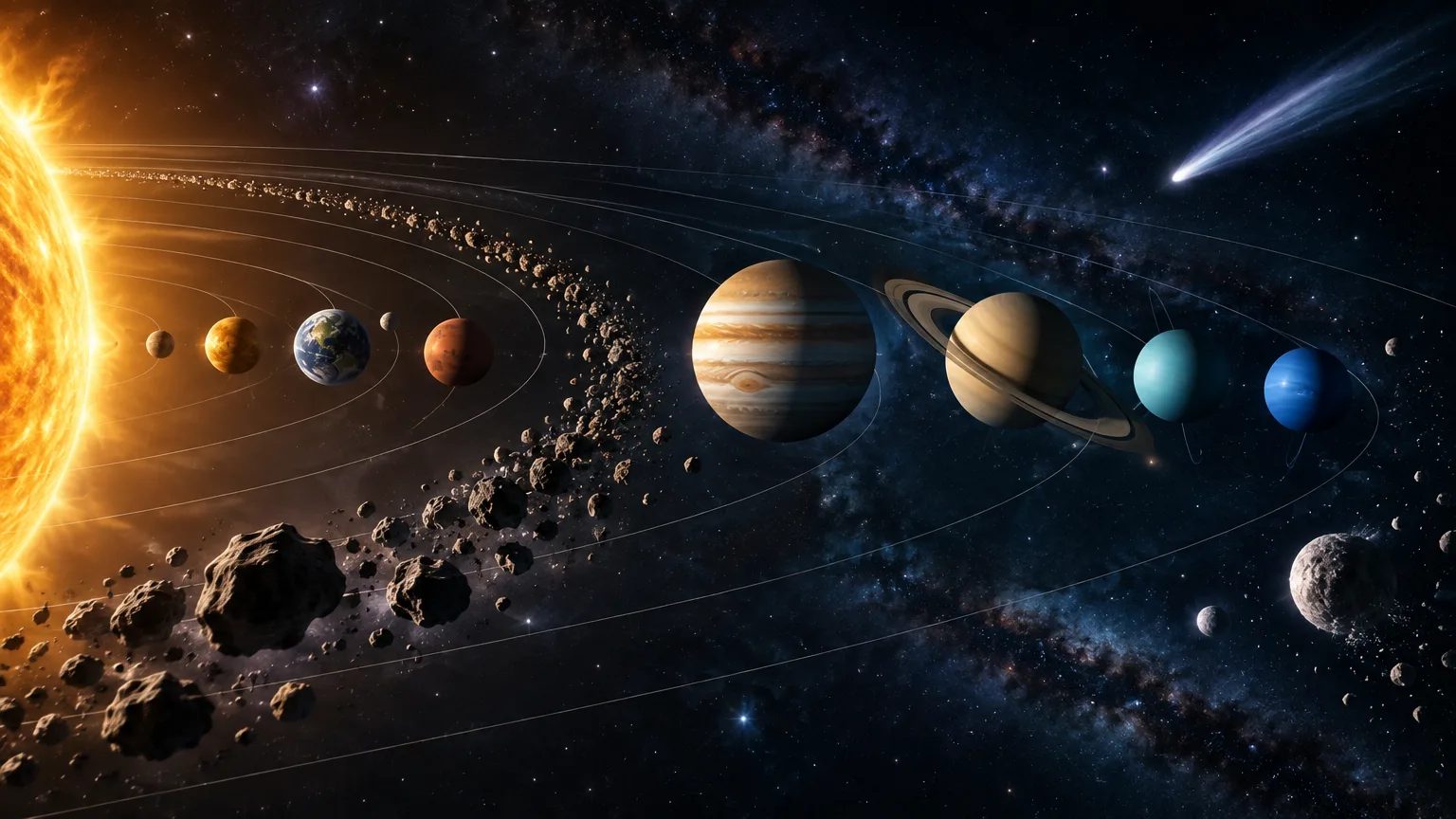
The solar system is often depicted as an orderly collection of planets orbiting the Sun. That picture is useful, but it leaves out much of what astronomers investigate: moons, asteroids, comets, dust and other material. An inventory on NASA’s Solar System Exploration page gives a sense of that diversity: one star, eight planets, five dwarf planets, at least 290 moons, more than 1.3 million asteroids and about 3,900 comets.
These figures are not a complete list of every object that exists, nor do they explain by themselves how each one formed. They do, however, help put research in context: exploring the solar system means studying large and small worlds as well as the environment they share. The evidence available here offers examples of that work, from the Sun to asteroids near Earth.
An inventory that goes beyond the planets
The eight planets are only part of NASA’s count. The same page lists five dwarf planets and at least 290 moons. It also reports more than 1.3 million asteroids and about 3,900 comets. These terms describe different kinds of bodies; the figures indicate the known scale of their populations according to that inventory, not that scientists have observed every part of the solar system.
The scale of the list matters because small objects can also provide clues about the system’s history and conditions. One example appears in NASA’s Laboratory Astrophysics newsletter list of recent publications: it cites a physical analysis of samples from asteroid Bennu. The study title says the analysis reveals regolith production—loose surface material—through collisional disruption on near-Earth asteroids. The available record gives no further methodological details and does not quantify the process, so the conclusion should be limited to what that description says.
The Sun is also an exploration target
The system’s star is not merely the centre of an illustration. NASA describes Parker Solar Probe as the first spacecraft to fly through the solar corona, the outer region of the Sun’s atmosphere. The agency also describes PUNCH as a mission designed to gain new insights into that corona. Together, these references show two ways of investigating the solar environment: a spacecraft that has crossed the corona and a mission designed to study it.
The information available here does not include specific measurements from those observations or establish which questions they have answered. Their significance should therefore be stated cautiously: their objectives put the solar atmosphere among the subjects of research, but these details are not enough to summarise all their findings.
Asteroids: orbital changes and samples
Asteroids feature in more than one line of NASA research. The agency’s astronomy page highlights that the DART mission changed asteroid Didymos’s orbit around the Sun. The available description does not say how much the orbit changed or explain here how the change was measured. It is therefore more accurate to report the result as NASA presents it, without adding figures or explanations that are not included.
Bennu appears in a different context: the analysis of samples cited in the publications newsletter. An orbital result and the study of collected material are different kinds of evidence. The first concerns an asteroid’s motion; the second concerns the properties of the material studied. Considered together, they show why research on these bodies does not rely on a single technique.
Dust, telescopes and forming worlds
The same NASA astronomy page notes that tiny amounts of dust could yield answers under the gaze of the Webb telescope. This wording describes a research possibility, not a detailed result: the evidence provided does not identify which specific questions could be answered or what observations have been obtained.
NASA also describes Webb as the premier observatory of the coming decade, serving thousands of astronomers. In the group of news items consulted, the European Southern Observatory (ESO) reports observations of two planets forming in the disc around a young star named WISPIT 2. This report concerns a planetary system forming around another star, not a newly discovered planet in our solar system. The comparison helps put planetary research in context, but the available information offers no further details for comparing the two environments.
What we can conclude—and what remains open
The sources consulted bring together an inventory of objects and several examples of observation: missions studying the solar corona, a reported orbital change for Didymos, analysis of Bennu material, dust under Webb’s gaze and planets forming around WISPIT 2. They are not a single discovery and do not prove a complete explanation of how the solar system originated; they are separate pieces of a broader research effort.
- What NASA’s inventory states: one star, eight planets, five dwarf planets, at least 290 moons, more than 1.3 million asteroids and about 3,900 comets.
- What the news descriptions report: DART changed Didymos’s orbit around the Sun; Parker Solar Probe flew through the solar corona; and PUNCH is designed to study that region.
- What these details cannot establish: the exact size of the orbital change, quantitative details of the Bennu analysis or specific results from Webb’s dust observations.
The most faithful picture, then, is of a diverse system studied with complementary tools, with catalogues and findings depending on what has been observed and published. The numbers offer an entry point; missions and studies allow more specific questions to be asked, without erasing the remaining uncertainties.