

Key facts
- NASA estimates that dark matter makes up around 27% of the universe and ordinary matter about 5%.
- Dark matter does not appear to interact with the electromagnetic spectrum, but it exerts gravitational influence on ordinary matter and light.
- Gravitational lenses make it possible to estimate the distribution of mass from the bending of light; visible matter in clusters alone does not explain all the observed distortion.
- Roman will study weak gravitational lensing and measure the location and amount of ordinary and dark matter in hundreds of millions of galaxies.
- According to predictions described by NASA, heavy, slow particles would cluster easily, while lighter, faster particles would take longer to form large-scale structures.
- The identity and mass of dark matter particles remain poorly understood; the relationship between speed and clustering is a prediction that observations can test.
Related records
Dark matter presents a paradox: it does not emit, absorb, or reflect light, but its gravity leaves observable traces in the universe. According to estimates presented by NASA, it makes up around 27% of the universe, compared with about 5% for ordinary matter. This gravitational influence makes it possible to study where it is and how it is organized, although the particles that compose it are still not well understood.
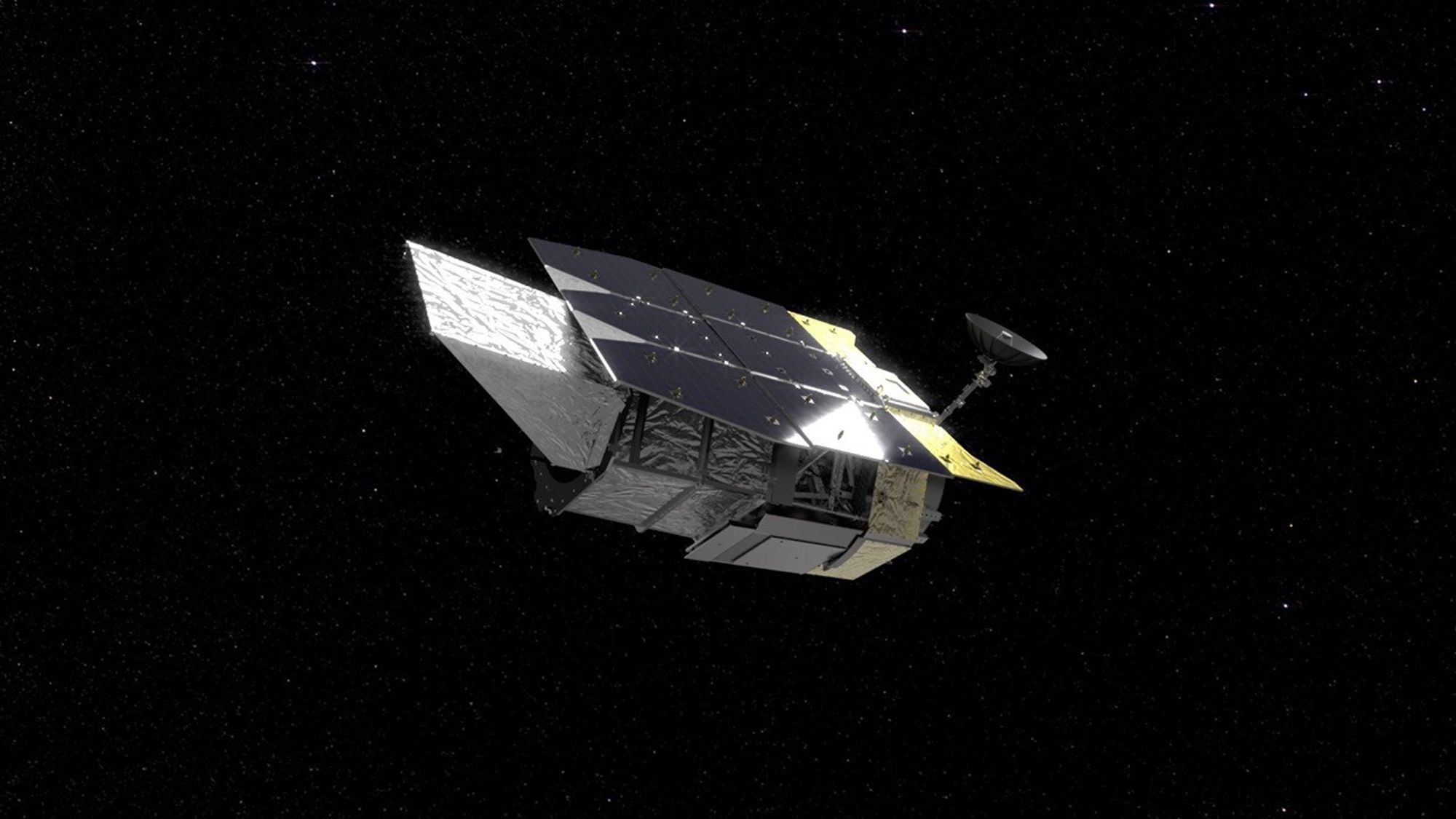
NASA’s Nancy Grace Roman mission will use gravitational lensing to study the distribution of matter on different scales. The relationship between the hypothetical speed of particles and the growth of galaxies offers a way to frame what these observations could reveal: not a direct identification of the particles, but the possibility of comparing the history of cosmic structures with different predictions.
An invisible presence that bends light
Ordinary matter—the matter that forms stars, galaxies, and the objects we can observe—interacts with light. Dark matter, by contrast, interacts gravitationally with ordinary matter, but does not appear to interact with the electromagnetic spectrum. Telescopes therefore do not detect it as a source of light. Its presence is inferred from the effects of its gravity.
One such trace is gravitational lensing. Concentrations of mass curve spacetime and alter the path of light passing nearby. When light from a distant galaxy passes through the region of a galaxy cluster, it may reach telescopes distorted—and, in some cases, amplified. By measuring that distortion, astronomers can estimate the location and amount of matter producing it.
In galaxy clusters, visible matter alone is not enough to explain all the observed curvature. Dark matter contributes additional gravity. Lenses therefore do not show this matter directly: they make it possible to reconstruct its distribution from the combined effect of mass on light. Experiments such as NASA’s Wilkinson Microwave Anisotropy Probe (WMAP) have also been used to measure the proportions of ordinary and dark matter in the early universe.
Speed changes the pace of clustering
The question of whether particles are slow or fast matters because, according to predictions described by NASA, their motion would influence how long they take to gather into concentrations of matter. If dark matter consists of heavy, slow particles, they would cluster easily. In that scenario, galaxy formation would be expected at early stages of cosmic history.
If, on the other hand, the particles were lighter and faster, they would take longer to settle into clumps and develop large-scale structures. The difference would therefore appear in the timeline of cosmic growth: when concentrations of matter form and how galaxies and clusters evolve.
These relationships are predictions conditional on the hypothetical properties of the particles. They do not, by themselves, establish which scenario is correct. NASA also notes that, in simulations, the observed structures correspond better to cold or slow dark matter than to warm or hot dark matter. This comparison helps explain why the motion of dark matter is studied, but it does not determine the identity of its particles.
What Roman will measure
Roman will use the technique of weak gravitational lensing, which seeks subtler distortions in the apparent shapes of distant galaxies. Unlike the more striking effects produced by large concentrations of mass, this technique makes it possible to track how smaller groups of dark matter alter the image of objects behind them.
According to NASA’s mission description, Roman will measure the location and amount of both ordinary and dark matter in hundreds of millions of galaxies. The goal is to study how matter is distributed and how galaxies and clusters changed throughout cosmic history. By looking at more distant objects, astronomers can observe earlier epochs and reconstruct stages in the growth of these structures.
This cosmic map would make it possible to compare the observed distribution with the two predicted sequences: early clustering if particles are heavy and slow, or later development of large structures if they are light and fast. Observing weak lensing is not the same as capturing a particle in a detector; its value here lies in helping to constrain which explanations fit the history of structures.
A clue, not a particle identification
NASA describes a wide range of dark matter candidates and notes that scientists still do not have a good estimate of the mass of its particles. This uncertainty makes it difficult to decide how to search for them directly. The Roman mission is designed to provide information about the distribution of matter and new clues that could help refine those searches.
The connection between speed and galaxy formation should therefore be understood as a tool for comparison. Gravitational lenses can show how mass is distributed and make it possible to track the evolution of structures; predictions link that history to the behavior expected from particles with different properties. Together, these lines of research can constrain models describing dark matter. The mass and identity of its particles remain open questions, while the pattern of cosmic clustering offers a way to investigate which scenarios are compatible with observations.