

Key facts
- NASA says its robotic systems explore planets and Solar System objects, assist ISS astronauts, and study the universe.
- NASA describes those systems as precursors to crewed missions.
- According to NASA, the ISS remains a workspace for astronauts’ experiments in 2026.
- NASA connects AI with mission support, data analysis, and systems development.
- ESA groups content under human and robotic exploration.
Related records
Robotic exploration is a central part of contemporary space activity. It does not mean one mission or one kind of machine: the available evidence presents it as a group of systems used to explore Solar System destinations, assist people working in orbit, and contribute to the study of the universe. Its importance lies in technology’s ability to act as a scientific and operational tool wherever observation, measurement, movement, or information processing is needed.
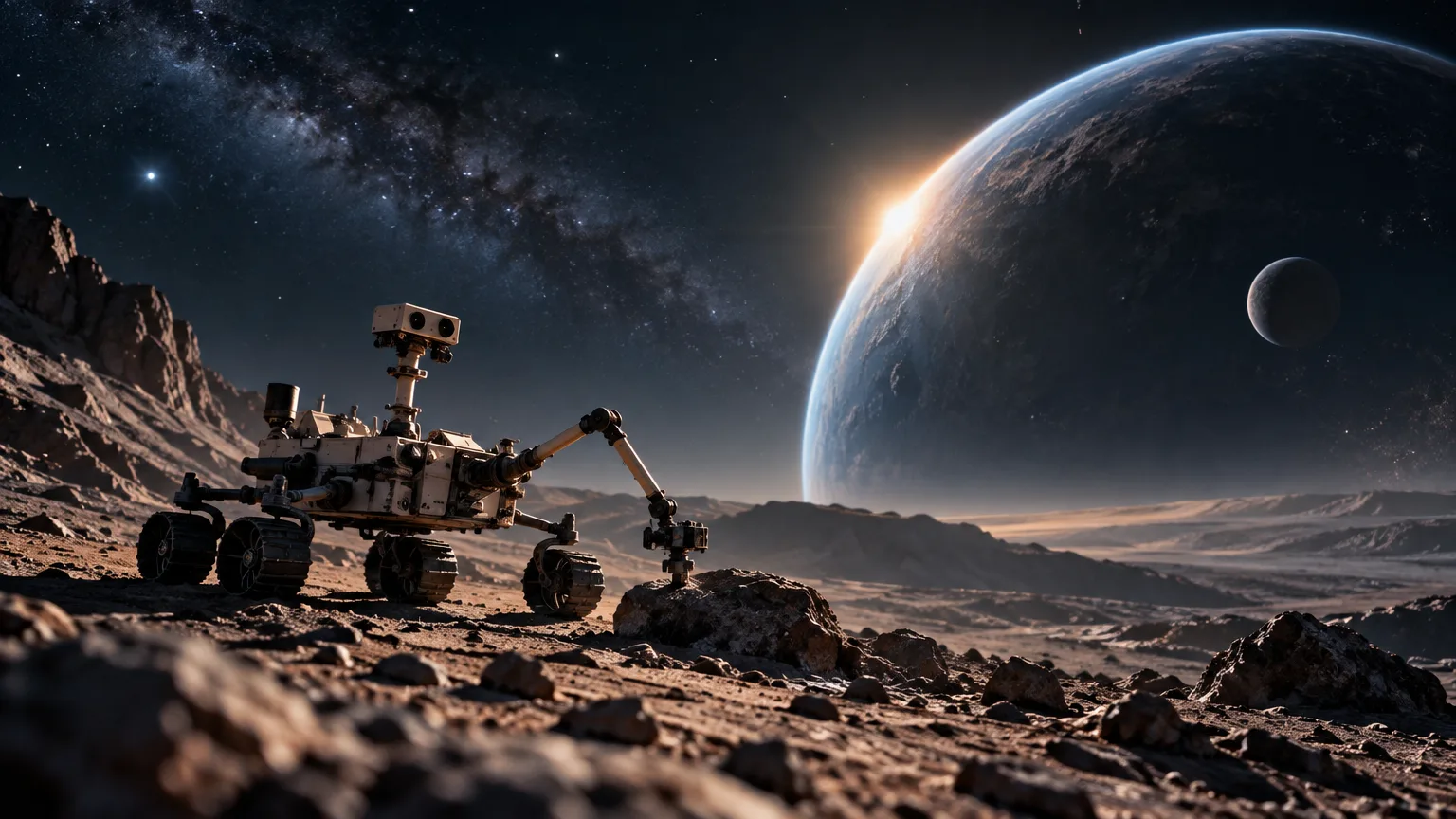
NASA summarizes this approach by saying it uses robotic systems to explore other planets and objects in the Solar System as precursors to crewed missions; to assist astronauts on the International Space Station, or ISS; to study the universe; and for many other purposes. This places robotics both before a possible human presence and within environments where crews already work.
A field with several functions
The word robotics may evoke a vehicle moving across a surface, but NASA’s evidence describes a wider scope. The exploratory role includes work on other planets and Solar System objects. The support role includes helping astronauts on the ISS. The scientific role reaches the study of the universe.
These categories should not be treated as separate compartments. A robotic system may serve operations and research, while mission data may feed scientific analysis. NASA also says artificial intelligence helps support missions and research projects across the agency, analyze data to reveal trends and patterns, and develop systems. In this setting, automation and data analysis are part of the technological ecosystem associated with exploration.
Robotics as preparation and support
The word “precursor” is important in NASA’s description. It indicates that robotic systems can come before crewed missions in exploring other worlds and objects. The supplied sources do not specify which missions follow that sequence, nor do they establish that every robotic mission leads to a human one. They do support the statement that NASA presents such preparation as one purpose of its robotic systems.
The other dimension is orbital support. NASA identifies the ISS as a place where robotic systems assist astronauts. An institutional page on station research adds that throughout 2026 the ISS has continued as a workspace for astronauts conducting a variety of scientific experiments, laying groundwork for missions to the Moon and beyond. This links research, human work, and support technology, without specifying which robot takes part in each experiment.
Institutions and exploration frameworks
The material comes mainly from public space-exploration organizations and centers. NASA maintains pages on robotics, technology, artificial intelligence, space-station research, and news. Its Jet Propulsion Laboratory, or JPL, presents itself as exploring the universe and searching for new worlds; its robotics area also maintains a list of publications.
In Europe, the European Space Agency, or ESA, has an area called “Human and Robotic Exploration.” The available description says the site features news about astronauts, the ISS, space research, and education. This shows that robotic exploration is institutionally communicated alongside human exploration, although the supplied evidence does not allow description of specific European programs or attribution of particular results to ESA.
Technology, data, and potential benefits
NASA says technology development drives exploration and supports the United States’ innovation economy by creating space-exploration solutions that also generate tangible benefits for life on Earth. The source does not list those benefits or quantify their scale. The claim should therefore be read as NASA’s institutional position on the transfer and usefulness of its technology development, not as an independent measurement of impact.
NASA’s artificial-intelligence page also describes uses that support missions and research, analyze data, and develop systems. In a field that produces observations and data, this capacity may matter for identifying trends and patterns. Yet the available evidence cannot assess the autonomy, performance, limitations, or exact AI role of a particular system or mission.
Recent items: how to read them
The supplied institutional pages show editorial and technical activity in 2026. NASA says its robotics-news page was updated on June 2, 2026, to align with current program details. Its news index also says the Curiosity Mars rover captured navigation-camera panoramas while parked at a sand ridge nicknamed “Chocolatal,” at two times of day, including August 30, 2026. JPL Robotics’ publication list includes an August 25, 2026 paper on a high-fidelity actuator model for robotic autonomy in space and beyond.
These items show that the sources present dated 2026 information, but they are insufficient to reconstruct scientific results, verify the full content of the publication, or draw conclusions about the overall state of robotic exploration. A panorama, webpage update, or technical-paper title is not by itself a scientific discovery.
What is known and what remains open
On the available evidence, the cautious conclusion is that robotics has a cross-cutting role: it explores, supports crews, produces or helps process information, and can prepare later missions. It is also connected with technology development, orbital research, and artificial intelligence.
Important questions remain open: the capabilities of each system, the aims and outcomes of individual missions, criteria for measuring benefits on Earth, and operational autonomy. Addressing them would require technical documents, mission data, and assessments not included in the supplied material.