

Key facts
- The University of Alicante describes research on autonomous robots and AI for space exploration.
- According to that source, learning approaches can seek locomotion strategies, optimize energy, and adapt to different gravities.
- The Moon and Mars are cited as examples of gravitational environments in that research.
- NASA Science presents Artemis as a program addressing high-priority scientific questions related to the Moon and Mars.
Related records
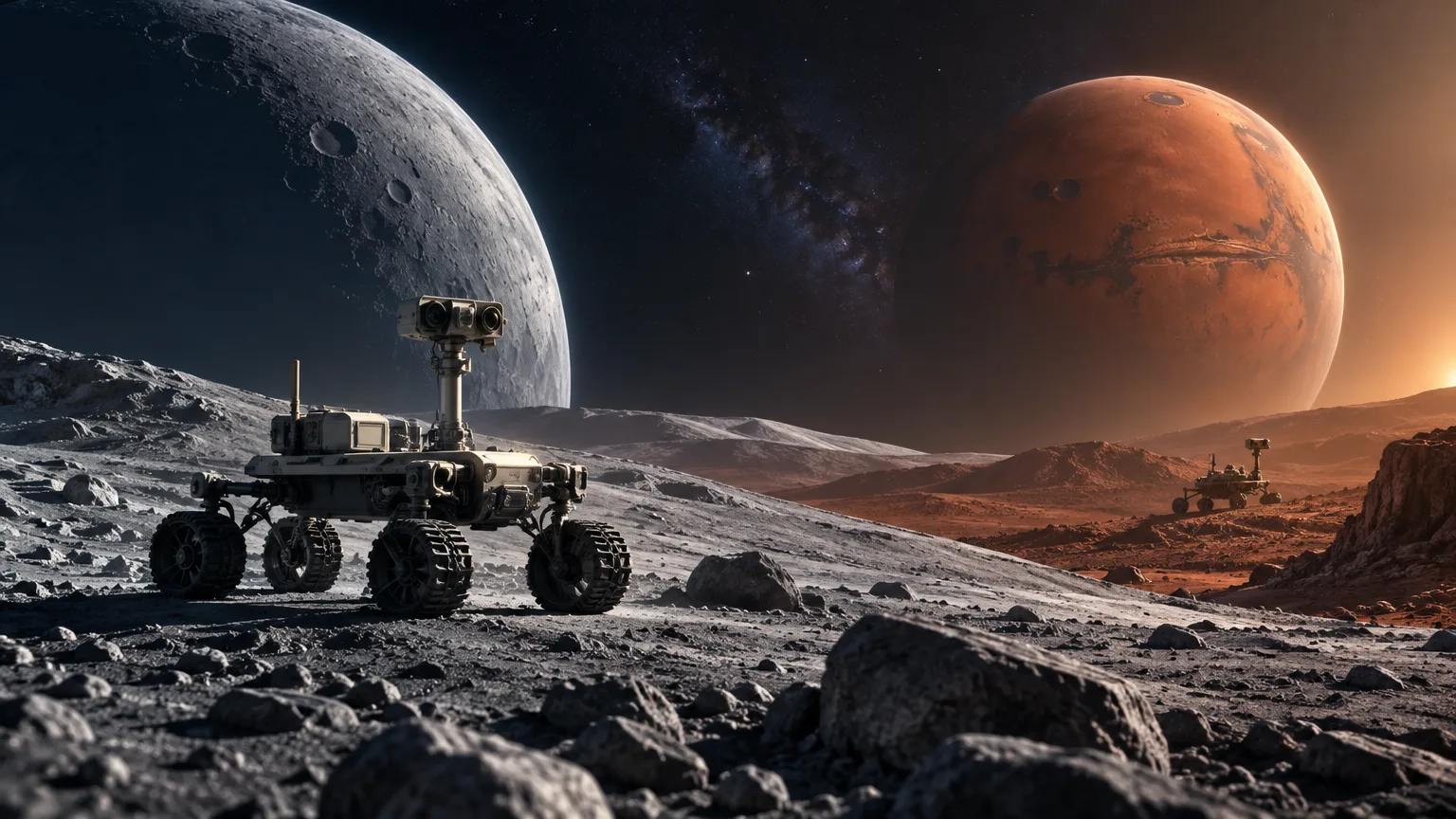
Robotic exploration encompasses systems designed to function beyond Earth and contribute to the investigation of other environments. In the documentation available for this article, the most clearly defined technical element is autonomy: a robot's ability to discover movement strategies, optimize energy use, and adapt its travel to different gravitational conditions. This research line is explicitly mentioned for the Moon and Mars, two destinations that also appear in the scientific context of NASA's Artemis program.
It is important, however, to distinguish technological research, a program's objectives, and operational missions. The supplied sources make it possible to describe broad advances and ambitions; they do not identify a specific robot, detail a particular demonstration, or document a deployment schedule. That distinction matters when discussing “latest developments”: this body of evidence is insufficient to verify a recent announcement or establish which system is most advanced.
Autonomy for moving on other worlds
The University of Alicante's Space Robotics Laboratory says that recent advances in artificial intelligence and reinforcement learning are enabling new levels of autonomy in these systems. According to that description, learning-based control approaches can allow robots to automatically discover locomotion strategies, optimize energy consumption, and adapt movement to environments with different gravity, such as the Moon or Mars.
The significance of this framing is that it does not reduce space robotics to following fixed instructions. Movement becomes a problem of adaptation: the system must find locomotion strategies and adjust its performance to the environment. Energy optimization is also part of that objective. The source provides no quantitative results, comparisons with alternative methods, or list of platforms on which these capabilities have been used. These possibilities should therefore be read as a description of research lines and approaches, not as certification of a particular robot's performance.
Its place in space research
Space exploration requires technologies capable of reaching locations not investigated directly from Earth. Among the collected sources, one explanatory account summarizes that advances in rocket engineering, communications, and robotics have made missions to previously unimaginable destinations possible. That statement places robotics within a broader technical set: it does not act in isolation, but alongside systems that enable travel and information exchange.
In this framework, autonomous and intelligent robots are presented as a way of responding to environmental conditions without relying solely on predefined decisions. Yet the material provides no data on communications, scientific instruments, landings, or operational duration. Nor does it establish that all space robots use reinforcement learning. The supported conclusion is narrower: research exists that explores AI and learning to increase the autonomy of robots intended for contexts such as the Moon and Mars.
Artemis: scientific context, not evidence of integration
The NASA Science website states that, through Artemis, NASA will address high-priority scientific questions, focusing on those that human explorers can best accomplish in person on and around the surface of the Moon and Mars, using systems. This reference explicitly connects the program with research at both destinations and with the use of systems, but its description focuses on human explorers.
Artemis therefore provides context for understanding why the Moon and Mars are prominent in exploration discussions, but it does not by itself demonstrate that the techniques described by the University of Alicante are part of Artemis. Nor does it allow an inference that a particular robotic mission is approved, underway, or close to launch. Keeping those claims separate prevents a reasonable thematic relationship from becoming an undocumented operational connection.
What can be said, and what remains open
- Can be said: research exists into autonomous robots and artificial intelligence for space exploration.
- Can be said: learning-based approaches are described as able to seek locomotion strategies, optimize energy, and adapt movement to different gravities.
- Can be said: the Moon and Mars are explicit examples in this research, and Artemis mentions them as settings for high-priority scientific questions.
- Cannot be said from these sources: which specific robot uses these techniques, what results it has achieved, or when they will be used on a mission.
- Cannot be said from these sources: that Artemis has incorporated the cited developments.
How to read the available evidence
NASA's institutional source provides a framework for Artemis and its scientific priorities. The university page supplies the technical detail on autonomy, artificial intelligence, and reinforcement learning. The remaining supplied results include explanatory material, media, and videos, but their excerpts do not add enough verifiable information to build a chronology or attribute advances to a specific mission.
The resulting picture is of a field in which autonomy is a central goal: a robot that learns to move, adjusts its behavior to gravity, and manages energy better could expand research options on the Moon or Mars. This is a technological possibility described by the sources, not a guaranteed outcome. To follow the subject rigorously, it is useful to distinguish among a research objective, experimental validation, and actual adoption in a mission.
The starting references are available from the University of Alicante Space Robotics Laboratory and NASA Science.