

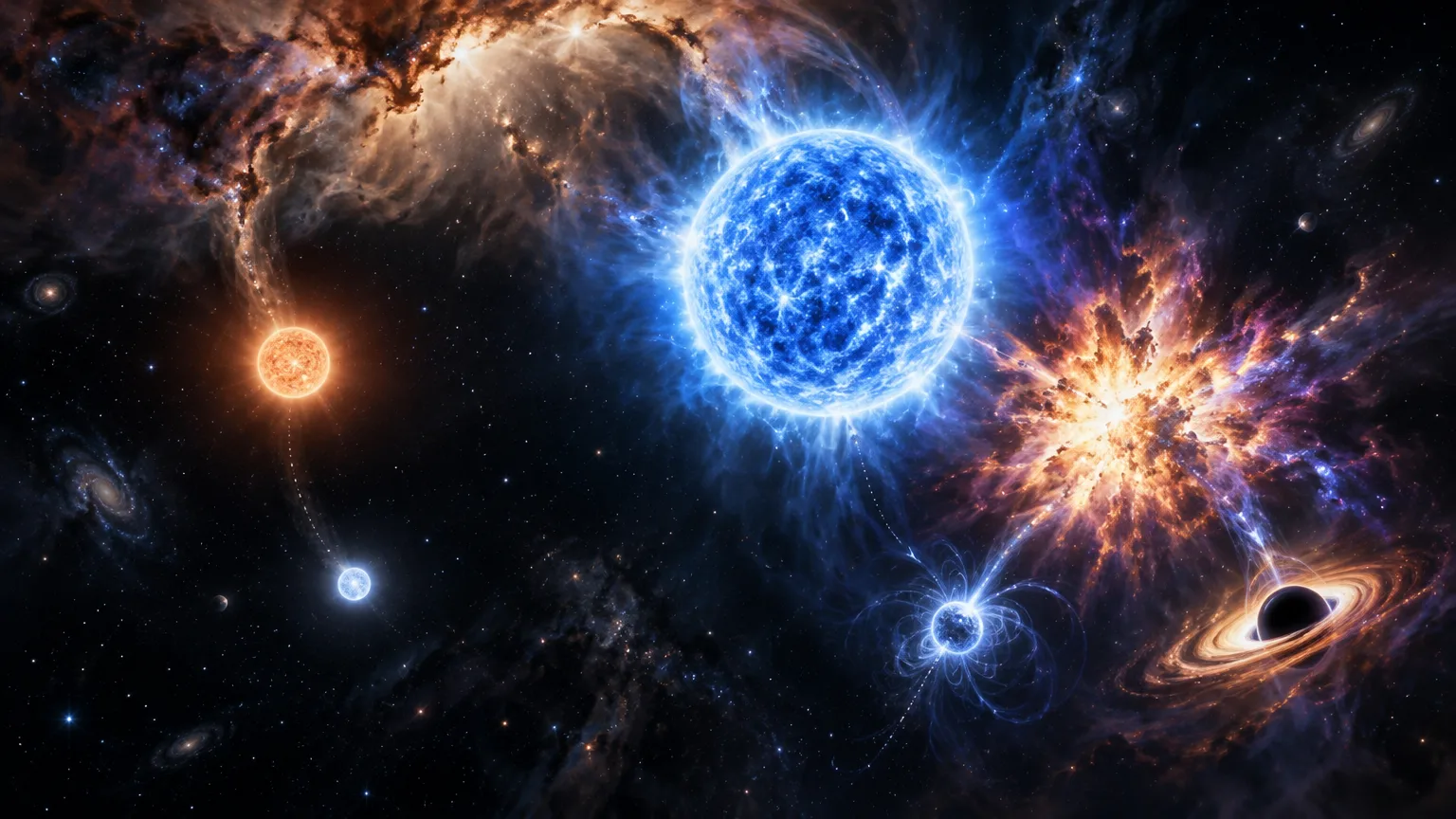
Key facts
- Stars form in molecular clouds of gas and dust; gravity causes some clumps to collapse and give rise to protostars.
- Mass determines how quickly a star consumes its fuel: some low-mass stars can shine for trillions of years, while some massive stars live for only a few million.
- The stable fusion of hydrogen into helium defines the main sequence, the longest phase of a star’s life.
- A low-mass star can expel its outer layers as a planetary nebula and leave behind a white dwarf roughly the size of Earth.
- In the outcome described for high-mass stars, core collapse produces a supernova and leaves a neutron star or a black hole.
- Material expelled by supernovae and other stellar events can become part of future molecular clouds and new stars.
Related records
Stars do not all run on the same clock. According to NASA, their lives can span from a few million to trillions of years, and mass helps explain the difference. Lower-mass stars consume fuel for longer; very massive stars burn it faster and need to produce energy at a higher rate to support themselves against their own weight.
The difference in lifespan is connected to another difference: stars do not all end in the same way. When the hydrogen in the core runs out, what happens next depends strongly on mass. Some low-mass stars become giants and leave behind a white dwarf. In the case described for high-mass stars, the core’s collapse triggers a supernova and leaves a neutron star or a black hole.
Birth: gas, dust, and gravity
Stars begin to form in vast clouds of gas and dust called molecular clouds. NASA says these can have between 1,000 and 10 million times the mass of the Sun and extend for hundreds of light-years. They are cold, a condition that encourages gas to gather in high-density regions.
Some clumps of material collide with one another or gather more matter. As their mass grows, so does their gravitational force; eventually, gravity causes some of these clumps to collapse. Friction heats the material and gives rise to a protostar, a star in formation. At first, most of a protostar’s energy comes from the heat released during this initial collapse.
Fusion sustains the longest stage
After millions of years, the enormous pressures and temperatures in the core allow hydrogen nuclei to join together to form helium. This process is called nuclear fusion. The energy released heats the star and helps prevent it from continuing to collapse under gravity.
Stars that stably fuse hydrogen into helium are on the main sequence, the longest phase of their lives. During this phase, their luminosity, size, and temperature change slowly over millions or billions of years. The Sun is approximately halfway through this stage.
Mass means that this period does not last the same amount of time for every star. A star’s gas is its fuel and, according to NASA, mass determines how quickly it consumes it. Lower-mass stars burn fuel for longer and are dimmer and cooler than very massive stars. The latter must burn it at a higher rate to generate the energy they need to support themselves. As a result, some low-mass stars can shine for trillions of years, while some massive stars live for only a few million.
When the hydrogen runs out
At the beginning of the end of a star’s life, its core runs out of hydrogen to convert into helium. The pressure produced by fusion had counteracted gravity’s tendency to pull matter together; when that balance is lost, the core begins to collapse. As it contracts, its temperature and pressure rise, and the star gradually expands. From that point on, the outcome depends strongly on mass.
In a low-mass star, the atmosphere can continue to expand until the star becomes a subgiant or a giant. Meanwhile, in the core, fusion transforms helium into carbon. NASA says this will be the Sun’s fate in several billion years. Some giants become unstable, pulsate, and periodically expel part of their atmospheres. Eventually, their outer layers disperse as an expanding cloud of gas and dust called a planetary nebula. The remaining core is a white dwarf, a stellar remnant roughly the size of Earth that gradually cools over billions of years.
The explosive ending of some massive stars
High-mass stars can go through additional stages of fusion. Carbon is transformed into heavier elements, such as oxygen, neon, and magnesium, which serve as fuel for the core. In the largest stars, the chain continues until silicon fuses into iron. Each new fuel provides less time than the previous one, and the process described by NASA lasts only a few million years.
When silicon is transformed into iron, the star runs out of fuel in a matter of days. Fusing iron to produce heavier elements requires energy instead of releasing it. In the outcome described by NASA, the iron core collapses until the forces between nuclei halt the collapse and cause a rebound. This change generates a shock wave that travels through the star: the resulting explosion is a supernova. The core survives as an extremely dense remnant, which can be a neutron star or a black hole.
One generation of stars fuels the next
A star’s end also plays a part in the beginning of other stars. Material expelled by supernovae and other stellar events enriches future molecular clouds and can become part of new generations of stars. In this way, the cycle described by NASA connects formation in clouds of gas and dust with fusion, remnants, and matter that returns to space.
The central idea is that mass acts as a regulator of the stellar clock: it influences how quickly fuel is consumed and the path a star follows when the hydrogen in its core runs out. The paths described are not identical for all stars; their final stages depend strongly on their mass.