

Key facts
- Luna 3 was launched in October 1959 and photographed the far side during a lunar flyby.
- The exposed film was developed and scanned aboard the spacecraft before the data were transmitted to Earth.
- The spacecraft needed suitable communication geometry; its limited radio capacity resulted in weak signals and several transmission attempts.
- The images showed extensive areas not previously observed and provided the first global view of the far side.
- Between 1966 and 1967, Lunar Orbiter obtained a new generation of images using two-lens cameras, onboard film development, and high-resolution scanning.
- Lunar Orbiter’s high-resolution maps helped select Apollo landing sites.
Related records
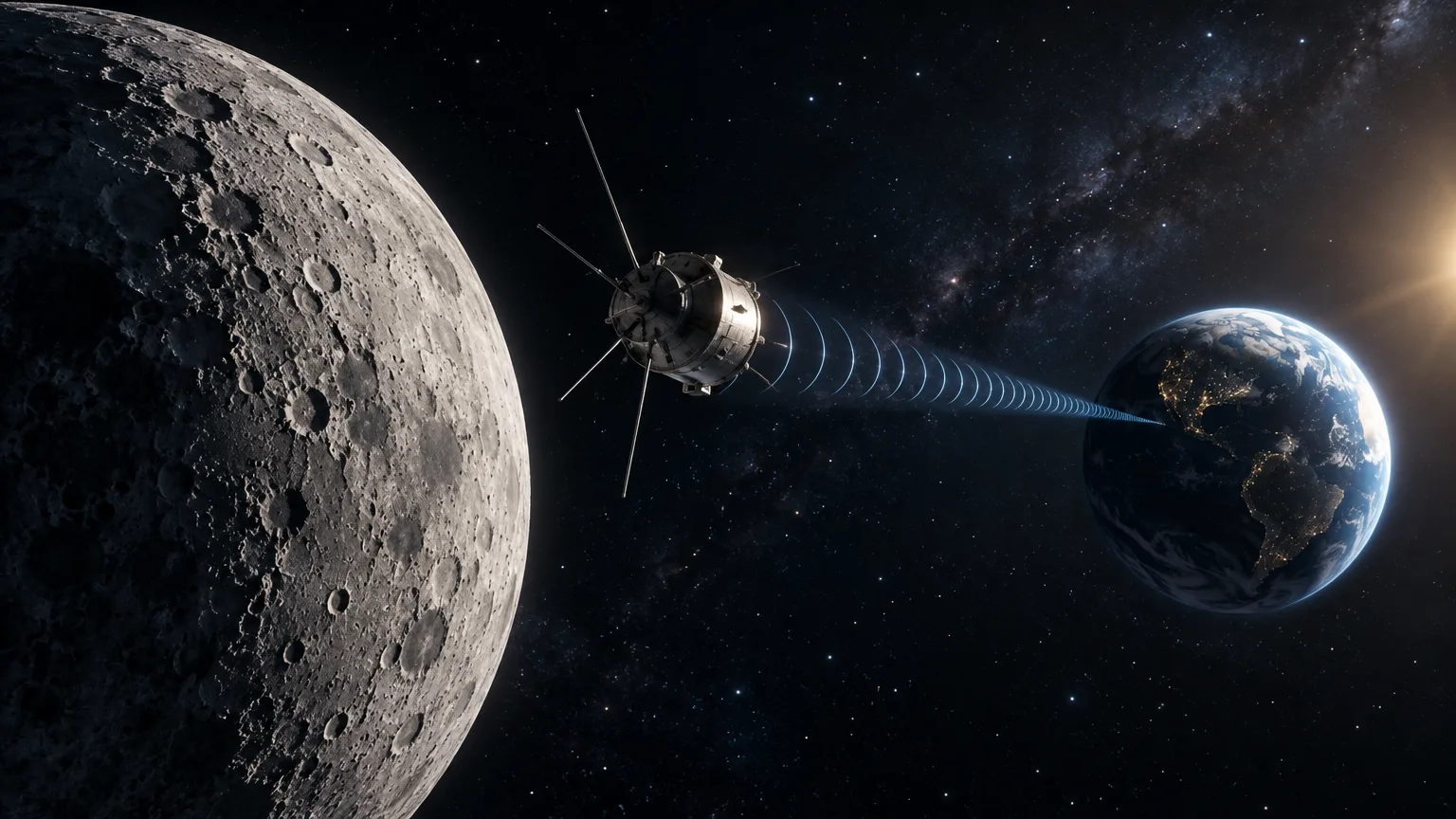
The Moon’s far side cannot be seen from Earth because lunar rotation is synchronized with its orbit: the same half always faces our planet. To observe the other half, it was necessary to travel there. The Soviet spacecraft Luna 3 did so in October 1959: it flew past the Moon and took images of its far hemisphere with an onboard photographic system. However, capturing the terrain was not enough. The spacecraft also had to process the photographs and transmit them to Earth.
This work, described in a review article published in the Journal of Astronomy and Space Sciences, helps explain the flight not merely as a flyby, but as a chain of technical operations. The review, by Ulkar Karimova, Yu Yi, and Kyungguk Min, places Luna 3 within a Soviet program that had to tackle navigation, communications, and attitude-control challenges, as well as operate in space, in orbit, and on the lunar surface.
From the first tests to the far side
The missions that preceded Luna 3 help put its achievement in context. Luna 1, launched in January 1959, failed to reach the intended trajectory for impacting the Moon and instead entered an orbit around the Sun: it was the first human-made object to do so. During its mission, it transmitted scientific data and information about the spacecraft’s status to ground stations, and demonstrated spin-stabilized attitude control and the operation of scientific instruments in deep space.
Luna 2, launched in September of that year, achieved the first lunar impact. Its forward-facing instruments transmitted data during the final descent, confirming the trajectory’s accuracy and the intended impact location. Luna 3 faced a different task: not to end its journey on the surface, but to photograph a region that had never been directly observed from Earth and return the images.
Taking photographs was only the first step
The flyby presented a particular problem: Luna 3 had to photograph the far side and then convert what it recorded into information that could be received on Earth. According to the review, the exposed film was developed and scanned aboard the spacecraft. Only after this processing could the spacecraft transmit the image data.
Transmission also depended on establishing suitable communication geometry with Earth. Luna 3’s radio equipment had limited capacity, too: the signals were weak, and several attempts were needed to reconstruct usable images on our planet. The delay between taking and receiving the photographs was therefore not an unexplained pause, but the result of the steps needed to process and send them.
This sequence helps show the scale of the challenge: the photographic system had to work, the film had to be processed without intervention from Earth, and communication had to be completed from a spacecraft near the Moon. Each stage affected the next. The mission succeeded in returning images of extensive areas that had not previously been observed.
A first view of an unknown hemisphere
According to the review article, Luna 3’s images provided the first global view of the lunar far side and supported the orbital and surface exploration that followed. Their importance lay in showing extensive regions that had been unknown until then; the mission turned a hemisphere inaccessible to observation from Earth into territory that could be studied through images.
The 2026 review places this result within an early period of lunar exploration, when Soviet missions gradually developed their technical and operational capabilities. In that history, Luna 3 did more than add photographs to the lunar record: it tested a complete method for obtaining, processing, and transmitting them from space.
The contrast with Lunar Orbiter
Between 1966 and 1967, the US Lunar Orbiter program obtained a new generation of images of the far side. Its system differed from Luna 3’s experimental film-scanning method: the spacecraft used a two-lens camera, developed the film on board, and scanned it at high resolution before transmitting it to Earth.
Lunar Orbiter produced the first high-resolution photographic maps of both the near and far sides. These maps helped select landing sites for the Apollo program. The comparison does not diminish Luna 3’s role: it shows how lunar photography progressed from an initial experimental chain—capture, development, scanning, and transmission—to a system capable of producing detailed maps for mission planning.
The Luna 3 episode is a reminder that exploring the Moon depended on more than simply getting there. In 1959, photographing its far side required coordinating onboard operations and communications with Earth; the result opened a new window for later missions.