

Key facts
- LID-568 is at the center of a galaxy that existed about 1.5 billion years after the Big Bang.
- The team used Webb to observe a sample of galaxies selected from Chandra’s COSMOS survey; LID-568 stood out because of its intense X-ray emission.
- The NIRSpec integral field spectrograph made it possible to obtain spectra for every pixel in its field of view and detect powerful gas outflows around the black hole.
- The team estimates that LID-568 appears to be feeding at a rate more than 40 times its Eddington limit.
- The speed and size of the outflows support the inference that a substantial part of the growth may have occurred in an episode of rapid accretion.
- The possible role of the outflows as an escape valve for excess energy is a team hypothesis; follow-up observations with Webb were planned.
Related records
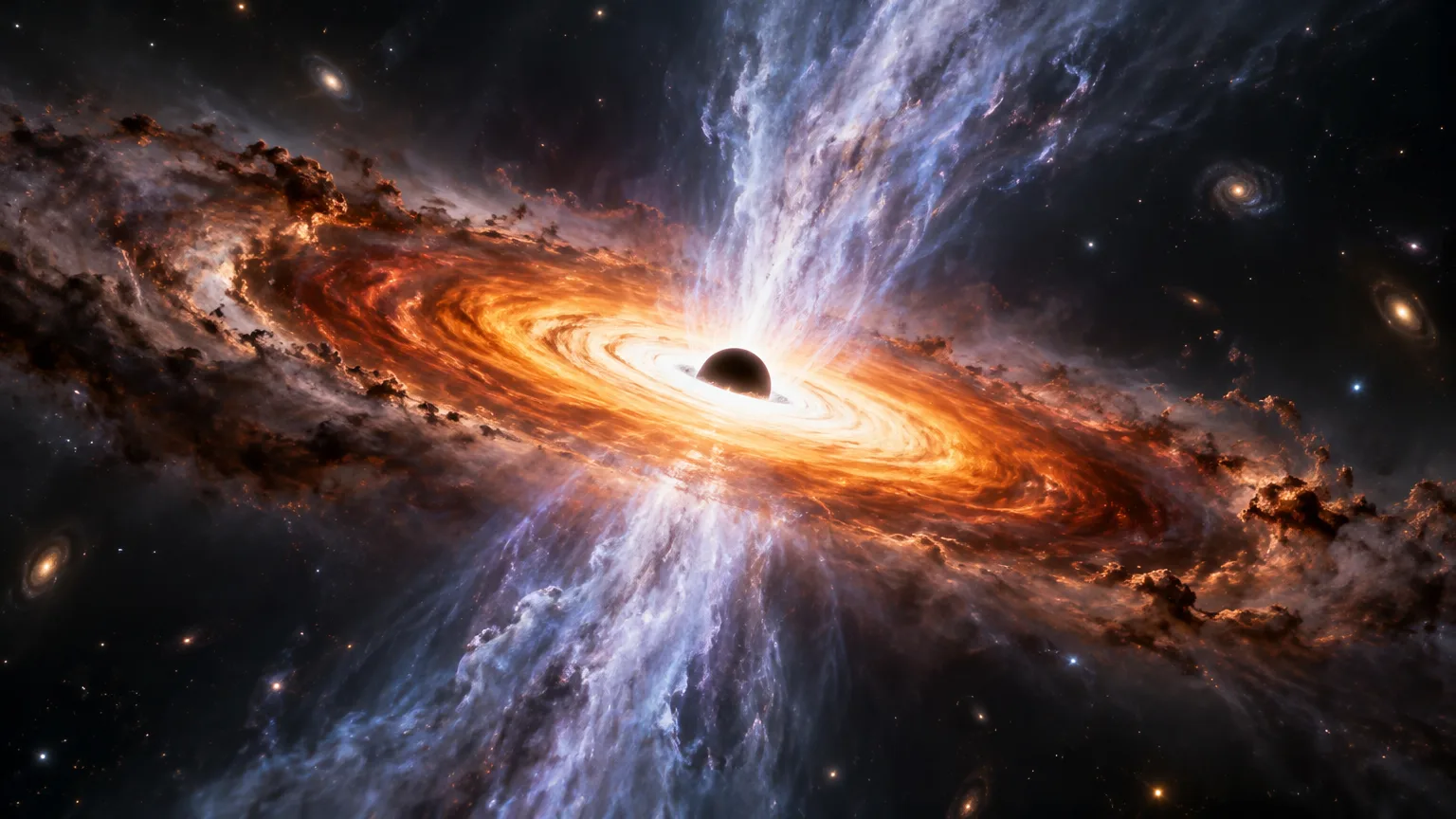
The case of LID-568 offers a look at a supermassive black hole at an early stage of cosmic history. It lies at the center of a galaxy that already existed when the universe was about 1.5 billion years old. On November 4, 2024, NSF NOIRLab announced that an international team had studied the object using data from the James Webb Space Telescope (JWST) and the Chandra X-ray Observatory. The team estimated that LID-568 appears to be feeding at a rate more than 40 times the Eddington limit, and detected powerful gas outflows around it.
From an X-ray source to observations with Webb
The team, led by astronomer Hyewon Suh, used Webb to observe a sample of galaxies selected from Chandra’s COSMOS survey. LID-568 stood out because of its intense X-ray emission. However, Chandra’s observations did not allow the source’s position to be determined precisely, making it difficult to center it in Webb’s field of view.
To address this problem, the team used Webb’s NIRSpec integral field spectrograph instead of traditional slit spectroscopy. This instrument can obtain a spectrum for each pixel in its field of view, rather than being limited to a narrow strip. The observations therefore covered both the target and the region around it. This coverage led to the unexpected detection of powerful gas outflows around the central black hole.
Chandra and Webb contributed different parts of the observation: the X-ray survey made LID-568 stand out in the sample, while NIRSpec made it possible to study a broader region around the object spectroscopically. This combination helped the team characterize a source whose initial position had not been well determined.
What the Eddington limit indicates
The Eddington limit describes a balance related to the maximum luminosity a black hole can reach and how quickly it can absorb matter. Gravity pulls material toward the black hole, while outward pressure comes from the heat of the compressed material falling in. The estimate reported by the team places LID-568’s feeding rate above that limit: the announcement describes it as more than 40 times the Eddington limit.
This figure is an estimate of the object’s feeding rate, not a direct observation of every step taken by the matter. Its significance is that it offers a specific case for studying a phase of super-Eddington accretion, meaning accretion that exceeds the theoretical limit described by Eddington. The NSF NOIRLab announcement notes that observing a supermassive black hole at such an early epoch may offer clues to how these objects grew rapidly.
Gas outflows and rapid growth
The researchers used the speed and size of the observed outflows to infer that a substantial part of LID-568’s growth may have occurred during a single episode of rapid accretion. This is an interpretation of the observations, not a step-by-step record of the black hole’s history. The team suggests that a feeding phase above the Eddington limit could allow a considerable increase in mass during a rapid episode.
The result also relates to ideas about the seeds of supermassive black holes. The models mentioned by the team include light seeds, which could originate when the first stars die, and heavy seeds, which would arise from the direct collapse of gas clouds. According to Suh’s interpretation, as reported in the announcement, an episode of rapid accretion could contribute significantly to growth whether the initial seed was light or heavy.
The outflows could help explain how such intense feeding is regulated. The team proposes as a possibility that they act like a kind of escape valve, releasing some of the excess energy and preventing the system from becoming too unstable. This explanation is presented as a hypothesis that requires further investigation.
What follow-up observations could clarify
NSF NOIRLab said the team planned follow-up observations with Webb to investigate the mechanisms at work in LID-568. Those observations could help study the relationship between extreme accretion and gas outflows, as well as the possible role of the latter in the system. The escape-valve hypothesis and the inference of a single growth episode are interpretations by the team based on the observations described.
The 2024 announcement said the results were presented in a paper titled “A super-Eddington-accreting black hole ~1.5 Gyr after the Big Bang observed with JWST”, which, according to NSF NOIRLab, was due to appear in Nature Astronomy. Taken together, the observations make LID-568 a useful case for studying the rapid growth of supermassive black holes in the early universe: the rate of more than 40 times the Eddington limit is the team’s estimate, while the possible regulatory role of the outflows remains a hypothesis.