

Key facts
- At 1 bar, Jupiter’s polar radius is 66,842 ± 0.4 km, its equatorial radius is 71,488 ± 0.4 km, and its mean radius is 69,886 ± 0.4 km.
- The new radii are 12 km, 4 km, and 8 km smaller, respectively, than previous estimates.
- Analysis of Juno radio occultations incorporates the effects of zonal winds and reduces uncertainty by an order of magnitude.
- The authors indicate that winds above the visible cloud tops are largely barotropic, with minimal vertical variation.
Related records
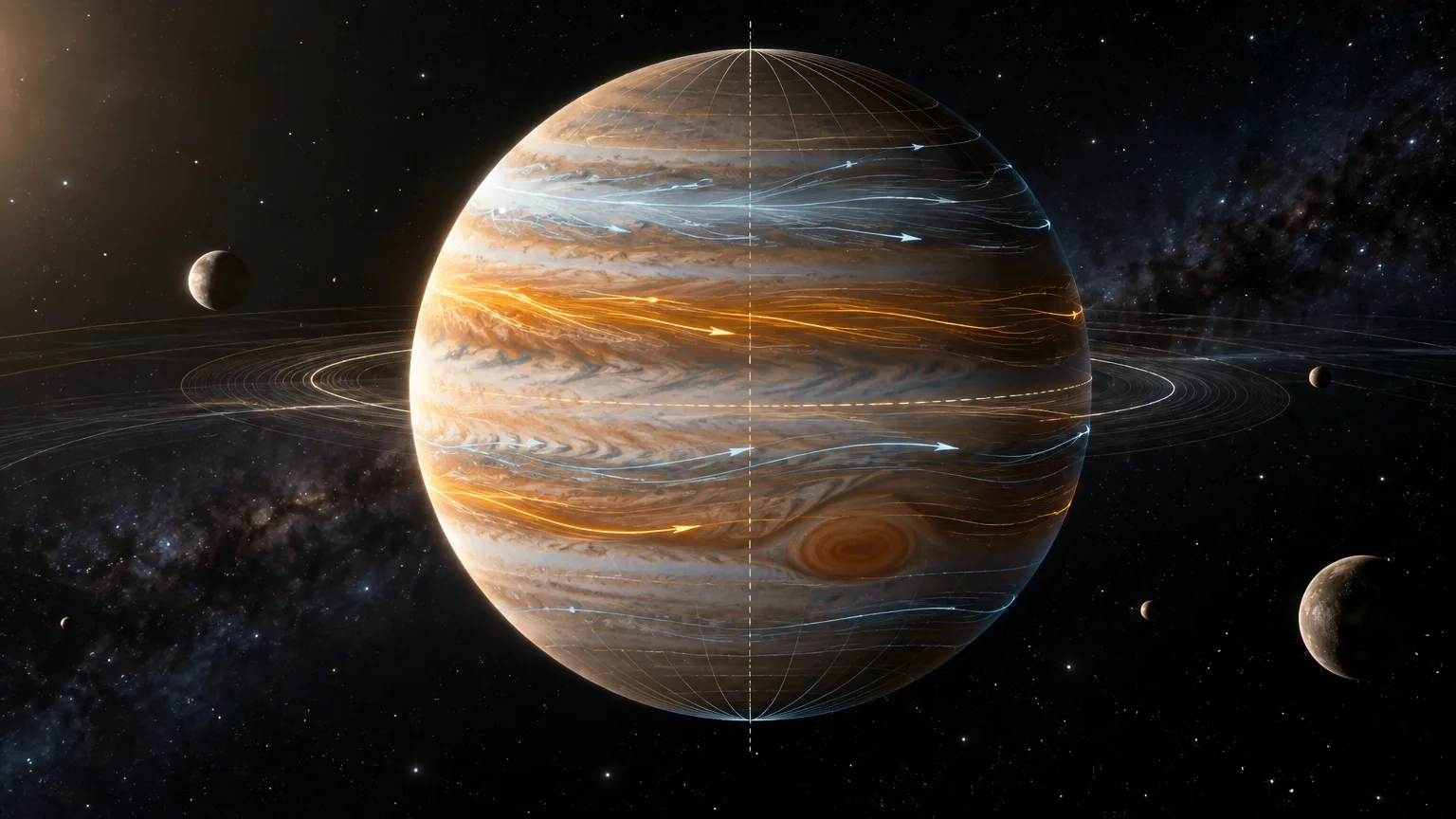
The Juno spacecraft has made it possible to recalculate Jupiter’s shape with unprecedented precision by accounting for the influence of its zonal winds. By analyzing numerous radio occultations, the study determines the planet’s radii at the 1-bar pressure level, obtaining values smaller than previous estimates and reducing uncertainty by an order of magnitude. This refined profile improves the spatial reference for pressure-dependent atmospheric measurements and has direct implications for models of Jupiter’s interior structure.
The shape of a rapidly rotating planet
Jupiter is the fastest-spinning planet in the solar system and displays a pronounced equatorial bulge. According to the study, this flattened shape reflects the combination of rapid rotation, complex internal structure, and atmospheric winds. Previous estimates of the shape, with uncertainties of approximately 4 km, were based on a single analysis of radio occultations from the Voyager and Pioneer missions conducted almost five decades ago, and did not account for the influence of Jupiter’s strong winds.
Radio occultation measurements
Juno is a NASA spacecraft that studies Jupiter. The probe has recently provided numerous high-precision radio occultation measurements, which the study uses to determine the planet’s shape. In this type of observation, the spacecraft’s radio signal passes through Jupiter’s atmosphere before reaching Earth. Changes in the signal make it possible to probe the atmosphere and determine the planet’s size and shape with great precision.
The analysis incorporates the effects of zonal winds into the shape calculation. With these effects included, the authors report an order-of-magnitude reduction in uncertainty compared with previous estimates. The paper reports results derived from Juno’s measurements and the inclusion of these atmospheric effects.
The three radii at 1 bar
The values refer to the 1-bar pressure level. Under this condition, the study obtains:
- Polar radius: 66,842 ± 0.4 km.
- Equatorial radius: 71,488 ± 0.4 km.
- Mean radius: 69,886 ± 0.4 km.
The ± sign expresses the uncertainty reported for each radius. Compared with previous estimates, the new values are, respectively, 12 km, 4 km, and 8 km smaller. These are distinct dimensions of an oblate planet, not interchangeable values; their comparison describes both the equatorial bulge and a mean scale, always at the specified pressure level.
What the results indicate about the winds
The analysis indicates that winds above the visible cloud tops are largely barotropic, meaning they show minimal vertical variation in the region considered. This result refers to the interpretation of the winds obtained in the study alongside the new determination of the shape.
The refined radius profile also improves the spatial reference for pressure-dependent measurements. According to the authors, this reference provides a more precise context for interpreting Jupiter’s atmospheric dynamics.
Implications for models of the interior
The authors note that the updated shape has important implications for interior-structure models. In particular, the results support a cooler, metal-enriched atmosphere and help reconcile discrepancies between models, measurements from the Galileo probe, and temperatures derived from Voyager. These are implications for comparing and evaluating models, whereas the three radii at 1 bar are the geometric values reported directly.
Taken together, Juno provides a more precise determination of Jupiter’s shape by incorporating the effects of zonal winds. The radii are understood under the explicitly stated 1-bar condition and their uncertainties; in turn, the revised profile serves to improve the reference for atmospheric measurements and to examine models of the planet’s interior.