

Key facts
- The Trifid Nebula is about 5,000 light-years from Earth.
- Hubble observed the region in 1997 and again in 2026, 29 years apart.
- The recent image was taken with the Wide Field Camera 3; the 1997 observation used the Wide Field and Planetary Camera 2.
- Herbig-Haro 399 is a plasma jet periodically ejected for centuries by a young protostar.
- Several massive stars outside the frame have shaped the region for at least 300,000 years; their winds push and compress gas and dust.
- A green arc could indicate that ultraviolet radiation is eroding a circumstellar disk; NASA presents this interpretation as a possibility.
Related records
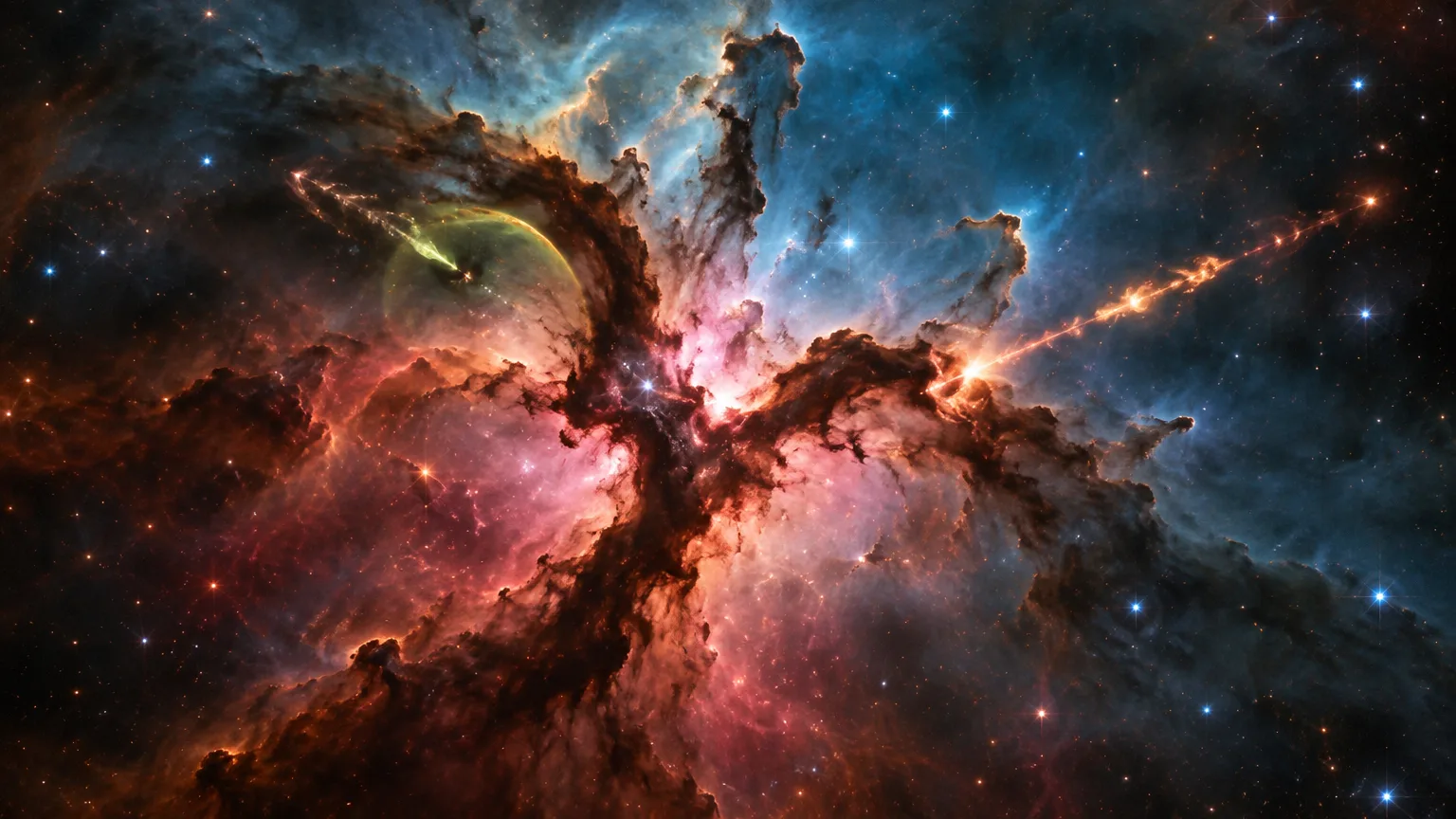
A cloud of gas and dust about 5,000 light-years from Earth offers an unusual opportunity to observe changes in a star-forming region over decades. The Hubble Space Telescope observed the Trifid Nebula in 1997 and photographed part of it again in 2026. In an article published on April 20, 2026, NASA presented the new image to mark the 36th anniversary of the observatory’s launch, commemorated on April 24. The comparison makes it possible to examine visible changes in jets from young stars and in the material around them.
The Trifid is also known as Messier 20 or M20. Hubble, a space observatory operated in cooperation by NASA and the European Space Agency (ESA), collects light at different wavelengths. The recent image was taken with its Wide Field Camera 3; the 1997 image used the Wide Field and Planetary Camera 2. NASA notes that the current camera, installed during Servicing Mission 4, has a wider field of view and greater sensitivity. The comparison therefore benefits both from the 29-year interval and from the capabilities of the newer instrument.
A region where stars are born
Stars form in large clouds of gas and dust called molecular clouds. In these cold clouds, gas can gather in denser regions. Some clumps accumulate more material or collide with others; as their mass grows, the force of gravity also increases. When one collapses, friction heats the material and can give rise to a protostar, a star in formation.
Hubble’s image shows only part of the Trifid. NASA explains that several massive stars outside the field of view have shaped the region for at least 300,000 years. Their winds continue to inflate an enormous bubble, of which the close-up shows only a portion. By pushing and compressing gas and dust, these winds trigger new waves of star formation. At the same time, ultraviolet radiation from the massive stars strips electrons from nearby gas, which emits light, while the winds clear away dust and sculpt the cloud.
A jet tracked over decades
One of the highlighted features is Herbig-Haro 399, a plasma jet that forms part of the left “horn” of a gas-and-dust structure NASA has nicknamed the “cosmic sea lemon.” A young protostar embedded in the cloud has been periodically ejecting this plasma for centuries. By comparing the two Hubble observations, researchers can measure the speed of the flows and estimate how much energy the protostar injects into its surroundings. These measurements help researchers study how newly formed stars interact with the material around them.
NASA also points to signs of a counterjet: irregular orange and red lines that appear to descend along the back of the structure shaped like a “neck.” In the comparison, these features can be distinguished behind the cloud. The value of images separated by 29 years lies not only in showing what the region looks like, but also in making visible changes that allow researchers to investigate the motion and activity of young objects.
What other structures in the image may suggest
At the tip of a dark, triangular area to the right of the main structure is another young star. It appears as a faint red dot with a small jet. Above it, a green arc could be evidence that the intense ultraviolet light from nearby massive stars is eroding a circumstellar disk—the material surrounding a star. NASA presents this explanation as a possibility. The clearer area around the protostar, in turn, suggests that it may be close to completing its formation.
Elsewhere in the image, near the center, a wavy line seems to change position when the observations are compared. NASA proposes that it could be a jet ejected by another star in formation, deeply hidden in the dust. The wording is deliberately cautious: the apparent shift is the clue behind this interpretation. The densest regions of the cloud harbor protostars, but they are hidden in visible light.
The evolution of the stellar cloud
Ultraviolet radiation from the massive stars is slowly eroding the gas; NASA says many ridges and slopes of dark dust will remain for a few million years. Over millions of years, the nebula’s gas and dust will disperse, leaving the stars behind. The scene thus shows simultaneous processes: young stars ejecting material, massive stars altering their surroundings, and dense clouds where star formation may continue.
The comparison between 1997 and 2026 offers a perspective on these processes on a human timescale. This is not an instantaneous photograph of an unchanging cloud: by repeating the observation, Hubble makes it possible to examine changes and track structures such as jets. The new image and NASA’s explanation can be viewed in the Hubble team’s presentation of the Trifid Nebula.