

Key facts
- The Carina Nebula, which contains the region nicknamed the Cat’s Head, is about 7,500 light-years from Earth.
- ESA released the images on October 29, 2026; Hubble provides a visible-light view, while Webb observes in near- and mid-infrared.
- Hubble shows a dark pillar of dust and a gas edge consistent with illumination and ionization by ultraviolet radiation from nearby massive stars.
- Webb reveals stars and details of gas and dust; according to ESA/Hubble/Webb, a bright source to the right of the pillar is probably a baby star embedded in dust.
Related records
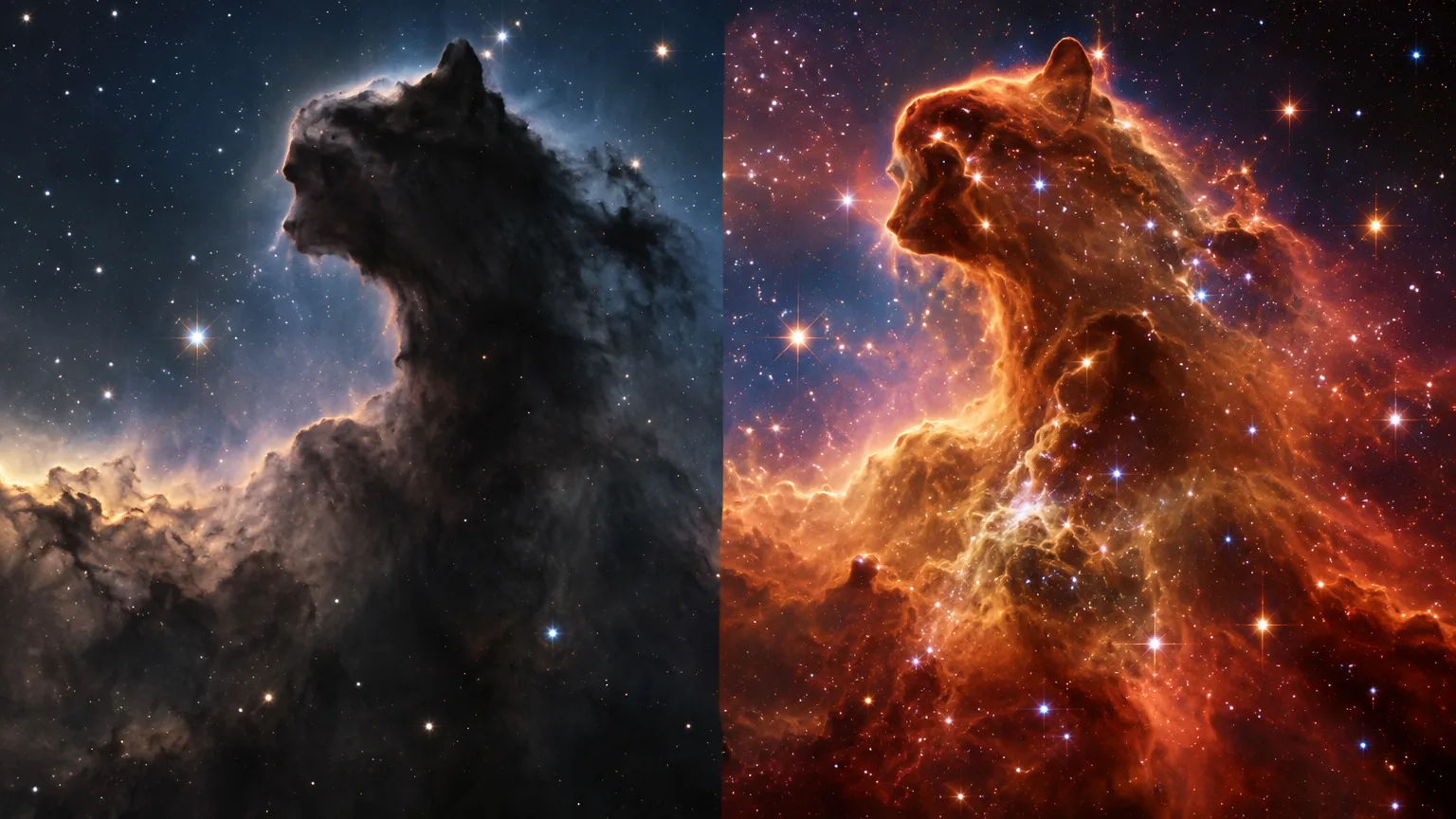
The Cat’s Head Nebula is a nickname for a small star-forming region observed within the vast Carina Nebula. This cloud of gas and dust lies about 7,500 light-years from Earth. The region’s shape resembles a seated cat seen from behind, with its head turned to the right and a bright spot that looks like an eye.
The European Space Agency (ESA) released the images on October 29, 2026. Hubble, a joint NASA and ESA mission, shows the region in visible light. The James Webb Space Telescope, an international collaboration between NASA, ESA, and the Canadian Space Agency, observes it in near- and mid-infrared. Each wavelength reveals different aspects of the same scene.
The dust pillar seen by Hubble
In Hubble’s visible-light image, the Cat’s Head appears as an elongated, dark pillar of dust surrounded by diffuse material. The reddish spot that looks like an eye could mark a young star partially embedded in the dust.
A yellowish edge runs along part of the filament. Its appearance is consistent with gas illuminated and ionized by ultraviolet radiation from nearby massive stars, a process that could promote photoevaporation of the material. Hubble’s filters capture light emitted by oxygen, hydrogen, and sulfur, as well as starlight scattered by dust.
What Webb’s infrared view reveals
In near-infrared light, the filament becomes more transparent and its surface shows more detail. Webb reveals a concentration of stars; some remain surrounded by varying amounts of dust. Faint background galaxies also appear. To the left of the pillar, delicate strands and clouds of gas and dust are exposed to radiation from nearby massive stars.
In mid-infrared light, emission from warm dust and carbon-bearing molecules traces intricate structures within the nebula. Variations in color and brightness are associated with changes in local conditions and composition. Small clumps and filaments to the left of the pillar stand out in this view.
A bright source appears to the right of the pillar, yellow in the mid-infrared image, against reddish emission from the surrounding material. According to the ESA/Hubble/Webb description, it is probably a baby star embedded in dust. A narrow filament seems to cross the source, but the image alone cannot establish whether the two are physically related.
A shape sculpted by its stellar environment
The Cat’s Head’s shape has probably been sculpted over time by intense ultraviolet radiation and winds from massive stars in Carina. This activity erodes the surrounding gas and dust, while the denser material in the pillar resists erosion for now.
ESA describes the region as a temporary scene that will eventually disperse as stars form and evolve. Hubble’s and Webb’s complementary images reveal different components of this star-forming region: from the dust pillar in visible light to stars and structures seen in infrared.
Sources: ESA, ESA/Hubble/Webb, and NASA.