

Key facts
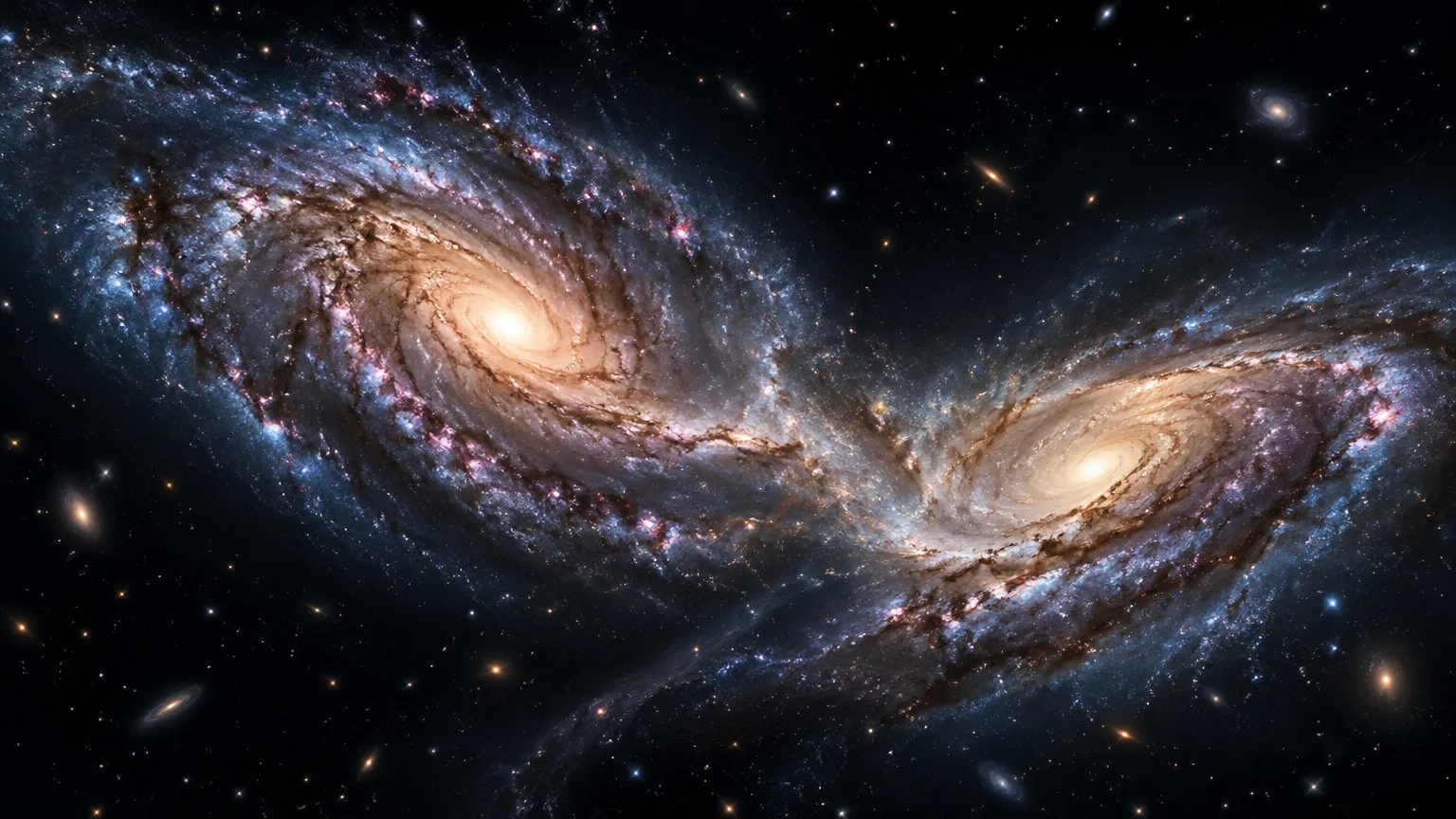
- NASA Science states that galaxy assembly is still occurring today.
- The source notes many examples of galaxies colliding and merging to form new galaxies.
- NASA Science says Andromeda is moving toward the Milky Way for a possible future collision.
Related records
Galaxies are not only a subject of the remote universe or a fixed category in astronomy atlases. According to NASA Science’s overview of galaxies over time, their assembly continues today. The source says that many examples are seen of galaxies colliding and merging to form new galaxies. This provides an essential framework for reading any development in the field: a galaxy may be part of a history of transformation, interaction and assembly.
This article deliberately limits itself to what the supplied evidence supports. It adds no specific timelines, masses, distances, detailed physical mechanisms or firm predictions that do not appear in those sources. Caution matters because a general explanation of galactic mergers cannot by itself determine what every encounter will be like or turn a possibility into a certain outcome.
An ongoing process
NASA Science’s wording is clear: the process of galaxy assembly is still occurring today. The same source illustrates this with many cases in which galaxies collide and merge to form new ones. Mergers therefore should not be presented only as episodes from an early phase that has ended; in NASA’s explanation, they are also phenomena that can be recognized in the present-day universe.
The word assembly contains the source’s central idea. In this context, it describes a history in which galaxies can interact, collide and merge. The available text does not say that all galaxies follow one path or that every interaction produces an identical result. What it supports is narrower: there are many examples of collisions and mergers, and these processes take part in forming new galaxies.
Andromeda and the Milky Way as a nearby example
NASA uses our local neighborhood in space to make that explanation concrete. It says that the Andromeda galaxy is moving toward the Milky Way for a possible future collision. Mentioning these two names makes a dynamic that might otherwise seem abstract tangible: galactic interaction is also present in the nearby cosmic setting identified by the source.
The word “possible” is decisive. The supplied evidence does not allow the collision to be described as inevitable, does not set a date, and does not detail its consequences. Nor does it support an exact sequence of events. The reliable point is the one NASA Science states: Andromeda is moving toward the Milky Way in the context of a possible future collision.
What NASA Science contributes for readers
NASA Science provides Spanish-language material about the universe, including galaxies, stars, black holes and exoplanets. Within that material, its page on galaxies over time provides the basis for this overview. The organization cited here serves an informational role: it offers the public an accessible explanation of galactic assembly and examples of collisions and mergers.
The value of consulting that page is not to treat it as an answer to every question about galaxies. It is to distinguish carefully between a point well established in the available material—that assembly continues and mergers are observed—and questions that would require further studies, observations or sources. That distinction prevents overstating the reach of a public-facing source.
How to read galaxy headlines
A headline about an ancient galaxy, a merger or a collision may be striking, but it should be placed in this framework. That galaxies collide and merge is consistent with NASA Science’s explanation; however, every specific announcement needs its own evidence. The general fact does not automatically validate a number, interpretation or conclusion attached to a particular case.
- Supported fact: galaxy assembly continues today.
- Supported fact: many examples are observed of galaxies colliding and merging to form new galaxies.
- Example cited by the source: Andromeda is moving toward the Milky Way for a possible future collision.
- Not established by the available evidence: dates, parameters or detailed outcomes of that possible encounter.
A conclusion matched to the evidence
The picture that emerges is not one of motionless galaxies, but of assembly that continues. Collisions and mergers are an explicit part of NASA Science’s explanation, and the Andromeda–Milky Way case brings that framework into the local neighborhood of space. At the same time, the language of possibility requires uncertainty to remain where the source retains it.
The strongest conclusion is therefore deliberately precise: galaxies can change through collisions and mergers, that process is still observed, and Andromeda is moving toward the Milky Way in a possible future-collision scenario. Beyond that, the supplied evidence is insufficient to establish further details.