

Key facts
- NASA published the story on September 24, 2026.
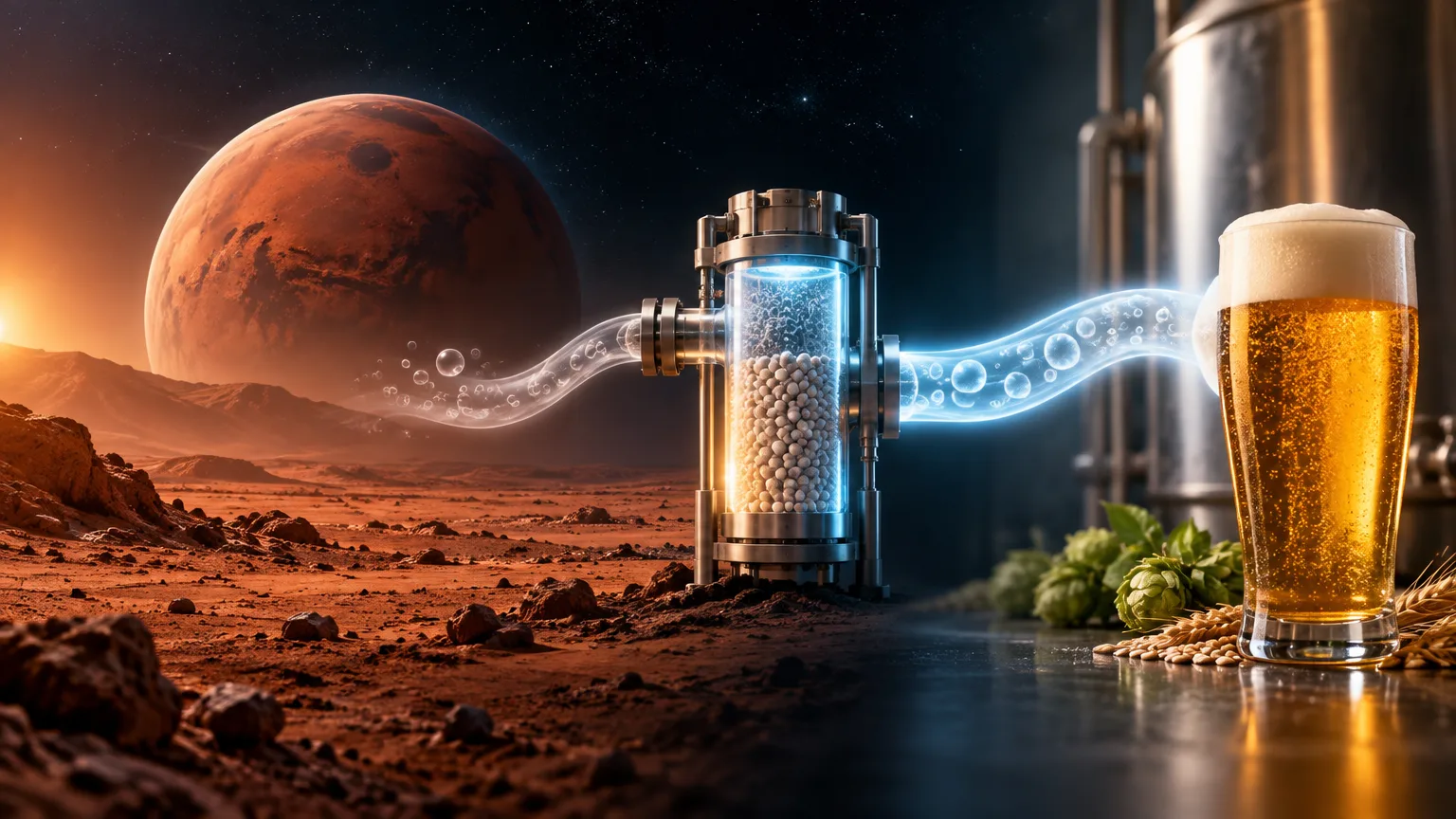
- The Earthly Labs carbon-capture unit purifies carbon dioxide from beer brewing for reuse in carbonation.
- Fermentation produces alcohol and carbon dioxide; the latter is also needed to carbonate the beverage.
- Pioneer developed the technology based on its founder’s work for Johnson Space Center related to separating and combining elements on Mars.
- NASA presents CO₂ recycling as a possible way to help reduce costs, but the available information does not quantify savings or system performance.
Related records
The news: space-related technology finds a brewing use
On September 24, 2026, NASA published a story about repurposing Mars-related technology for beer production. The development it describes is not a machine taken to Mars by a mission. Rather, technology associated with work for future space applications has been adapted to a process on Earth: recovering carbon dioxide generated at a brewery and purifying it so it can be used to carbonate beer.
The story identifies the system as an Earthly Labs carbon-capture unit. According to NASA’s description, a brewer adjusts the equipment, which purifies CO₂ from the brewing process for use in carbonation. NASA presents this as an example of technology transfer: knowledge or technology associated with space exploration being put to use in a non-space application.
Why carbon dioxide matters in beer
The connection to brewing involves two stages of the same process. Fermentation produces alcohol and carbon dioxide. Later, that gas is needed to carbonate the beverage, adding the bubbles associated with beer. Instead of leaving the CO₂ produced during fermentation unused, the system described aims to capture, purify and route it to that later stage.
This basic explanation helps clarify what the equipment does—and does not do. It does not make beer or generate the gas: it collects carbon dioxide produced during fermentation and purifies it for later use. The available description identifies carbonation as the destination for the recovered gas, but gives no figure for how much CO₂ can be processed or what share of a brewery’s needs the equipment could supply.
The connection to Mars and Johnson Space Center
NASA traces the technology’s origins to Pioneer and work its founder did for Johnson Space Center, a NASA facility. The available information says Pioneer developed the technology based on that work, which was intended to enable the separation and combination of elements on Mars. That link explains the planetary-exploration connection; it does not mean the brewery unit has been tested on Mars or is part of a Mars mission.
The adaptation illustrates how a capability developed to address a problem in one setting can inspire a different application. Here, the account connects the tasks of separating and combining elements with capturing and purifying a gas for reuse. The supplied information does not detail the original design, technical components or the steps between the Johnson Space Center work and Earthly Labs’ equipment, so the development path cannot be reconstructed in detail.
Potential benefits and what remains unknown
NASA presents recycling fermentation CO₂ as a way to help breweries reduce costs. The stated logic is that gas produced during brewing can be recovered and used for carbonation. However, the available information includes no savings figures, comparative data, test results, performance details or count of breweries using the system. Cost reduction should therefore be understood as a benefit described by NASA, not as an outcome quantified in the information provided here.
The description also says the technology has spread and is finding new applications, but it does not identify those other applications or explain the scale of its adoption. Nor does it provide enough information to assess capture capacity, installation requirements or performance across different kinds of breweries. These gaps do not negate the principle described, but they limit broader conclusions about its impact.
Technology transfer, not a Mars mission
The case shows a specific link between space technology and an everyday activity: equipment derived from work related to separating and combining elements for Mars is used to recover CO₂ from beer fermentation and direct it to carbonation. NASA’s story, published September 24, 2026, presents the adaptation as an Earth-based application of technology associated with space exploration. What remains unclear from the available evidence is its scale, its economic results and the reach of its other uses.