

Key facts
- The NASA/NSSDC metric fact sheet consulted on November 17, 2026, and updated on November 13, lists Earth’s distance as 149.6 million kilometers and Neptune’s as 4,515.0 million kilometers.
- At a scale of 1 AU = 10 cm, Neptune is about 301.8 cm from the Sun; all eight positions are measured from the Sun, not by adding the distances between planets.
- With Earth represented by a 1 cm circle, the ratio of the diameters listed in the fact sheet gives about 11.2 cm for Jupiter and 3.9 cm for Neptune.
- NASA describes Phobos as heavily cratered and Deimos as smoother in appearance because loose material tends to fill its craters.
- The activity using modeling clay, a soft ball, and drops from 5, 10, and 15 cm is an original educational proposal; it does not reproduce the conditions of hypervelocity impacts.
Related records
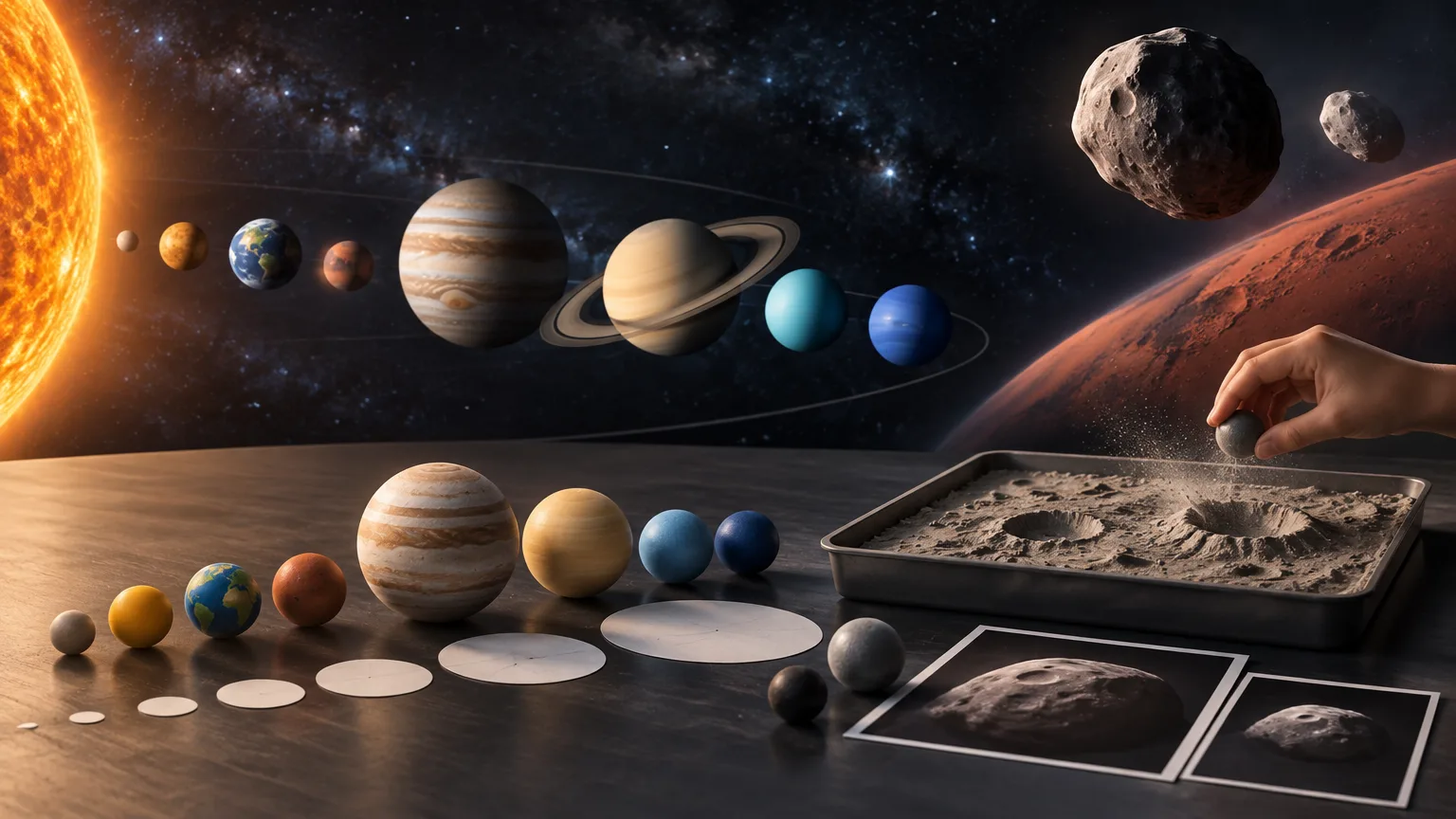
The distances between the planets and their sizes differ so greatly that a small model cannot represent them together using a single scale. Separating these two ideas helps make clearer models and opens a conversation about what they show—and what they leave out. These four activities, intended as a guide for ages 8 to 16, combine measurement, experimentation, and image reading. The suggested ages and durations are adjustable recommendations, not the results of an educational evaluation.
Before you begin: what each model represents
The NASA/NSSDC metric fact sheet includes, among other data, the planets’ distances from the Sun and their diameters. The fact sheet consulted on November 17, 2026, indicates that it was updated on November 13, 2026. For the activities below, the distance data and calculations have been rounded to two decimal places where appropriate. These are reference values for making models, not current planetary positions.
NASA/JPL explains that a scale model can represent sizes, distances, or both, but combining distances and diameters at a single scale requires a lot of space: JPL’s activity notes that at least half a mile would be needed. For that reason, the first two activity sheets use different scales.
Overview of the four activity sheets
| Activity | Suggested age | Suggested duration | Main idea |
|---|---|---|---|
| 1. Distances from the Sun | Ages 8–16 | 30–45 minutes | Place the eight planets using a scale of 10 cm per astronomical unit. |
| 2. Diameters on paper | Ages 8–16 | 30–45 minutes | Compare circles drawn using a separate size scale. |
| 3. Impact marks | Ages 8–16 | 30–40 minutes | Observe and measure marks in modeling clay after dropping a soft ball from different heights. |
| 4. Phobos and Deimos in images | Ages 10–16 | 30–45 minutes | Distinguish visible features from interpretations when comparing two Martian moons. |
1. A walk through the distances in the solar system
Objective
Visualize how the average distance of each planet from the Sun increases and practice conversions using a simple scale.
Materials
- Tape measure or long ruler.
- Eight cards or markers for the planets and one for the Sun.
- Calculator, optional.
- A hallway, yard, or other clear route about 3.1 meters long.
Scale and data
The NASA/NSSDC fact sheet gives distances from the Sun in millions of kilometers. To convert them to astronomical units (AU), divide each distance by 149.6 million kilometers, the approximate value of one AU used here. Then multiply by 10 centimeters: in this model, 1 AU equals 10 cm.
| Planet | Distance from the Sun in fact sheet (million km) | Approximate distance (AU) | Marker position from the Sun |
|---|---|---|---|
| Mercury | 57.9 | 0.39 | 3.9 cm |
| Venus | 108.2 | 0.72 | 7.2 cm |
| Earth | 149.6 | 1.00 | 10.0 cm |
| Mars | 228.0 | 1.52 | 15.2 cm |
| Jupiter | 778.5 | 5.20 | 52.0 cm |
| Saturn | 1,432.0 | 9.57 | 95.7 cm |
| Uranus | 2,867.0 | 19.16 | 191.6 cm |
| Neptune | 4,515.0 | 30.18 | 301.8 cm |
Steps
- Mark the Sun at one end of the route.
- Starting from that point, measure and place each planet at the indicated distance. All measurements start at the Sun; do not add the distances to one another.
- Read the sequence aloud and observe how much space remains between the inner planets and the more distant ones.
- If the available space is shorter, choose and record a new scale for the entire model. For example, with 1 AU = 5 cm, divide all the positions in the table by two. Do not mix scales within the same model.
Questions and assessment
- Which planet is closest to the Sun in the model? Which is farthest away?
- What change in scale would make it possible to do the activity in a shorter space?
- Check one position using the calculation: distance in AU × 10 cm.
Model limitation: the markers show reference average distances, not a real alignment of the planets or their positions today. The planets do not need to touch: the distances in this fact sheet do not represent their diameters.
2. Planetary diameters in paper circles
Objective
Compare the listed diameters of the eight planets using a size scale different from the distance scale.
Materials
- Paper, pencils, and a ruler.
- Compass, circular templates, or a tool for drawing circles.
- Scissors, if you plan to cut out the shapes.
Scale and data
Use a diameter of 1 cm for Earth as the reference. For each planet, divide the diameter listed in the NASA/NSSDC metric fact sheet by Earth’s diameter, 12,756 km, and multiply the result by 1 cm. The values in the table are rounded to the nearest tenth of a millimeter.
| Planet | Listed diameter (km) | Diameter in the model |
|---|---|---|
| Mercury | 4,879 | 3.8 mm |
| Venus | 12,104 | 9.5 mm |
| Earth | 12,756 | 10.0 mm |
| Mars | 6,792 | 5.3 mm |
| Jupiter | 142,984 | 112.1 mm |
| Saturn | 120,536 | 94.5 mm |
| Uranus | 51,118 | 40.1 mm |
| Neptune | 49,528 | 38.8 mm |
Steps
- First draw the 1 cm-diameter circle for Earth.
- Calculate the others using the formula: planet diameter ÷ 12,756 × 1 cm.
- Draw the circles and write each planet’s name next to it. For the smallest ones, you can carefully cut circles out of paper or draw a line and label its measurement.
- Arrange them from smallest to largest and compare the results.
Questions and assessment
- Which planet has the largest circle? Which has the smallest?
- Why can’t you use this same scale to place Neptune at its distance from the Sun in a small classroom?
- Check that every calculation uses Earth’s diameter as the reference, not its radius.
Model limitation: these circles compare diameters; they do not represent the distances between the planets or how they look from Earth. The diameters are used as they appear together in the NASA/NSSDC metric table, without mixing them with radii from other tables.
3. Modeling-clay craters: a classroom experiment
Objective
Observe what happens to a surface when a ball is dropped from different heights, and practice describing and measuring. The Lunar and Planetary Institute (LPI) presents an educational activity about craters that proposes investigating the relationship between the height from which a marble is dropped and the crater’s size, as well as measuring the ejected material. The activity below uses different materials and is an original educational adaptation, not a protocol validated by NASA or LPI.
Materials
- A large tray and modeling clay.
- A large, soft ball, such as a foam ball, that can be dropped with adult control.
- Ruler, paper, and pencil.
Steps
- Spread the modeling clay evenly in the tray and place it on a stable surface.
- With adult supervision, hold the ball 5 cm above the surface and drop it vertically. Do not throw it.
- Observe the mark and write down what you see. If possible, measure the mark’s diameter in two directions and record both measurements.
- Repeat the activity at 10 cm and 15 cm. Keep the ball, tray, and thickness of the modeling clay the same; smooth the surface before each drop.
- If there is time, do three repetitions at each height. Record every result instead of choosing only the one that seems clearest.
Questions and assessment
- What differences do you observe between the marks made from different heights?
- Do repetitions from the same height produce identical marks?
- Which conditions did you keep constant, and which did you change?
- Compare the records and describe the observed pattern without assuming in advance that each increase in height will produce a particular change.
Safety and limitations: an adult directs the drops; work over a tray, and drop the ball—never throw it or aim it at anyone. No powders, marbles, sharp objects, or weights are needed. The slow-moving ball and modeling clay do not reproduce the speeds or conditions of a hypervelocity impact on a planet: the activity is for observing marks in a material, not for fully reproducing how planetary craters form.
4. Reading images of Phobos and Deimos
Objective
Practice observing images and distinguish what is visible from explanations of how a feature may have formed. Phobos and Deimos are the two moons of Mars. NASA describes Phobos as heavily cratered and notes that Deimos appears smoother because loose material tends to fill its craters.
Materials
- NASA images of Phobos and Deimos, such as those obtained by the HiRISE camera on the Mars Reconnaissance Orbiter mission.
- A screen or printed copies; pencil and observation sheet.
Steps
- Choose one image of each moon and identify the body’s name alongside each image and, when available, the mission or camera that obtained it.
- Before reading explanations, write down three features you can point to directly—for example, craters, light or dark areas, or differences in texture.
- In a separate column, note what interpretation is proposed by the information accompanying the images. Distinguish these explanations from your direct observations.
- Compare the two lists. Consider whether framing, lighting, orientation, or level of detail could affect what appears most visible.
Questions and assessment
- Which features appear in both images, and which seem different?
- Which statements describe something visible, and which explain why it might look that way?
- What additional information would you need to compare the surfaces with greater confidence?
Model limitation: an image shows a surface from a particular orientation and under specific lighting conditions. If the images have different scales or levels of detail, it is not appropriate to attribute every visual difference to the moons’ surfaces.
Observation sheet to copy
This template can be copied onto a whiteboard or paper for any of the activities. No downloadable file is required.
| Activity / object | What I did or what I observe | Measurement or data | What I conclude from it | What the model cannot establish |
|---|---|---|---|---|
Adaptation and safety
For younger ages, you can provide the positions and measurements already calculated and focus the activity on ordering, measuring, and describing. For older groups, you can ask them to redo the conversions and justify the rounding. These are suggested adaptations, not the results of educational trials.
The activities can be done indoors or in a clear yard, with adult supervision and a safe route. This collection does not include observing the Sun: do not look directly at the Sun or point cameras, binoculars, or telescopes at it. NASA warns that observing the Sun through these devices without a specialized solar filter secured in front of the optics can cause serious eye injuries.
The NASA/NSSDC planetary fact sheet cautions that its values do not constitute a single set of official figures and may change with research. It also explains that orbital distances are expressed as approximate values. Therefore, the figures and scales in these activities are rounded educational references; the markers do not show where the planets are on a particular date.
The four activities offer different ways to explore the solar system without confusing size with distance: measure a scale, check proportions, compare marks, and read images carefully. The goal is for each model or record to also prompt questions about what it represents and what its limitations are.
Sources and resources for preparing the activity sheets
CosmoInsider presents these activity sheets independently; they do not reproduce the University of Hawaii collection or imply endorsement by NASA, JPL, LPI, or ASP. When using images, retain the identification and credit provided with each image and check its reuse conditions. Date consulted: November 17, 2026.
To prepare the session, consult: NASA/JPL: scale solar system models; NASA/NSSDC metric planetary fact sheet; definition notes; LPI impact-crater activity; NASA: Mars and its moons; NASA solar-viewing safety; LPI educational resources directory.