

Key facts
- NASA describes black holes as enormous concentrations of matter compressed into a very small space.
- ESO obtained conclusive evidence for a black hole at the Milky Way’s centre after 15 years of regular monitoring.
- Webb produced evidence supporting an interpretation of GLIMPSE-17775 as a supermassive black hole surrounded by partially ionized gas.
- NASA said Roman was scheduled to launch by 2027, potentially as early as fall 2026.
Related records
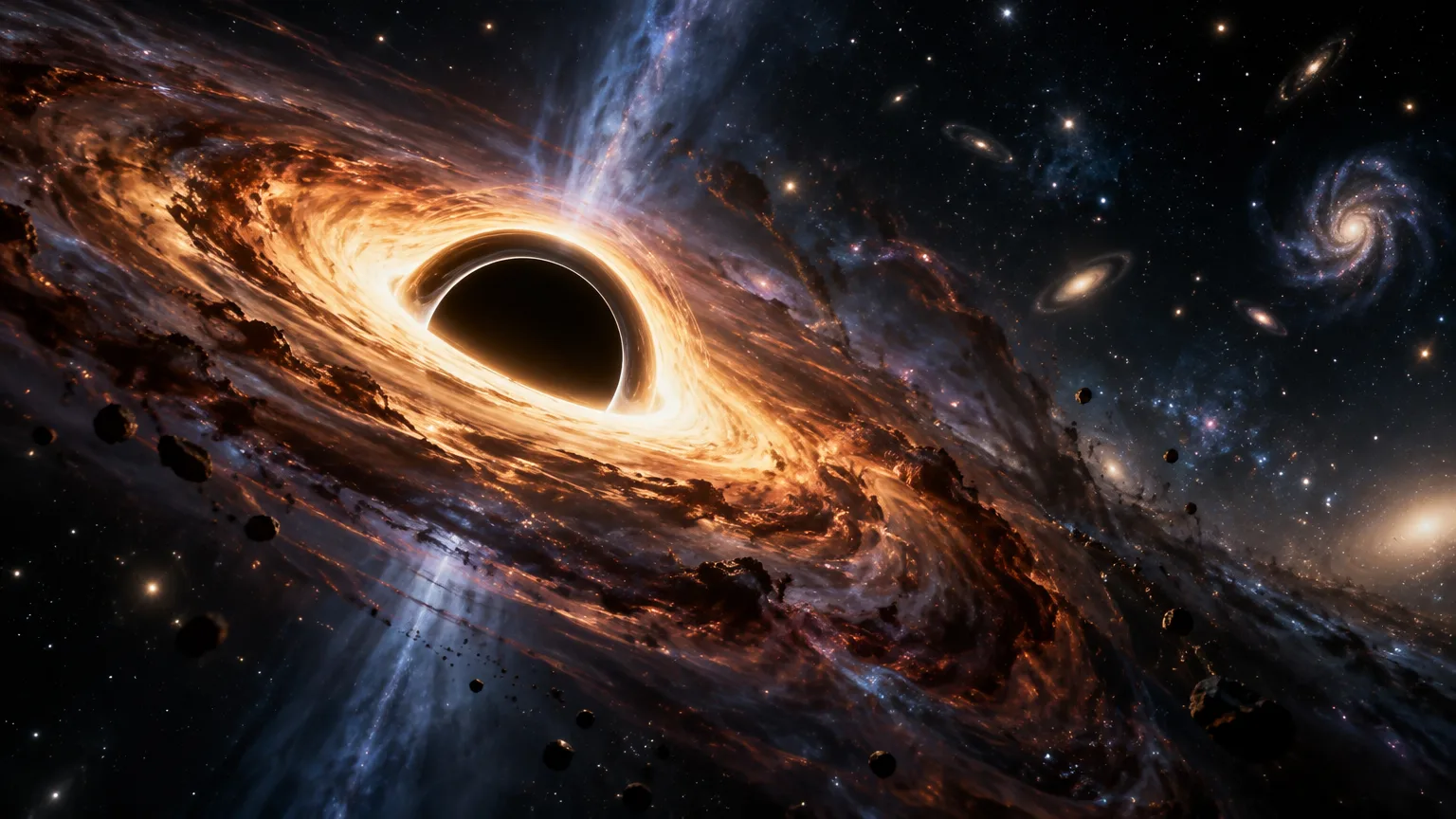
Black holes hold a singular place in astronomy because they are not “holes” in the everyday sense. According to NASA Science, they are enormous concentrations of matter compressed into a very small space. Their density is so extreme that the region associated with their boundary is called the event horizon. This definition helps distinguish the physical object from popular images of an empty void that indiscriminately swallows everything around it.
Studying them requires gathering clues from their surroundings: gas, dust, stars, radiation and orbital motion. Advances therefore do not come from one kind of telescope or answer one question alone. Observations of the Milky Way’s centre, discoveries of very distant objects and monitoring of energetic episodes belong to a shared effort to understand how black holes relate to stars and galaxies.
What a black hole is, and why its surroundings matter
NASA’s description stresses two features: a great deal of matter and very little space. The event horizon is the name for the surface or boundary associated with that extreme concentration. Since a black hole is not studied in isolation, the material around it is crucial. Gas and dust can reveal processes that would not be visible by looking only at the central object.
This reliance on the environment also explains why scientific reports describe apparently different phenomena: cyclical X-ray outbursts, interaction with massive stars, or systems in which gas and dust affect black-hole growth. These are neither interchangeable lines of evidence nor necessarily measurements of the same thing; they are complementary observational routes.
The Milky Way’s centre: evidence built over years
The European Southern Observatory says astronomers long suspected a black hole at the centre of our galaxy. Certainty did not arise from a single observation: after 15 years of regular monitoring of the Galactic Centre with ESO telescopes at the La Silla Paranal Observatory, scientists obtained conclusive evidence.
The case illustrates a core feature of the field: repeated measurement can matter as much as a striking signal. The Galactic Centre is a comparatively nearby astronomical laboratory for linking the black-hole hypothesis to sustained observations. The cited evidence confirms that central object’s existence, but it does not make every aspect of its behaviour settled.
Webb and objects in the early universe
NASA’s James Webb Space Telescope has extended the debate to remote epochs. One NASA release reports a black hole that formed before its galaxy. The precise scope of that statement should be read in the context of the underlying study: it raises a relationship between the formation of the black hole and its host galaxy that does not necessarily fit a simple sequence.
Another result concerns GLIMPSE-17775. After analysing its spectrum, the team found lines of evidence supporting an interpretation of a supermassive black hole enclosed in a dense cocoon of partially ionized gas. NASA calls this model a “black hole star.” The wording matters: it is an interpretation supported by multiple lines of evidence, not an identification that removes every alternative or uncertainty.
Feeding, feedback and galactic balance
Observations also link black holes to the evolution of their surroundings. ESO describes a case in which a supermassive black hole was observed interacting with the material on which it feeds. The reported conclusion is that the most powerful black holes can slow their own growth by expelling the gas and dust that supply them. This would bring the system closer to a form of galactic balance.
This does not mean every black hole grows in the same way or every galaxy reaches the same balance. Rather, it indicates that growth can alter the stores of material available. Such feedback matters because it links a very compact scale—the black hole’s neighbourhood—to the distribution of gas and dust in a galaxy.
Future observations and the limits of current knowledge
NASA has also reported three black holes seen consuming massive stars in agency data. In that context, it says the Nancy Grace Roman Space Telescope was scheduled to launch by 2027, potentially as early as fall 2026. If it meets that schedule, Roman could find many more such events and provide another way to investigate how stars, galaxies and black holes formed and evolved.
Clear uncertainties remain. Not every proposal about distant objects has the same level of confirmation; GLIMPSE-17775 is presented as an interpretive model. Nor can Roman’s launch timetable be treated as certain from a forecast. What these sources firmly show is that black holes are investigated through observable effects, and that new measurements can alter explanations of how they grew alongside their galaxies.