

Key facts
- On 3 September 2026, ESA published a replay about the start of BepiColombo’s arrival at Mercury.
- Separation of the Mercury Transfer Module (MTM) was scheduled for 3 September; the available text does not explicitly confirm its outcome.
- BepiColombo is a joint ESA-JAXA mission with two scientific orbiters: ESA’s MPO and JAXA’s Mio.
- ESA’s 31 August briefing placed orbital insertion in November 2026 and separation of MPO and Mio in December; these were planned milestones.
Related records
Mercury is the planet closest to the Sun: a small, little-explored world. Reaching it and operating nearby pose challenges for a space mission, which is why BepiColombo’s progress matters both for exploring the planet and for understanding the Solar System’s history. The recent news is not a new scientific result about Mercury, but an operational milestone: on 3 September 2026, ESA released the replay of a broadcast about the mission’s arrival phase.
An operational milestone, not a scientific discovery
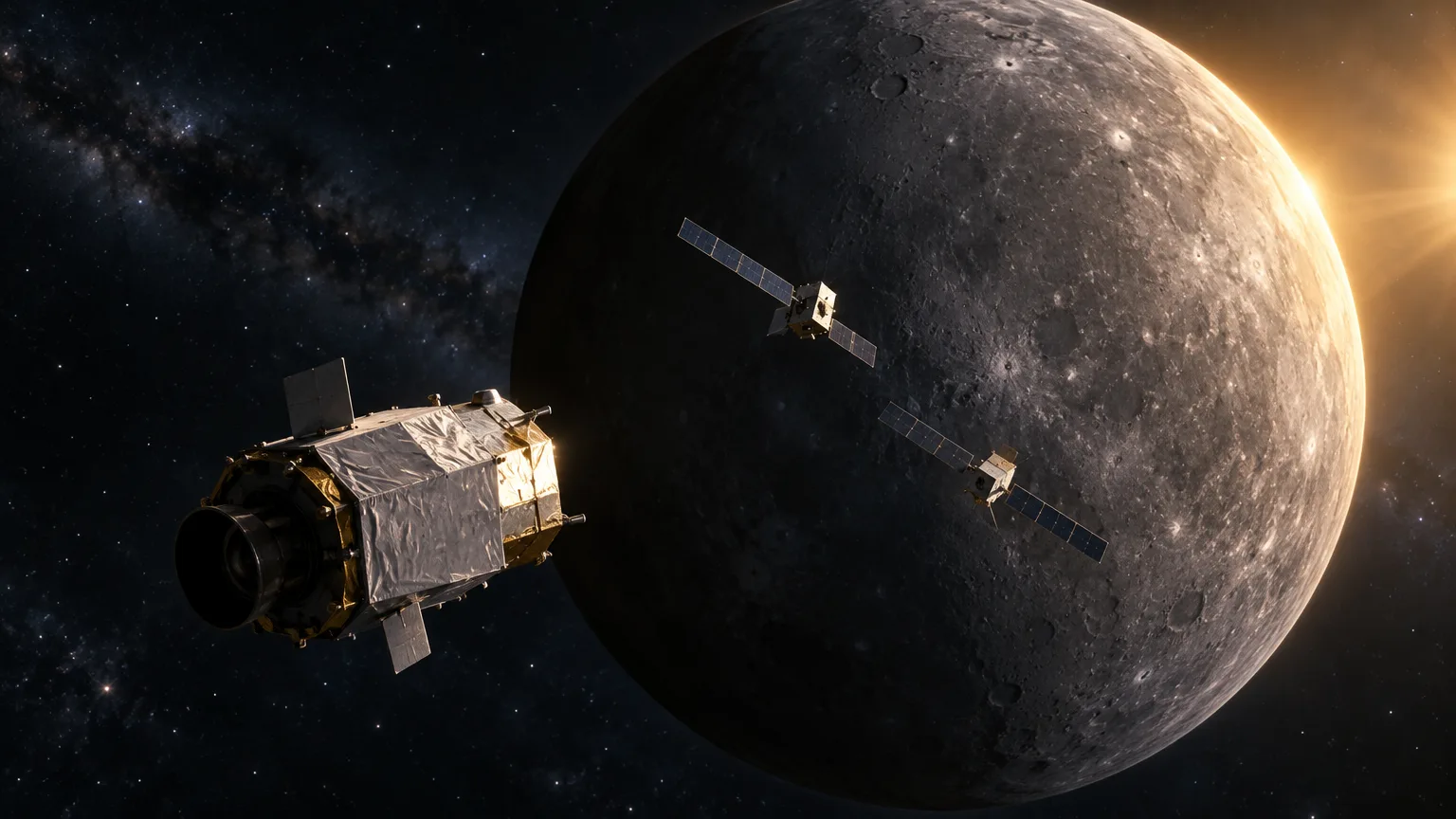
ESA’s replay was titled BepiColombo’s Mercury arrival begins and described separation of the Mercury Transfer Module (MTM) as the first critical step towards arrival. The MTM had travelled with the other spacecraft elements through the inner Solar System for eight years. The programme, broadcast from ESA’s European Space Operations Centre (ESOC) in Darmstadt, Germany, included planned views from mission control, expert analysis and the spacecraft’s first signal after separation.
It is important to distinguish the announcement and broadcast from an independent technical confirmation. ESA’s description identifies separation as the central event on 3 September and mentions a subsequent signal, but the available text does not detail the manoeuvre’s outcome or provide an explicit report on the spacecraft’s status. It is therefore fair to say that the agency marked that date as the beginning of the arrival phase and published the replay; operational details that the source does not explicitly confirm should not be treated as established here.
What BepiColombo is and who is involved
BepiColombo is a joint mission of ESA and JAXA, the Japanese space agency, and, according to ESA’s 31 August 2026 briefing, the first European-Japanese mission to Mercury. Its architecture includes two scientific orbiters: ESA’s Mercury Planetary Orbiter (MPO) and JAXA’s Mercury Magnetospheric Orbiter, called Mio. An orbiter is a spacecraft designed to remain around a celestial body and observe it from orbit.
The MTM has a different role: it is part of the configuration carrying the mission on its journey to Mercury. ESA describes its separation as the beginning of the arrival phase, but the supplied text does not specify all the module’s technical functions or the details of the manoeuvre. Nor does MTM separation mean that the two orbiters are already operating around the planet: ESA’s own schedule placed those stages later.
The announced timetable for reaching Mercury
In an online press briefing published on 31 August 2026, ESA said MTM separation was scheduled for 3 September and described it as a critical milestone. The agency also outlined the main steps that were to follow: insertion into Mercury orbit, planned for November 2026, and separation of the two scientific orbiters, planned for December of the same year. These are dates in an announced plan, not evidence that each manoeuvre has been completed.
The mission’s complexity is reflected in the fact that arrival is not a single event. The spacecraft has to pass through several stages before MPO and Mio can make observations from their respective orbits. In its August briefing, ESA called BepiColombo the most complex mission ever sent to Mercury and said that, once separated, the orbiters would be the second and third spacecraft to orbit the planet. The evidence provided is not detailed enough to describe every intermediate manoeuvre or its parameters.
Why study a planet so close to the Sun
Mercury is the world nearest to the Sun and, in ESA’s words, one of the least explored planets in the inner Solar System. The agency says that learning more about it could shed light on the history of the Solar System as a whole. That is the mission’s broad scientific motivation; it should not be confused with results already obtained by BepiColombo. Coverage of this milestone concerns operations and plans, not new measurements or scientific conclusions.
The wider context helps show the scale of Solar System exploration. NASA’s Solar System overview lists one star, eight planets, five dwarf planets, at least 290 moons, more than 1.3 million asteroids and about 3,900 comets. These are reference figures given on that page, not measurements made by BepiColombo. The inventory of known objects can change as new bodies are identified and catalogued; the cited page does not specify an update date for these figures in the available material.
What is known—and what still needs confirmation
The available information establishes what the agencies communicated: BepiColombo is an ESA-JAXA mission; MTM separation was scheduled for 3 September 2026; ESA published a replay of the broadcast about the milestone that day; and the agency’s earlier briefing placed orbital insertion in November and the separation of MPO and Mio in December 2026. Those later milestones were presented as part of the mission schedule.
By contrast, the supplied sources include no technical report confirming the specific outcome of the separation, no independent verification of the subsequent signal, and no new scientific data. They also do not establish that the November and December dates remained unchanged or that the manoeuvres were completed. The cautious conclusion is that, according to ESA’s plans and communications, the mission was entering a key stage of its approach to Mercury; success and subsequent steps require explicit confirmation.
Sources: ESA replay published 3 September 2026; ESA briefing of 31 August 2026; NASA Solar System overview.