Identity and discovery
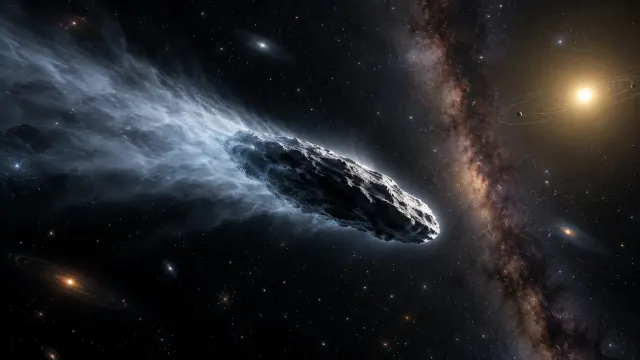
3I/ATLAS was reported on 1 July 2025 by the ATLAS telescope at Río Hurtado, Chile. The number 3 records its place among confirmed interstellar objects, following ʻOumuamua and 2I/Borisov; it does not imply that only three such visitors exist. Earlier observations recovered from archives extended the observing interval and helped astronomers determine its trajectory more reliably.
A passing visitor
Its hyperbolic orbit indicates that it is not part of the population of comets bound to the Sun. It arrived from the apparent direction of Sagittarius, but a direction on the sky does not identify a birth star. In this catalogue, the Milky Way supplies a galactic context, not an assignment to a known original planetary system. The approximately 670 million kilometres mentioned in the July 2025 announcement described its distance from the Sun at that time, not its current position or its distance from Earth.
The 2025 encounter
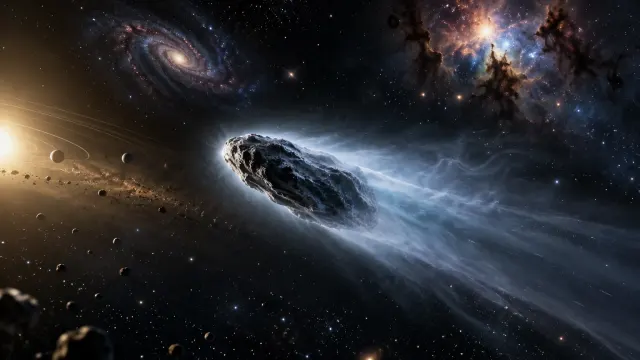
Perihelion took place in late October 2025, at approximately 1.4 astronomical units from the Sun, inside the orbit of Mars. The closest approach to Earth on 19 December 2025 remained around 1.8 astronomical units, or 270 million kilometres. These are circumstances of a past encounter: this profile does not provide live positions, and the comet posed no impact threat to Earth.
What observers measured
Unlike the initially inactive appearance of ʻOumuamua, 3I/ATLAS displayed a coma of gas and dust. ESA reports Webb detections of carbon dioxide, water and carbon monoxide. These results concern material observed in the coma, not a complete measurement of the interior. NASA placed the nucleus diameter between approximately 0.44 and 5.6 kilometres in information dated 20 August 2025. This is an observationally constrained interval affected by the bright coma, not an exact diameter whose endpoints should be averaged.
Importance and limitations
Ground-based telescopes and space observatories conducted a complementary campaign, including observations from missions elsewhere in the Solar System. This was remote investigation, not a spacecraft visit to the nucleus. The scientific value lies in comparing the activity and chemistry of an interstellar visitor with those of our own comets. Having observations does not remove every uncertainty: these sources establish neither a birth star, a resolved nucleus shape nor a demonstrated age for this individual object.