

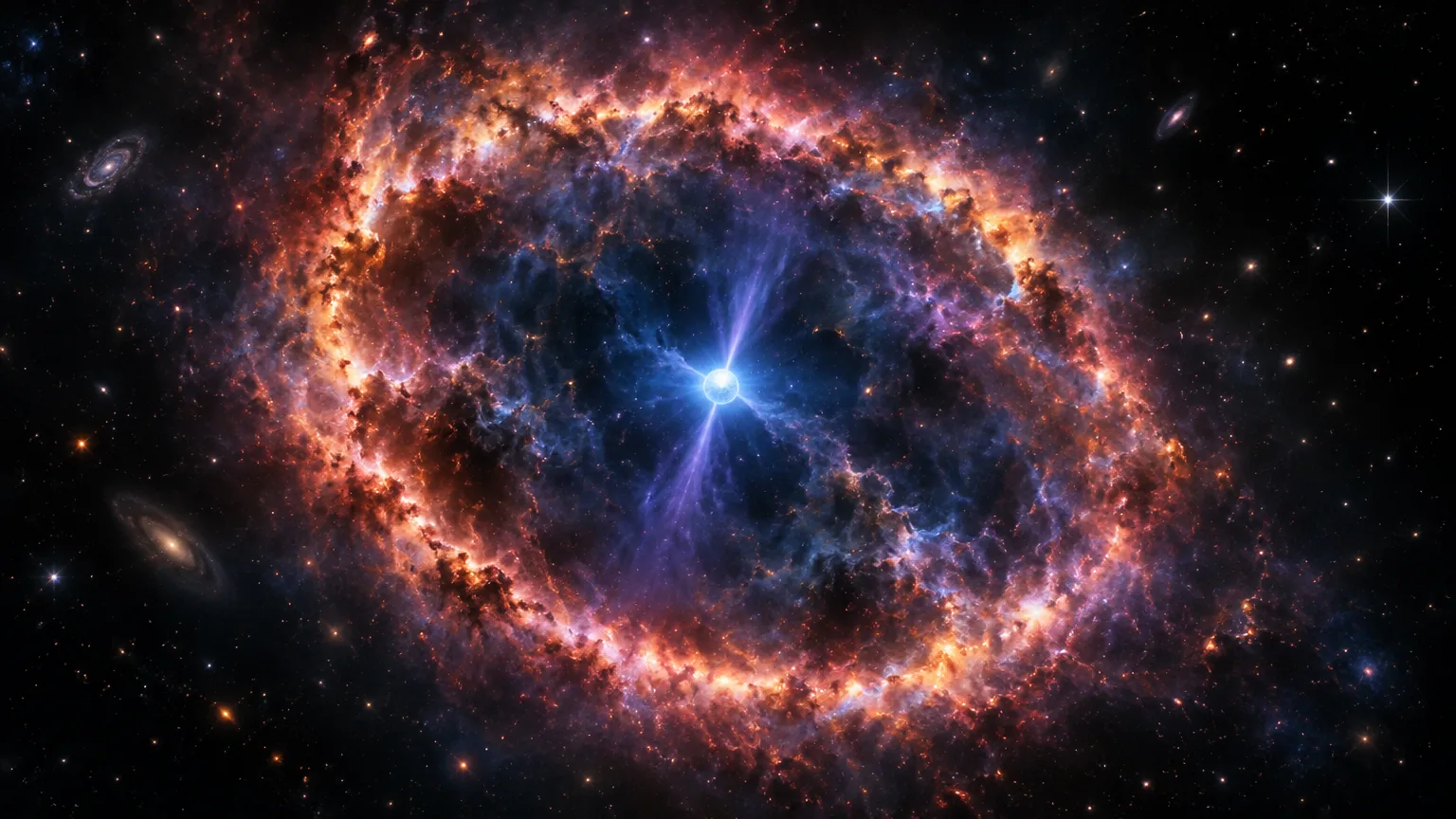
Key facts
- SN 1987A was a core-collapse supernova.
- NASA says the James Webb Space Telescope found the best evidence so far for neutron-star emission at the site of SN 1987A.
- JPL describes the result as indirect evidence for the possible presence of a neutron star.
- JPL cites the Crab Nebula as an example of an older remnant known to contain a neutron star.
Related records
Stars can reach the end of their evolution in different ways. In the case of SN 1987A, the explosion was a core-collapse supernova: according to NASA’s description, the star’s core compacted and left compact remains. The question that remains open is whether those remains include a neutron star, one of the compact objects that can be left behind at the site of this kind of explosion.
The development reported by NASA and the Jet Propulsion Laboratory (JPL) is not a new explosion, but observational evidence concerning the remnant of SN 1987A. NASA says Webb has found the best evidence so far for emission at the site where the supernova occurred. JPL characterizes it as indirect evidence for the possible presence of a neutron star. The information provided does not give the publication date of those pages, so it is not possible to specify when the finding was announced.
What it means to search a remnant for the object
A supernova remnant is material associated with a star after its explosion. In SN 1987A, astronomers study this environment to find out what was left at the center. Observed matter and emission can help investigate the scene, but they do not mean that the compact object can always be identified directly. In this case, the reported result concerns emission that offers clues to a neutron star, not an unequivocal observation of the object itself.
A neutron star is a relevant possibility because core-collapse supernovas can leave compact remains. NASA’s description explicitly connects this kind of explosion with compacted remains. But that general relationship does not automatically establish what is at the center of SN 1987A: the conclusion depends on what observations of this particular remnant show.
Webb’s contribution and the limits of the finding
Webb is the James Webb Space Telescope, and its role in this result is to observe emission from the central region of the remnant. NASA says the telescope’s observations provide the strongest evidence so far for emission associated with a neutron star at that location. JPL, which also reported the result, emphasizes that this is indirect evidence for the object’s presence. The distinction matters: a signal consistent with an interpretation can strengthen it without fully resolving every alternative.
The NASA and JPL pages say observations have been gathered over the past few years. The material provided does not specify dates, complementary instruments, detailed analyses, or measurements from those observations. It is therefore not possible here to give a precise timeline or attribute a particular measurement to the result. What can be said is that Webb adds a new observational piece to a search that is not limited to a single image.
Why comparisons with other stellar remnants matter
JPL notes that observations of much older remnants, such as the Crab Nebula, confirm that neutron stars are found in many supernova remnants. That comparison provides context: a neutron star among the remains of a stellar explosion is a known possibility, not an unprecedented idea. But the Crab example does not by itself prove that SN 1987A contains a neutron star. Each remnant must be assessed using its own observations.
Evidence from other objects therefore helps frame the questions astronomers ask about SN 1987A, while Webb’s observations provide information specific to this case. Treating those two levels as interchangeable would turn general context into direct proof that the sources do not claim.
What is known and what remains unresolved
The result supports the statement, attributed to NASA, that Webb detected the best evidence so far for emission from a neutron star at the site of SN 1987A. It can also be described, following JPL, as indirect evidence that such an object may be present. It does not justify saying that the identity of the central object has been definitively established, or explaining from the available information how other interpretations were ruled out.
The finding should therefore be understood as progress in studying the remnant, not as an indisputable resolution of the case. The central question—whether SN 1987A hosts a neutron star—still depends on how the observations are interpreted. Webb has strengthened that possibility with the strongest evidence reported so far, but caution is part of the result: evidence is not the same as conclusive confirmation.