

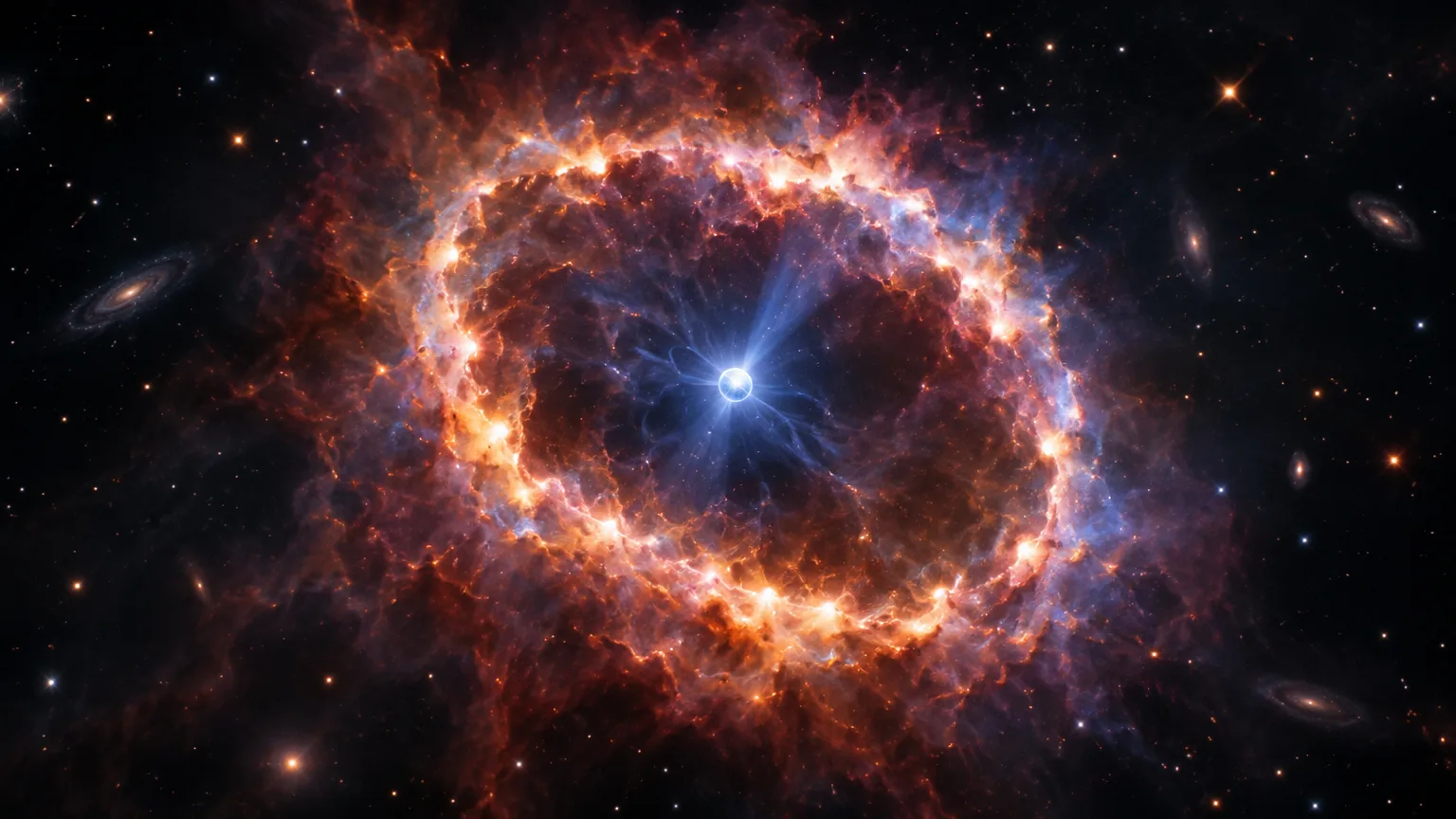
Key facts
- NASA says Webb found the best evidence yet for emission from a neutron star at the site of SN 1987A.
- SN 1987A is described as a core-collapse supernova.
- The evidence supports an interpretation; the available information does not confirm a direct, unambiguous detection of the neutron star.
- NASA cites older remnants such as the Crab Nebula as context, not as specific proof about SN 1987A.
Related records
Supernovas are stellar explosions that can leave compact remains and material thrown into space. NASA describes SN 1987A as a core-collapse supernova: the star’s core compacted during the event, leaving remnants at the site of the explosion. One possibility astronomers are investigating is that a neutron star is among those remains.
The new finding is that the James Webb Space Telescope detected a signal that, according to NASA, is the best evidence so far for emission from a neutron star at that location. The wording is intentionally cautious. The observation supports that interpretation, but the available information does not say that Webb directly imaged the object or that its presence has been confirmed beyond doubt.
What is known about SN 1987A
SN 1987A is the name of a supernova whose remnant remains under study. A supernova remnant is the material and structures left after the explosion; it is not the explosion itself. In a core-collapse supernova, the stellar core compresses during the event. The remains may include a compact object, but identifying exactly what is at SN 1987A’s centre is the question these observations are intended to clarify.
A neutron star is one possible kind of compact remnant left by an exploded star. In this case, the connection between that possibility and SN 1987A is not presented as a settled conclusion. It is the interpretation that best fits the signal NASA has reported so far. That distinction matters: the proposed name for the object should not be mistaken for a definitive identification.
What Webb contributes
The James Webb Space Telescope is the mission that made the observations highlighted in NASA’s announcement. According to the agency, the data show evidence of emission associated with a neutron star at the site of SN 1987A. The information available here does not specify which Webb instrument recorded the signal, the detailed properties measured, or which alternative analyses were ruled out. Adding those details would go beyond the evidence provided.
The phrase “best evidence yet” compares this result with evidence available earlier; it does not mean that absolute certainty has been reached. A signal can support an explanation without directly showing the object producing it. NASA describes the finding as evidence for emission from a neutron star, not as an unambiguous visual confirmation of the star itself. NASA’s account of Webb’s observations preserves that qualification.
Why caution matters
Establishing what remains at the centre of a supernova remnant helps researchers reconstruct the outcome of the explosion. But a claim about an object that has not been directly identified requires separating the observation from its interpretation: Webb recorded evidence of emission; attributing it to a neutron star is the explanation NASA emphasizes. The evidence supports that hypothesis, although the supplied information does not make it possible to fully assess other possible explanations or describe the uncertainty attached to each one.
NASA’s material also notes that observations of much older remnants, such as the Crab Nebula, confirm that neutron stars are found in many supernova remnants. This context makes the interpretation plausible in general, but it does not by itself prove that SN 1987A contains one. Each remnant must be assessed using its own observations.
What the finding allows us to conclude
The supported conclusion is specific: Webb has provided the strongest evidence reported so far for emission from a neutron star at the site of SN 1987A. The announcement does not establish that the object has been directly observed or that its nature is definitively settled. The information available also gives no publication date with which to specify when the result was released.
The advance is therefore an important observational clue, not the end of the investigation. If future observations or analyses confirm this interpretation, researchers will be able to say with greater confidence what compact object this supernova left behind. For now, the wording most faithful to the evidence is that Webb has strengthened the case for a neutron star in the SN 1987A remnant.