

Key facts
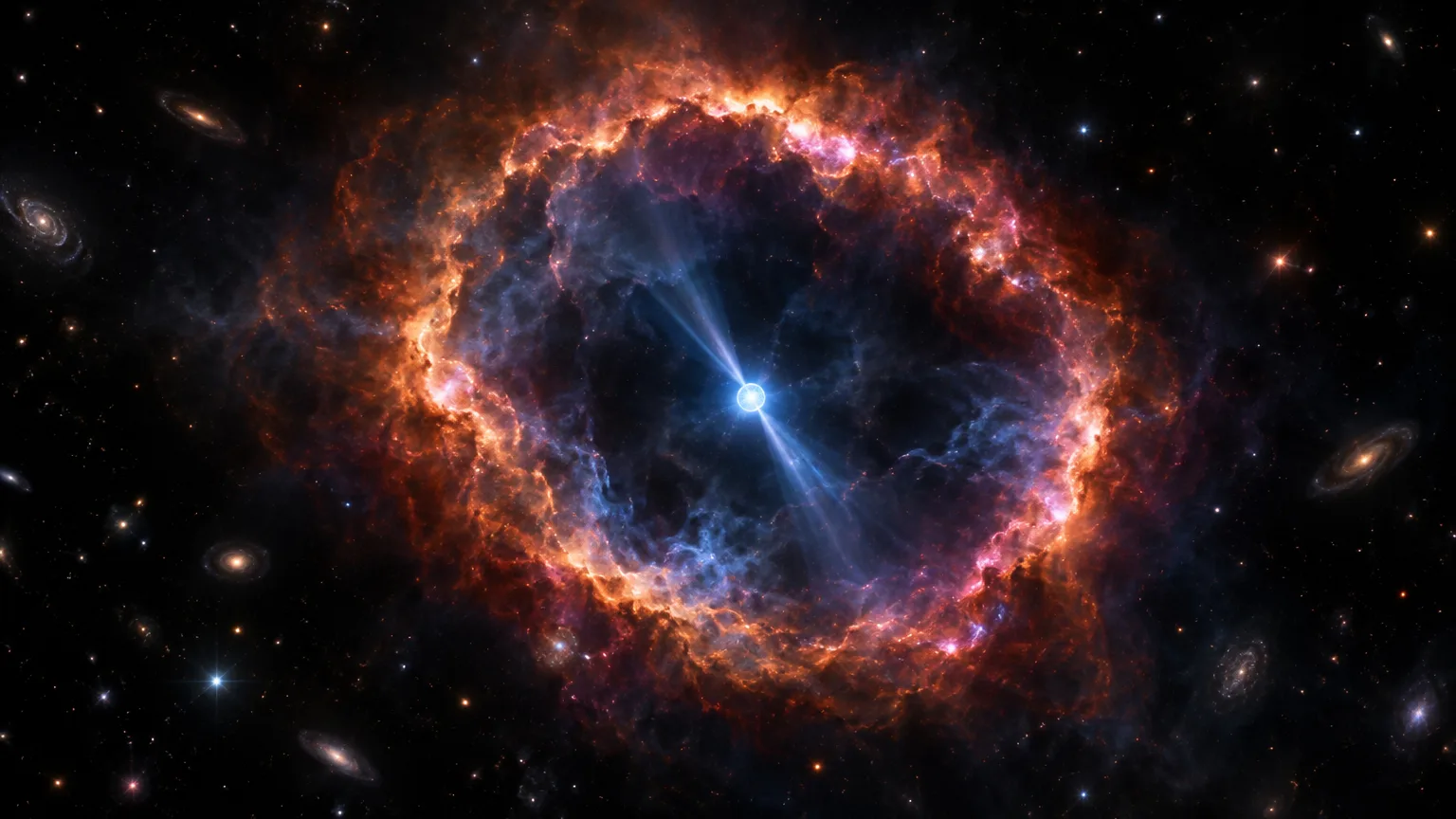
- NASA presents Webb’s observations as the best evidence to date for emission from a neutron star at the site of SN 1987A.
- SN 1987A was a core-collapse supernova; NASA describes the process as compression of the stellar core.
- JPL characterizes the evidence for a neutron star’s presence as indirect.
- JPL cites the Crab Nebula as an old remnant confirming that neutron stars are found in many remnants.
Related records
SN 1987A is a supernova whose explosion site has become a target in the search for what object may have remained at its center. NASA says observations from the James Webb Space Telescope provide the best evidence yet for emission from a neutron star at that location. The conclusion is significant, but it is important to distinguish the observation from its interpretation: the source describes evidence for emission associated with a neutron star, not an unambiguous direct image of the object.
What has been found and what it means
A supernova is a stellar explosion that leaves material expanding outward and, in some cases, a compact remnant. NASA identifies SN 1987A as a core-collapse supernova: the star’s core is compressed, and its remains can form a compact object. A neutron star is one possibility being investigated for the center of this remnant. In this case, Webb’s data point to emission consistent with that explanation.
Here, the term “remnant” refers to material that persists at the site of the explosion. Searching for a neutron star therefore does not mean the telescope has seen an intact star hidden among other stars. The aim is to identify signals associated with the compact object that may have remained after the explosion. The difference between detecting a signal and directly seeing its source is essential to understanding the scope of the result.
Why SN 1987A is an important clue
The work focuses on the site of a supernova described by NASA as having been observed relatively recently, and asks what happened to its central material after the collapse. In general, observations of a remnant let scientists study the aftermath of a stellar explosion; they do not reconstruct every stage as if it had been seen from inside. Looking for emission at the center is one way to assess whether a compact object is there and what explanation fits the data.
NASA places the result within a search for evidence of a neutron star’s presence. The Jet Propulsion Laboratory (JPL), which also reported the finding, characterizes the evidence as indirect and says indications have been sought over the past few years. That wording helps explain the phrase “best evidence yet”: it marks progress in the available body of clues, not necessarily a definitive resolution of every question about the center of SN 1987A.
What other remnants tell us
JPL adds that much older supernova remnants, such as the Crab Nebula, confirm that neutron stars are found in many remnants. This provides general context: the remains of an explosion can contain this kind of object. It does not, on its own, establish what is at SN 1987A. Each case must be assessed using its own observations, and the evidence cited for SN 1987A is still described as indirect.
The distinction matters because an analogy between remnants is not an automatic identification. The fact that neutron stars are present in many remnants makes it reasonable to look for one here, but the specific result depends on the signals studied at this site. The particular finding highlighted by NASA is evidence for emission that Webb detected at the explosion site; the Crab Nebula is a comparison, not an observation of SN 1987A.
What is known and what remains open
The result supports the interpretation that a neutron star could occupy the center of SN 1987A and provides a new piece of evidence for studying how a core-collapse supernova ends. However, the information in the supplied sources does not describe the signal or analysis in detail, or report independent confirmation. Nor does it allow the object’s properties—such as its mass, rotation, or physical state—to be specified here. Claims about those details would go beyond the available evidence.
This caution does not diminish the finding. In astronomy, indirect evidence can reduce uncertainty and favor an explanation without ruling out every alternative. NASA’s own presentation of the result—the best evidence to date for emission from a neutron star—sets its limits. The publication date is also absent from the information provided, so the announcement cannot be placed on a timeline here.
A promising signal, not an unlimited conclusion
In short, Webb has strengthened the hypothesis that a neutron star remains at the heart of the SN 1987A remnant. The finding links an observed emission to a fundamental question: what compact object survives a star’s collapse? Evidence from other remnants makes the search reasonable, but it cannot replace evidence specific to this case. On the claims supported by the cited sources, the result is strong, indirect evidence—not a complete account or an unqualified direct confirmation.
Sources: NASA Science and NASA Jet Propulsion Laboratory.