

Key facts
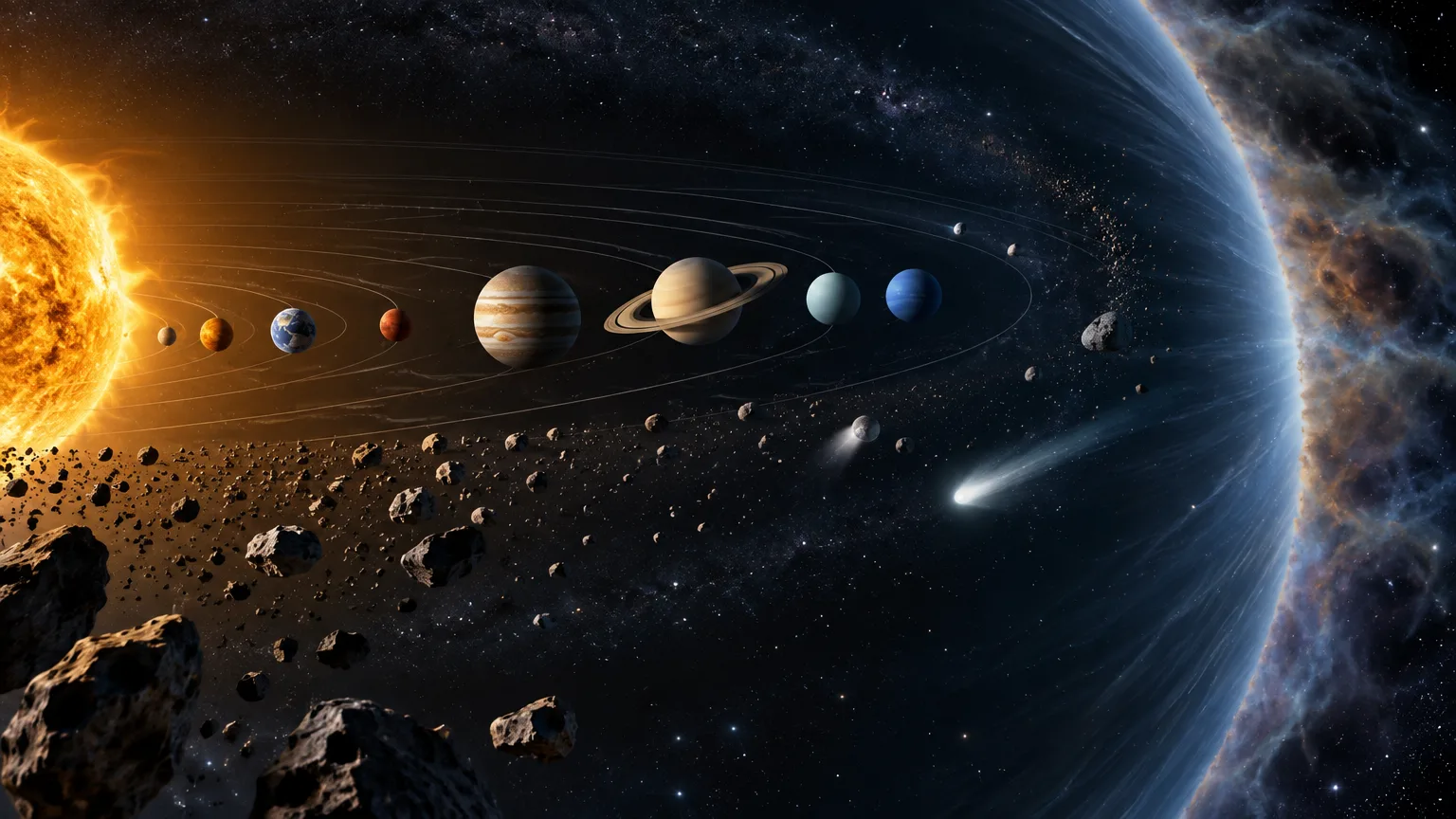
- NASA lists one star, eight planets, five dwarf planets, at least 290 moons, more than 1.3 million asteroids and about 3,900 comets.
- NASA describes the Oort Cloud as a shell of icy material extending from 5,000 to 100,000 astronomical units; some pieces may be as far as 1.6 light-years from the Sun.
- The heliosphere is a bubble created by the Sun that surrounds and protects the Solar System.
- IMAP launched on September 24, 2025, and will help investigate the heliosphere’s boundary.
Related records
The Solar System is often pictured as a star surrounded by eight planets. That picture is correct, but incomplete: the inventory presented by NASA also includes dwarf planets, moons, asteroids and comets. In the most distant regions, the story is no longer only a list of objects; it also matters how far the Sun’s influence reaches.
A system with many more members than planets
NASA’s description brings together one star, eight planets, five dwarf planets, at least 290 moons, more than 1.3 million asteroids and about 3,900 comets. The difference between “at least” and “about” matters: these figures are presented with different levels of precision, not as a definitive count of every body that may exist. In particular, the moon count is expressed as a minimum, while the comet count is approximate.
These categories show why the Solar System cannot be reduced to its large, familiar worlds. In NASA’s inventory, dwarf planets are listed separately from the eight planets; moons, asteroids and comets further expand the variety of bodies that make it up. The information available here does not detail the classification criteria or provide an item-by-item list, so the figures offer a general picture rather than a complete catalogue.
A distant edge populated by icy material
One of the most remote regions mentioned by NASA is the Oort Cloud. The agency describes it as a shell of icy pieces of space debris, some larger than mountains, orbiting the Sun. According to its facts page, this shell extends from 5,000 to 100,000 astronomical units; the same source places some of the pieces as far as 1.6 light-years from the Sun.
These distances convey the scale of the system, but they do not make the cloud a simple, sharply drawn boundary. The available description refers to an extended shell and gives a distance range; it does not explain how its shape was determined or provide a map of its objects here. Those figures are best understood as NASA’s published description, not as a uniformly precise observed edge.
The heliosphere: a bubble created by the Sun
Studying the Solar System means looking beyond its bodies to the environment generated by our star. NASA describes the heliosphere as a huge bubble created by the Sun that surrounds and protects the Solar System. Its boundary is a subject of scientific interest: understanding it better helps researchers investigate how far the bubble extends and how its outline is defined.
The heliosphere is not the same thing as the Oort Cloud. In the cited information, the first is presented as a Sun-created bubble and its boundary; the second as a distant shell of icy material orbiting the star. Both help explain that the Solar System has regions and scales of different kinds, but the available evidence does not specify their detailed spatial relationship.
IMAP and the study of the outskirts
The IMAP mission adds a concrete fact to this picture. According to NASA Science, it launched on September 24, 2025, and will help researchers better understand the heliosphere’s boundary. Its stated purpose is to study that frontier; no findings from its observations or date for future conclusions are provided here.
The launch must therefore be distinguished from what the mission aims to investigate. The fact that IMAP has launched does not mean it has already clarified the nature of the heliosphere’s boundary: the source describes its scientific objective, not confirmed findings. It also provides no further details here about the instruments, operating schedule or expected results.
What we know and what remains open
The inventory figures offer a useful way to gauge the Solar System, while the Oort Cloud and heliosphere extend the view into less familiar regions. However, this information does not state when the body count was updated, define the categories in more detail or provide quantitative uncertainties for the Oort Cloud’s distances. Nor does it report new measurements from IMAP.
The most cautious conclusion is that the Solar System is much more than its eight planets and that its boundaries remain a subject of research, rather than a single line described here with complete precision. NASA provides the broad figures and mission context; answers about the heliosphere’s boundary will depend on observations and analyses not yet detailed in these sources.