

Key facts
- The Bullet Cluster is formally known as 1E 0657-56 and formed through the collision of two large galaxy clusters.
- NASA places the system about 3.8 billion light-years from Earth.
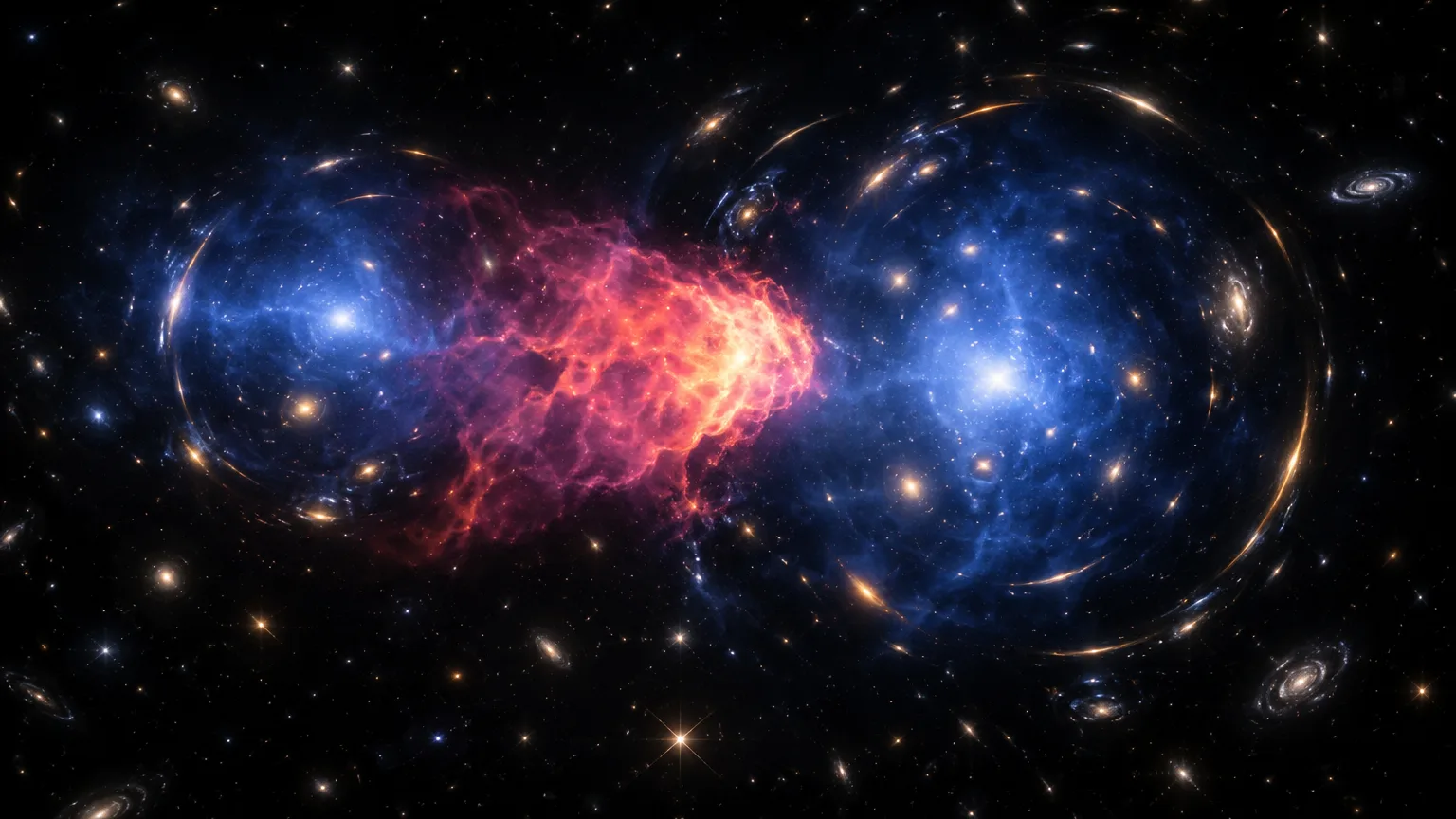
- Chandra detected the hot gas made of ordinary matter in X-rays; it is shown in pink in the composite image.
- Gravitational-lensing observations by Hubble and Magellan made it possible to reconstruct the mass distribution shown in blue.
- The inferred mass distribution differs from that of the hot gas; according to NASA, the blue regions represent most of the clusters’ mass.
- Researchers consider the reconstructed mass likely to be dark matter; this attribution is an interpretation of the observational evidence.
Related records
The Bullet Cluster, formally named 1E 0657-56, consists of two large galaxy clusters that collided. NASA places the system about 3.8 billion light-years from Earth and identifies it as one of the cases offering particularly strong observational evidence for dark matter. What matters is understanding what was observed and which part of the explanation remains an interpretation.
The composite image of the system compares two different tracers of matter. On one side, the Chandra X-ray Observatory detected the hot gas, which is made of ordinary matter and appears pink in the image. On the other, observations from the Hubble Space Telescope and the Magellan telescopes made it possible to reconstruct, through gravitational lensing, the distribution of mass shown in blue. NASA indicates that these blue regions contain most of the clusters’ mass and are distributed differently from the hot gas.
Two signals for studying a cosmic collision
In a cluster collision, galaxies and the material accompanying them form a system on an enormous scale. In the Bullet Cluster, the hot gas from one cluster interacted with the hot gas from the other during the collision. This interaction makes it possible to observe the gas with instruments sensitive to X-rays. In the image released by NASA, pink identifies this visible component.
The blue map is not a photograph of dark-matter particles. It is a reconstruction of the mass distribution based on how gravity alters the light arriving from galaxies located behind the cluster. The two image layers therefore do not record the same phenomenon: X-rays show the hot gas, while gravitational lensing makes it possible to estimate where the mass that bends light is concentrated.
How gravitational lensing works
The gravity of a concentration of mass bends spacetime and, with it, the path of light passing nearby. When light from a distant galaxy travels through a region with a cluster in front of it, it can be deflected before reaching the telescopes. Astronomers measure distortions in images of these background galaxies to map the cluster’s mass distribution.
The technique is not limited to the Bullet Cluster. NASA describes, for example, subtle signs of gravitational lensing in Abell 209: some background galaxies appear slightly curved. That case illustrates how observed shapes can help reconstruct the mass of a cluster. In 1E 0657-56, the reconstruction was based on gravitational-lensing observations by Hubble and Magellan.
The separation between gas and mass
The central point of the Bullet Cluster is the spatial difference between the two tracers. The hot gas visible in X-rays does not coincide with the blue distribution representing most of the inferred mass. In NASA’s explanation, the visible ordinary matter in the clusters is not enough to produce all the observed gravitational distortion; the distribution reconstructed through lensing shows where the additional gravity is located.
Researchers interpret the mass separated from the gas as probably dark matter. The wording matters: direct observation in the image consists of the gas detected in X-rays and the distortion of background light; attributing the reconstructed mass to dark matter is the explanation researchers consider most likely. According to NASA, dark matter does not appear to interact with light: it does not absorb, reflect, or emit it. Its presence is studied through its gravitational effects.
The wider context of the search
Dark matter is the name given to a form of matter whose composition has not yet been identified. Its importance is inferred from its gravitational effects in systems such as galaxies and clusters. The idea that there is more mass than is observed in the form of ordinary matter goes back to several observations: in 1933, Fritz Zwicky noted that galaxies in the Coma Cluster were moving too fast for the gravity attributable to the observed ordinary matter; in the 1970s, Vera Rubin found an analogous problem while studying stars at the edges of spiral galaxies.
The Bullet Cluster adds a particularly visual comparison: additional mass is not only inferred from the motion of objects, but the map of hot gas is also compared with the mass map obtained through lensing. NASA describes this case as one of the strongest direct pieces of evidence for dark matter. This description refers to the strength of the system’s observational evidence, not to the identification of a specific particle.
What the case allows us to conclude
The Bullet Cluster shows how different instruments and methods can be combined to study something that does not emit detectable light in the way described by NASA. Chandra locates hot gas through X-rays; Hubble and Magellan help reconstruct the mass distribution from gravitational distortions of background galaxies. The difference between the two distributions is the key feature supporting the interpretation that dark matter is present.
The scope of the conclusion must be stated precisely: researchers consider the mass shown in blue to be probably dark matter, while the composition of dark matter itself remains unidentified. NASA notes that the candidates proposed to explain dark matter have not yet been confirmed. The value of the Bullet Cluster lies in showing, through two comparable observations, how gravity reveals a mass distribution that does not follow that of the visible hot gas.