

Key facts
- NASA announced the development on October 8, 2026; L3Harris Technologies will design, assemble and integrate the Engineering Test Unit for NASA.
- NASA describes the unit as the final step before future production of flight hardware; Keski-Kuha called it the final preflight unit and the first delivery of an optical telescope to ESA.
- LISA, led by ESA with contributions from NASA, is scheduled to launch in the mid-2030s.
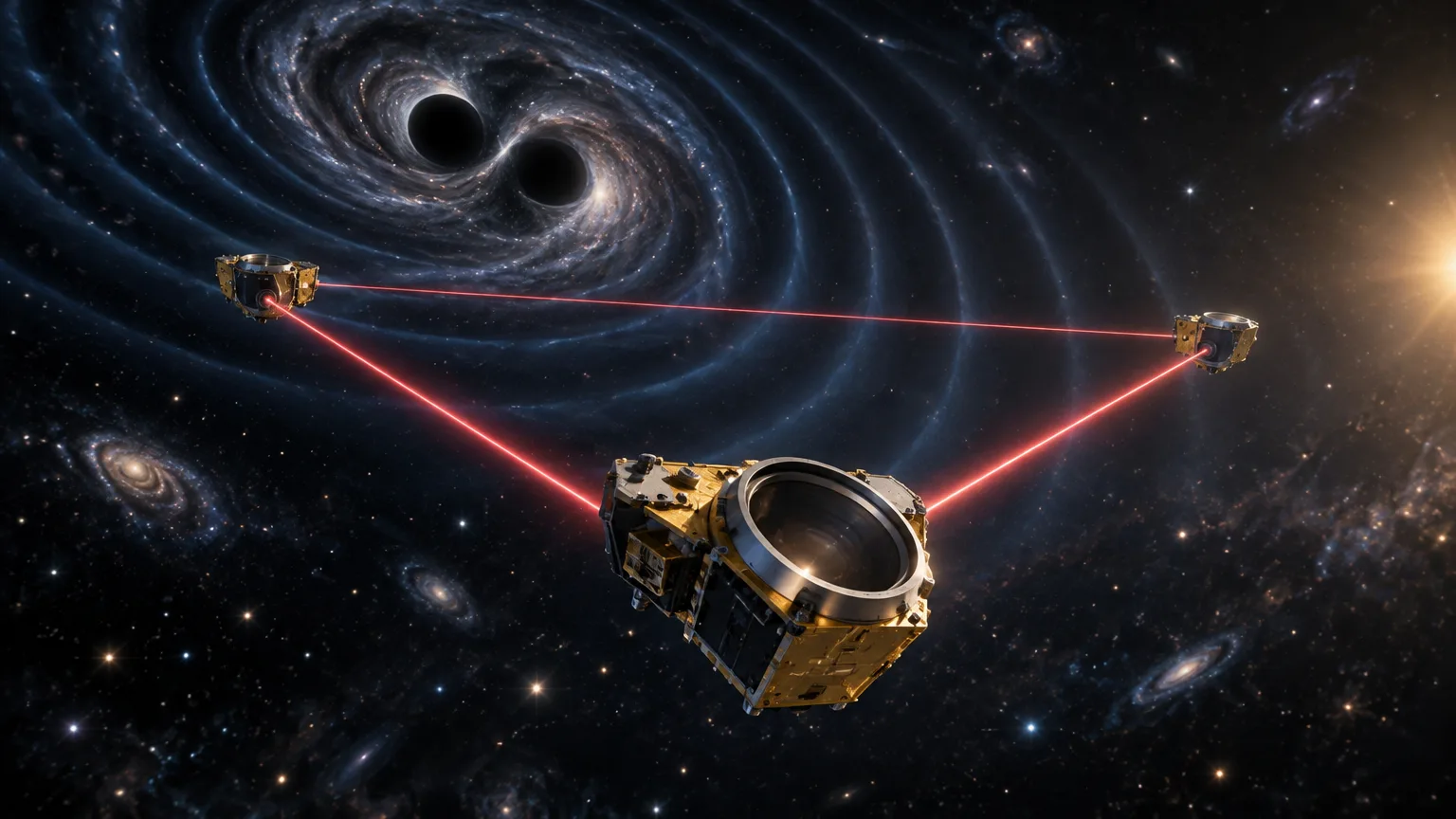
- The mission will deploy three satellites in a triangular formation with sides 2.5 million kilometers long; each spacecraft will carry two telescopes to transmit and receive infrared lasers.
- The telescopes will be made entirely of Zerodur, a glass ceramic that resists changes in shape across a wide range of temperatures.
- L3Harris delivered a prototype to NASA in 2024; NASA says it underwent rigorous testing. In June 2026, a structural model made of metal was delivered.
- LISA Pathfinder tested 46-millimeter cubic masses made of gold and platinum; NASA reported that it reduced non-gravitational forces to a level about 10^4 times lower than that of free-fall control technologies used on previous science missions.
Related records
On October 8, 2026, NASA announced a new step in the development of LISA, a space observatory designed to detect gravitational waves: ripples in spacetime associated with the motion of massive objects. L3Harris Technologies will design, assemble and integrate a test telescope called the Engineering Test Unit for NASA. The agency presents this unit as the final step before future production of hardware intended for flight.
The announcement concerns a component of the mission, not the start of its science operations. LISA is led by the European Space Agency (ESA), includes contributions from NASA and is scheduled to launch in the mid-2030s. NASA is providing the telescopes, other hardware components, and science and engineering support. The new unit is one stage in the development of that U.S. contribution.
A telescope for a three-spacecraft constellation
LISA will deploy three satellites in an orbit that follows Earth. Together, they will form a triangular configuration with sides 2.5 million kilometers long. Each spacecraft will carry two telescopes. These will simultaneously transmit and receive infrared laser beams between neighboring spacecraft, allowing the distances between them to be measured with great precision.
The sought-after signal consists of tiny changes in those distances as a gravitational wave passes. Ira Thorpe, NASA’s LISA project scientist at the Goddard Space Flight Center, explained that the variations would be smaller than the width of a helium atom. According to Thorpe, this sensitivity would allow the study of low-frequency gravitational waves that current ground-based facilities cannot detect.
The mission’s future science objectives include studying mergers of massive black holes and mapping compact binaries containing white dwarfs, neutron stars and stellar-mass black holes. Thorpe also noted that LISA might provide new insights into gravity. These are objectives and possibilities described for a future mission, not observational results from LISA.
Why the telescope is made of Zerodur
The mission’s telescopes will be made entirely of Zerodur, an amber-colored glass-ceramic material. NASA highlights that this material resists changes in shape over a wide temperature range, a useful property in high-precision applications. Keeping the telescope’s shape stable matters for a system that must measure very small changes in distance using laser signals.
The announcement builds on earlier development work. In 2024, L3Harris delivered a telescope prototype to NASA that served as an engineering development unit for the next step. Ritva Keski-Kuha, NASA Goddard’s LISA telescope program manager, said the team had subjected the prototype to rigorous testing and would incorporate what it learned from those tests into the new unit. In June 2026, the team also delivered a structural model of the telescope made of metal rather than glass.
Keski-Kuha described the Engineering Test Unit as the final preflight unit and the first delivery of an optical telescope to ESA. The new component therefore links design development and testing with a future stage of flight-hardware production. The announcement identifies L3Harris as responsible for designing, assembling and integrating this unit for NASA.
Experience from LISA Pathfinder
LISA’s development builds on an earlier technology demonstration: LISA Pathfinder, an ESA-led mission to test technologies needed for a future space-based gravitational-wave observatory. On that mission, two 46-millimeter cubic test masses made of a gold-platinum alloy floated inside the spacecraft. The goal was to isolate them from forces other than gravity.
A high-resolution laser interferometer measured the position of the masses and sent that information to the spacecraft’s free-fall and attitude control system. The system used microthrusters to keep the spacecraft in formation around the masses without disturbing them. According to NASA, LISA Pathfinder reduced the non-gravitational forces acting on them to a level about 10,000 times lower than that of the free-fall control technologies used on previous science missions.
This precedent helps explain LISA’s design: the spacecraft must measure the relative motion of test masses falling under the influence of gravity, while optical instruments precisely record changes between vehicles. Pathfinder tested technologies related to that principle; the telescope unit announced now concerns another part of development, NASA’s optical contribution.
What the announcement establishes—and what remains ahead
NASA’s announcement specifies the role of the Engineering Test Unit, the company responsible for designing, assembling and integrating it, and its position ahead of future flight-hardware production. It also explains why the telescope material is Zerodur and places the unit within a three-spacecraft mission led by ESA and planned for the mid-2030s.
The published information sets out the launch horizon in general terms and presents the new unit as a development step. The mission will have to turn the observatory’s design and components into systems capable of operating in space and measuring extremely small signals. NASA describes the future science goals as observing different sources of gravitational waves and potentially studying gravity; the announcement focuses on the hardware progress that will help prepare the mission.
More information about LISA at NASA and in the ESA mission fact sheet.