

Key facts
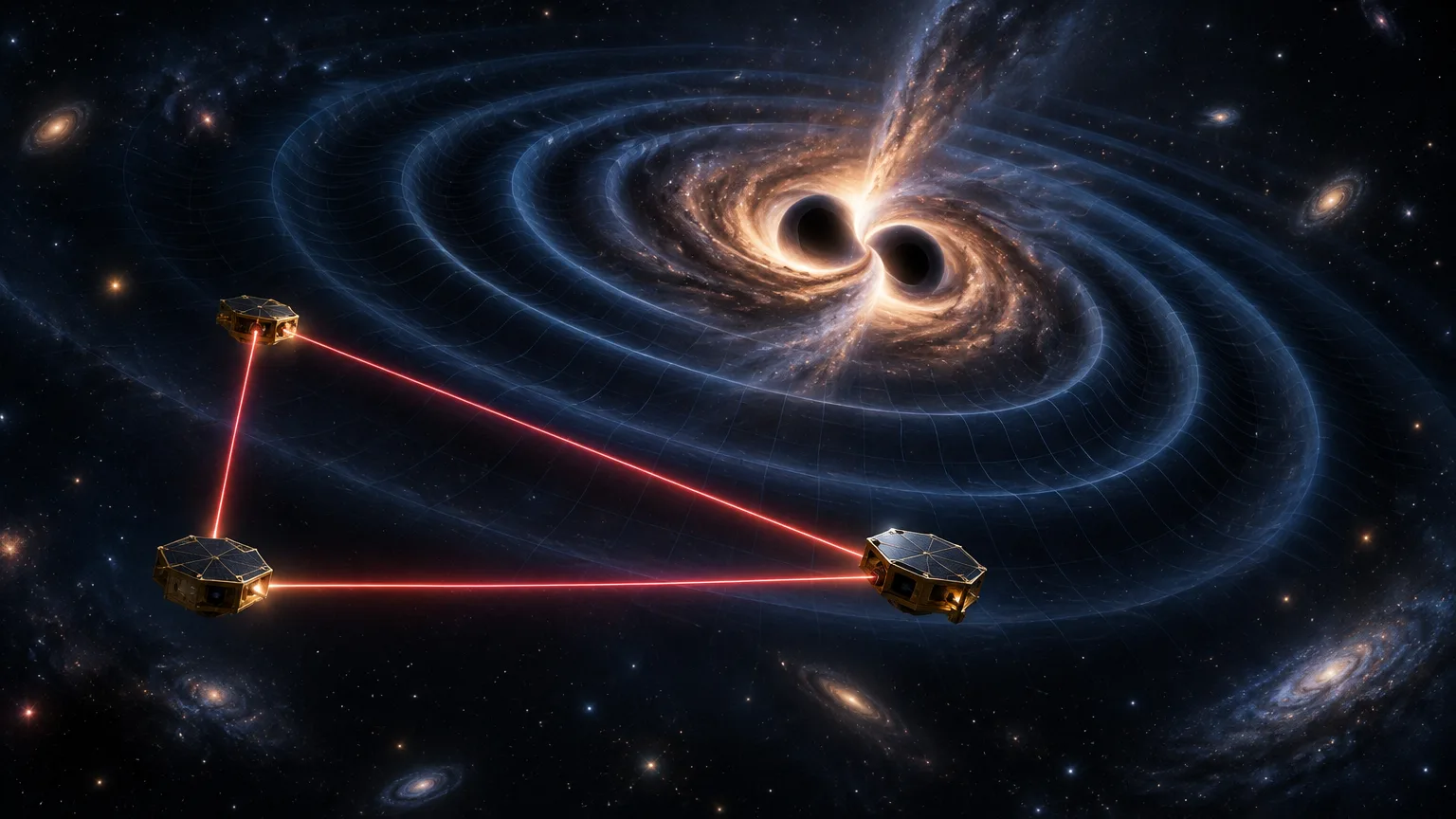
- ESA selected the LISA trio of satellites as the third L-class mission in its Science Programme.
- LISA is designed to search for gravitational waves from space; selection does not mean a launch has occurred or scientific results are available.
- NASA describes gravitational waves as spacetime disturbances produced by the motion of massive compact objects.
- ESO reports a joint observation of gravitational waves and light from the same event, associated with a neutron-star merger.
Related records
Astronomy often studies the universe through light, from visible radiation to other forms of electromagnetic radiation. Gravitational waves open another route. They are disturbances in spacetime associated with the motion of massive compact objects, including black holes, neutron stars and white dwarfs, according to NASA’s research description. They are not light waves, although they also travel through space.
This different perspective matters because it allows cosmic phenomena to be investigated through signals of different kinds. ESA describes gravitational waves as spacetime fluctuations, and NASA says they travel at the speed of light. Observing them offers another tool for studying the objects that produce them; it does not replace telescopes, but complements what they can reveal.
What is known about LISA’s next step
The institutional news highlighted by ESA is that the LISA trio of satellites was selected as the third L-class mission in its Science Programme. The same information distinguishes that selection from the Plato mission, which is dedicated to searching for exoplanets. This supports a statement about a selection decision, not a launch or scientific observations already made by LISA.
LISA is designed to detect gravitational waves from space. That aim sets it apart from observations made with ground-based facilities and presents the challenge of measuring extraordinarily small changes. ESA places LISA Pathfinder in the project’s history as a mission that paved the way for the search for these waves. The information available here does not specify LISA’s schedule, its full technical specifications or when it will begin producing results.
Why waves reveal another view of the universe
Gravitational waves and electromagnetic radiation are not two names for the same thing. Light comes from electromagnetic processes; gravitational waves are disturbances in spacetime. NASA notes that the motion of massive compact objects can produce them. Detecting them therefore makes it possible to study systems and cosmic processes from a perspective that observations of light alone do not provide.
The practical result is a multi-messenger form of astronomy. When a gravitational signal can be associated with light from the same phenomenon, researchers can compare complementary information. This combination does not mean that every detection will have an observable luminous counterpart: the evidence provided documents a joint observation in one case, not a rule that applies to every event.
A joint observation from Earth
The European Southern Observatory (ESO) describes a first observation of gravitational waves and light from the same event, achieved through international collaboration and a rapid response by ESO facilities and other observatories. The event was linked to a neutron-star merger. ESO’s information says that this kind of merger disperses elements such as gold and platinum into space.
The result matters not because light and waves are identical, but because both signals could be studied in connection with the same occurrence. The waves provide one kind of information and the light another. This example also helps explain why coordination and speed matter: observatories need to respond in order to search for electromagnetic emission associated with a gravitational signal.
What the evidence does not yet establish
The available sources describe LISA’s selection, the LISA Pathfinder precursor and the value of joint observations, but they do not provide a publication date for the selection news or enough information to reconstruct a mission schedule. They also do not give full satellite specifications or an estimate of how many signals LISA will detect. Those points remain open.
It is also important to distinguish the fact that ESA selected the mission from its future ability to make discoveries: the former is supported by the cited institutional information; the latter depends on stages and results not detailed here. Gravitational-wave research remains a developing field, and statements about a mission should match its documented status.
A new tool, not a replacement
LISA represents a step in a strategy to observe the universe through spacetime disturbances from space, while telescopes remain essential for capturing light. The neutron-star example shows the scientific value of bringing both kinds of signal together when they coincide. For now, the evidence supports explaining the mission’s selection and scientific context, but not predicting specific LISA results.
Sources: ESA on LISA’s selection; NASA on gravitational astrophysics; NASA Space Place on gravitational waves; ESO on visible detections of gravitational-wave sources; ESA on LISA Pathfinder.