

Key facts
- NASA’s Archives Program holds primary-source material relating to the history of NASA and its centres.
- NASA describes history resources including mission profiles, biographies, articles, e-books, chronologies and source documents.
- The NASA History Series includes more than 200 books and monographs, many available for download.
- The ESA Archives Portal lets users search documents and images through the SHIP database and browse digital collections.
- The available references describe research tools but do not document specific space-race missions or milestones.
Related records
Historical archives can be a starting point for studying the space race, but they are not, by themselves, a complete account of that period. The institutional resources described by NASA and the European Space Agency (ESA) have different purposes: some preserve an organisation’s historical records and material, while others provide access to collections and digital resources. Understanding that distinction helps researchers frame questions and avoid treating the existence of an archive as proof of a historical claim.
An archive is an entry point, not a conclusion
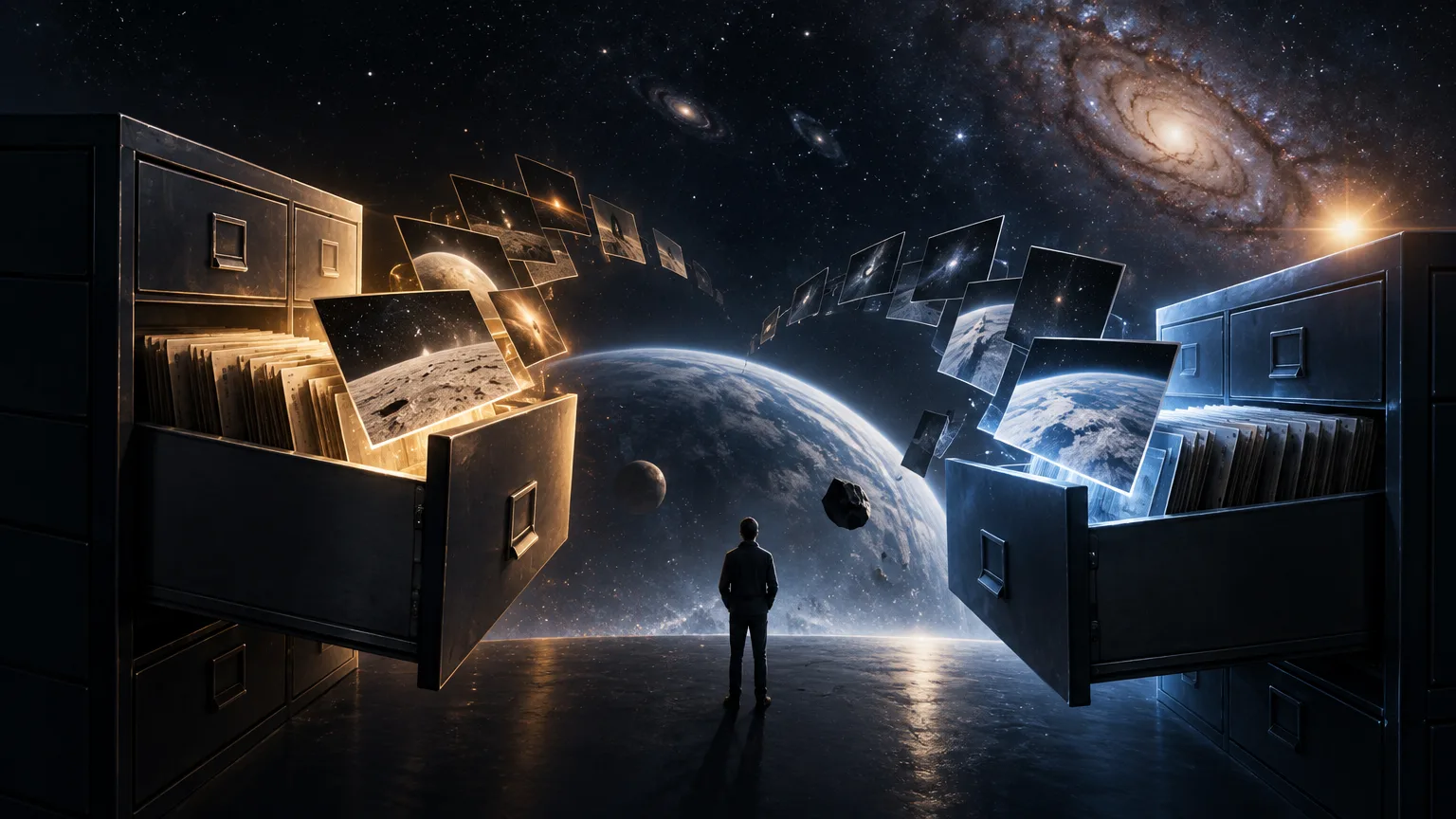
NASA’s Archives Program holds primary-source material relating to the history of NASA and its centres. The agency says its archives promote discovery and access across its records, organisational history and institutional memory. This makes them a relevant place to investigate how NASA recorded its own work. But the archive’s general description does not, on its own, establish what happened on a particular mission or prove a specific role in the space race.
NASA’s history site describes the preservation and access of historically and culturally significant records and material as part of this work. The material includes records created by NASA in areas such as engineering and science, as well as documents from centre archival collections. For a researcher, an important distinction is the one between a catalogue or collection overview and an original document that might support an interpretation. The evidence provided identifies the kinds of material held, but does not reproduce any particular document.
What NASA’s history resources offer
The “Explore NASA’s History” section brings together mission profiles, biographies, articles, e-books, chronologies and source documents. NASA says the collection spans the history of NACA and NASA. This variety can help researchers begin: a chronology provides an institution’s account of sequence; a biography or mission profile can point to people and programmes; and an original document can reveal a contemporary record, if one is available.
NASA also says its History Series includes more than 200 books and monographs on a wide range of aerospace-history subjects, many available to download. Its History Office prepares histories, chronologies, oral-history interviews and other resources for public access. These formats complement one another but are not interchangeable: a history publication is a synthesis, an interview preserves an individual’s testimony, and a chronology arranges events. To support a claim about the space race, a researcher would need to consult the specific material and assess its content, date, authorship and context. The descriptions available here do not allow that assessment.
The European route: ESA collections and digital resources
The ESA Archives Portal features a database called SHIP, where users can search for documents and images held in the agency’s archival collections. It also allows visitors to browse digital holdings by collection; each collection includes a description of its material and a link to the archive database. The portal also includes a timeline of space in Europe and digital resources.
This structure offers another research route: rather than starting with a general history, readers can locate a collection, review its description and follow the link to catalogued material. The European timeline may help with orientation, but the evidence supplied confirms only that it exists; it does not detail its entries or support a summary of its contents. No specific documents, images or dates are provided either. It would therefore be unjustified to present a sequence of events or claim that a particular item demonstrates a connection between space programmes.
How to assess what the resources can prove
A cautious method begins by distinguishing an institutional page describing a resource from the primary sources that resource may contain. Researchers should then identify who produced each document, when it was created, and why it was preserved or published. When using a chronology, relevant events should be checked against underlying documents where possible. An interview should be treated as a situated testimony, not automatic confirmation of every fact it mentions.
The NASA and ESA pages cited here are useful for finding material and understanding the broad scope of their archives. They are not a completed historical investigation. The information available does not specify which documents in either portal relate directly to the space race, which missions they cover, or how their collections relate to one another. For example, NASA’s research-archives page describes planetary-mission data and astrophysics archives; that description alone is not evidence about the history of the space race and should not stand in for relevant historical records.
What can be said—and what remains to be researched
The available information supports the statement that NASA maintains resources to preserve and provide access to records of its institutional history, and that ESA offers a portal for exploring archival documents, images and digital collections, alongside a European space timeline. It also shows that NASA’s history resources include several formats, from mission profiles and original documents to books and interviews. These facts describe research infrastructure, not specific events from the period.
The dates, participants, decisions and missions that a history of the space race would need to examine remain unestablished, as does any specific historical comparison between NASA and ESA collections. Answering those questions requires consulting original sources and relevant publications, which the brief descriptions available here do not make possible. The conclusion is therefore limited: these archives are useful routes for research, but they are not enough to verify a particular chronology or historical interpretation.