

Key facts
- GW170817 was recorded on 17 August 2017 and associated with the merger of two neutron stars.
- Fermi detected GRB 170817A; SPI-ACS aboard INTEGRAL recorded a signal about two seconds after the gravitational-wave event ended.
- The INTEGRAL paper gives a signal-to-noise ratio of 4.6 and significances of 3.2 sigma for the association with GW170817 and 4.2 sigma for the association between Fermi-GBM and INTEGRAL.
- Adding INTEGRAL’s observation reduced Fermi’s 90% localization area by a factor of 1.8.
- The estimated fluence was (1.4 ± 0.4 ± 0.6) × 10^-7 erg cm^-2 from 75 to 2000 keV; the uncertainties are statistical and systematic.
- INTEGRAL’s targeted follow-up began 19.5 hours after the event and lasted 5.4 days; the paper gives limits for signals from 3 keV to 8 MeV.
Related records
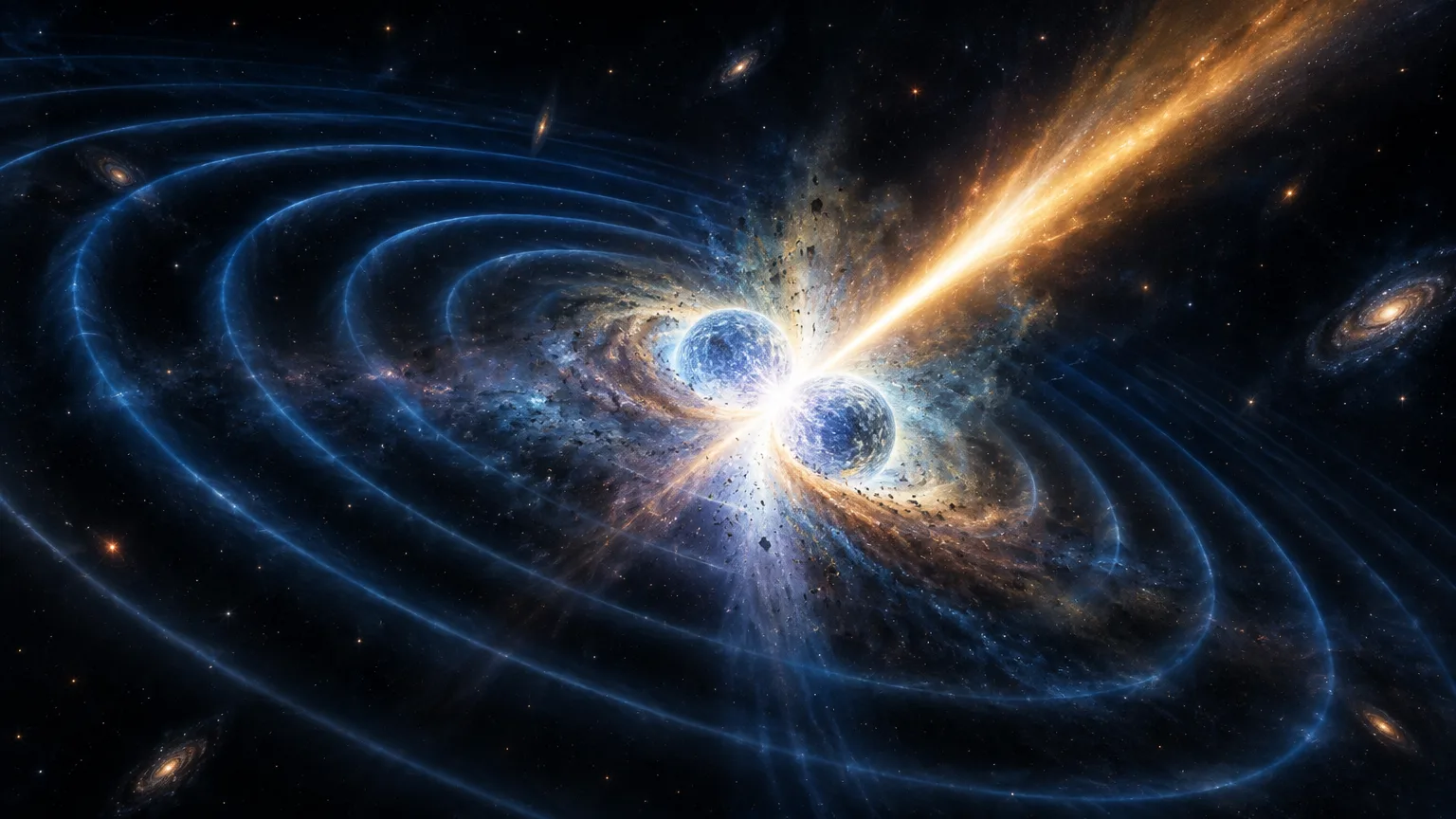
Gravitational waves are fluctuations in spacetime produced by powerful cosmic events. In GW170817, the ground-based LIGO detectors in the United States and Virgo in Italy recorded a signal associated with the merger of two neutron stars. The Fermi satellite and the space observatory INTEGRAL also recorded a brief gamma-ray burst, designated GRB 170817A. It was the first observed association between gravitational waves and high-energy light from the same cosmic source.
The detection prompted follow-up observations with ground- and space-based telescopes. About half a day later, optical observatories found a new source near the centre of the galaxy NGC 4993. Subsequent observations detected signals in other bands, from ultraviolet, visible and infrared light to X-rays and radio waves. The event could therefore be studied through complementary observations, rather than from the gravitational-wave signal or gamma-ray burst alone.
A coincidence between different signals
A paper by the INTEGRAL team, published on 16 October 2017 in The Astrophysical Journal Letters, reports that the SPI-ACS instrument detected GRB 170817A about two seconds after the gravitational-wave event ended. The paper gives a signal-to-noise ratio of 4.6 for the INTEGRAL detection. It also calculates a significance of 3.2 sigma for the association between the INTEGRAL signal and GW170817, and 4.2 sigma for the association between the Fermi-GBM and INTEGRAL detections. These figures refer to different statistical comparisons; they are not interchangeable measures of a single association.
Comparing the gamma-ray arrival times at Fermi and INTEGRAL helped narrow down the burst’s location. According to the paper, adding INTEGRAL’s observation reduced Fermi’s final localization area at the 90% level by a factor of 1.8. The gravitational-wave signal was recorded by both LIGO detectors and by Virgo, whose response was smaller. The European Space Agency (ESA) described the region of sky indicated by the measurements as 28 square degrees and placed the source about 130 million light-years away.
What INTEGRAL recorded—and what shaped the measurement
INTEGRAL, whose full name is INTernational Gamma-ray Astrophysics Laboratory, is an ESA space-based gamma-ray observatory. The team estimated the burst fluence to be (1.4 ± 0.4 ± 0.6) × 10−7 erg cm−2 in the 75–2000 keV range. The first uncertainty is statistical, quoted at the 1-sigma confidence level; the second is systematic and corresponds to uncertainty in the spectral model and instrument response.
The paper notes that the estimate depends on assumptions about spectral models because SPI-ACS does not have energy resolution. It also specifies an instrumental limit: SPI-ACS could not observe emission below about 100 keV because of its lower threshold. This matters because GRB 170817A was a relatively “soft” burst, with most of its energy below that threshold. The paper also mentions a brief, harder initial pulse emitting at least up to 200 keV. The SPI-ACS measurement must therefore be read in light of both the range it could observe and the assumptions used to estimate the fluence.
After the initial detection, INTEGRAL continued observing the region and carried out targeted follow-up observations that began 19.5 hours after the event and lasted 5.4 days. The paper gives an upper limit for electromagnetic signals over a broad range, from 3 keV to 8 MeV, and constrains the flux of a possible soft gamma-ray afterglow at a 99% probability level. For this calculation, the authors used a burst-duration distribution based on earlier work. The team also reports that its described follow-up observations detected neither further persistent emission nor other bursts from the direction of the optical counterpart.
NGC 4993 and the later observations
According to ESA, the optical source found near the centre of NGC 4993 was at a distance consistent with that indicated by LIGO and Virgo. Follow-up campaigns subsequently observed signals in ultraviolet, visible and infrared light, and later in X-rays and radio waves. Each band added a different part of the event’s observational record.
ESA describes the phenomenon as a kilonova: neutron-rich material ejected in the merger interacts with its surroundings, and heavy elements form in the process. The agency presents this explanation in the context of follow-up observations across different bands and the gravitational-wave signal; it is not a conclusion drawn solely from INTEGRAL’s gamma-ray measurement.
The agency also says that, among short bursts with measured distances, this was the closest and the dimmest. As a possible explanation for its properties, ESA proposes that the jets produced in the collision were not pointing directly towards Earth. This is an interpretation of the observations, not a direct measurement of the jets’ orientation.
Why combining observatories mattered
Before GW170817, the confirmed gravitational-wave detections described in ESA’s account had been attributed to merging black-hole pairs. The agency explains that other cosmic collisions, including those involving neutron stars, could produce both gravitational waves and light across different parts of the electromagnetic spectrum. GW170817 provided the first observed association of gravitational waves and high-energy light from the same source.
The instruments contributed different observations: LIGO and Virgo recorded gravitational waves; Fermi detected GRB 170817A, and INTEGRAL’s SPI-ACS recorded a coincident gamma-ray signal. Comparing arrival times at the satellites helped improve Fermi’s localization. Optical observatories then identified the source in NGC 4993, and the campaign tracked its evolution in other bands. This sequence shows the value of combining measurements without confusing what each instrument contributed.
Results and evidential limits
The combined interpretation links GW170817, GRB 170817A and the optical source in NGC 4993 to the merger of two neutron stars. The INTEGRAL paper reports its detection of the burst, the improvement in Fermi’s localization when the satellite’s observation was added, and the limits obtained during follow-up. ESA’s account provides context for the later observations and describes the interpretation as a kilonova.
The figures need to be distinguished by what they measure. The 4.6 signal-to-noise ratio characterizes the INTEGRAL detection; the 3.2 and 4.2 sigma significances refer to different statistical associations. The estimated fluence includes statistical and systematic uncertainties, and SPI-ACS’s lower sensitivity did not cover emission below about 100 keV. The limit on a possible afterglow, in turn, depends on the burst-duration assumptions used in the analysis. The proposed jet orientation is an explanation, not a direct observation.
GW170817 brought gravitational and electromagnetic signals associated with one event into a shared observational account. INTEGRAL added a gamma-ray record and helped refine the localization; later observations of NGC 4993 broadened the study of the event. Conclusions about the signal need to be read in light of the instrument’s limits and the analysis uncertainties.