

Key facts
- GRAIL used two orbiters, Ebb and Flow, and had a primary phase and an extended phase.
- The study estimated k3 = 0.0163 ± 0.0007, approximately 72% above the expected value for a spherically symmetric Moon.
- The authors say that a variation of around 2–3% in the mantle’s shear modulus between the two sides could explain the observed value.
- The model interpretation suggests a thermal anomaly of approximately 100–200 K in the mantle on the near side.
- According to that interpretation, the anomaly would be related to the formation of the lunar maria 3–4 billion years ago.
- The asymmetric structure could influence the spatial distribution of deep moonquakes.
Related records
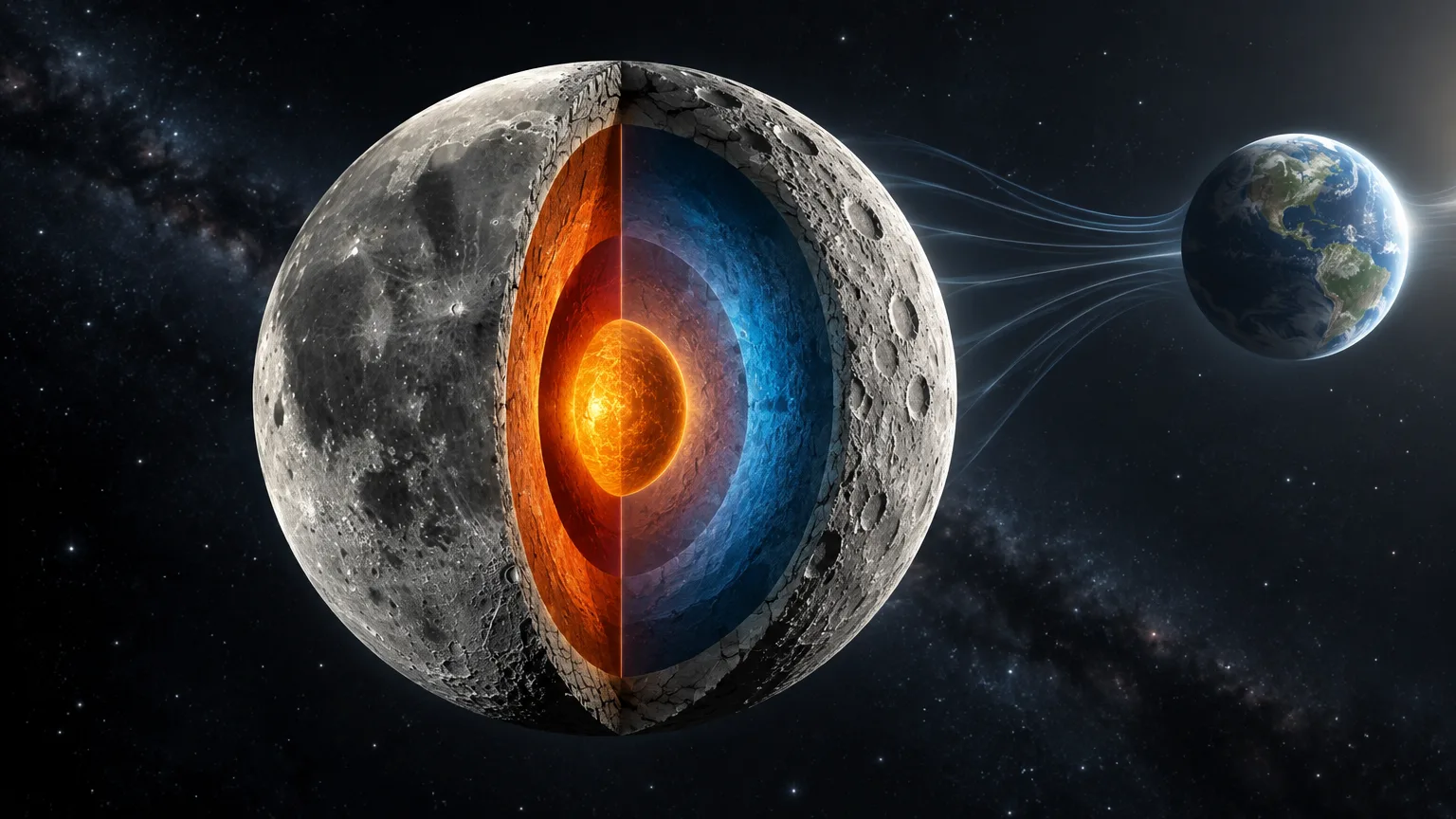
The Moon has a layered structure—crust, mantle, and core—and shows notable differences between the hemisphere facing Earth and the one on the far side. Known asymmetries include topography, crustal thickness, geology, and the surface concentration of radioactive elements. A study published in Nature used a different approach to investigate whether these differences also extend into the deep interior: measuring how lunar gravity responds to tides raised by Earth.
The main result is an estimate of k3 = 0.0163 ± 0.0007, a degree-3 gravitational Love number. The authors say it is about 72% higher than the value expected for a spherically symmetric lunar interior. Their analysis interprets this response as evidence of lateral heterogeneity in the deep interior. By contrast, the hemispheric temperature difference they suggest was not measured directly: it is inferred using models.
How gravity can probe the interior
The Moon’s orbit is eccentric and inclined relative to Earth. As a result, Earth’s gravitational pull produces periodic tidal forcing. The Moon’s response to this interaction causes temporary changes in its gravitational field, which are sensitive to the satellite’s internal structure.
The Love number expresses the relationship between the gravitational potential induced by lunar deformation and the potential imposed by Earth’s gravity. Put simply, it quantifies how the Moon responds to this periodic pull. The authors note that static gravity is especially sensitive to structures in the upper crust, while long-wavelength time-variable gravity is highly sensitive to deep mantle asymmetries. Analyzing changes associated with tides therefore provides a tool for studying regions that cannot be observed directly.
The Ebb and Flow data
The study reconstructed the time-variable lunar gravitational field using satellite-to-satellite radiometric tracking data and data from the Deep Space Network (DSN), NASA’s communications and tracking network. The data were collected by GRAIL—short for Gravity Recovery and Interior Laboratory—a mission consisting of two orbiters, Ebb and Flow, which had a primary phase and an extended phase.
The analysis incorporated data from both phases. The researchers attribute their higher estimate of k3, compared with those reported in earlier studies, mainly to the inclusion of low-altitude data from the extended mission: these data improved the gravitational information and reduced correlations between the field coefficients and the Love numbers. For comparison, restricting the analysis to data from the primary phase yielded k3 = 0.0098 ± 0.0021, a result consistent with earlier estimates cited in the study.
What the estimate says—and what it does not directly measure
The k3 value is about 72% higher than the prediction for a spherically symmetric Moon. To explain this difference, the authors suggest that the mantle’s elastic shear modulus—a measure of its resistance to deformation—could vary by approximately 2–3% between the near and far sides. This explanation makes the gravity measurement observational evidence of lateral heterogeneity, but the percentage variation in the modulus is a model interpretation, not a direct instrument reading.
The study also estimates that the asymmetry could correspond to a predominantly near-side mantle thermal anomaly of around 100–200 K. According to the authors’ interpretation, this anomaly would have formed the lunar maria on the surface between 3 and 4 billion years ago. The maria are extensive dark regions associated with ancient episodes of volcanic activity. The temperature figure should therefore be understood as an inference about the interior based on the gravitational response and the models used, not as a direct measurement of mantle temperature.
Another piece in an open question
Differences between the lunar sides were already known, but their origin remains debated. Proposals considered in earlier studies include the idea that the uneven distribution of heat-producing radioactive elements sustained long-lived temperature differences and contributed to the concentration of volcanism on the near side. The GRAIL analysis offers a way to assess the deep structure associated with this asymmetry; on its own, it does not resolve all questions about how it originated.
The authors also note that the asymmetric structure could influence the spatial distribution of deep moonquakes. They present this as a possible consequence, not as an effect established by the k3 estimate. Overall, the result shows how time variations in gravity can provide information about the mantle: a measurement made from orbit offers indications of internal differences between hemispheres, while translating those indications into temperature and geological history depends on model interpretation.