

Key facts
- NASA presented its analysis of GLIMPSE-17775 on June 10, 2026, and said the paper was published that day in The Astrophysical Journal.
- Webb obtained a 30-hour spectrum; gravitational lensing by Abell S1063 made it equivalent to 80 hours of telescope time.
- GLIMPSE-17775 has a cosmological redshift of 3.5 and corresponds to an era when the universe was around 1.8 billion years old.
- The spectrum contains more than 40 lines; the team identified 16 iron lines, which it called the “iron forest.”
- The team interprets several signals as supporting a model of a rapidly accreting supermassive black hole surrounded by dense, partially ionized gas.
- The analyzed Webb spectrum does not include the region that would reveal the Balmer break; ancillary Hubble data help interpret this feature and the host galaxy.
Related records
On June 10, 2026, NASA presented an analysis of GLIMPSE-17775, an object in the early universe classified among the so-called “little red dots.” A team led by Vasily Kokorev of the University of Texas at Austin studied spectroscopic data from the James Webb Space Telescope (Webb) and found more than 40 lines. The team interprets the set of signals as evidence supporting a rapidly accreting supermassive black hole surrounded by a dense envelope of partially ionized gas. The model is called a “black hole star” (BH*). NASA said the paper reporting the results was published that same day in The Astrophysical Journal.
A distant object behind Abell S1063
Webb began identifying little red dots in 2022. These objects appear in large numbers in the early universe, and researchers have studied several explanations for their nature and colors. The BH* model is one of them: it proposes that the central source is a growing black hole, enveloped in gas that affects the observed light.
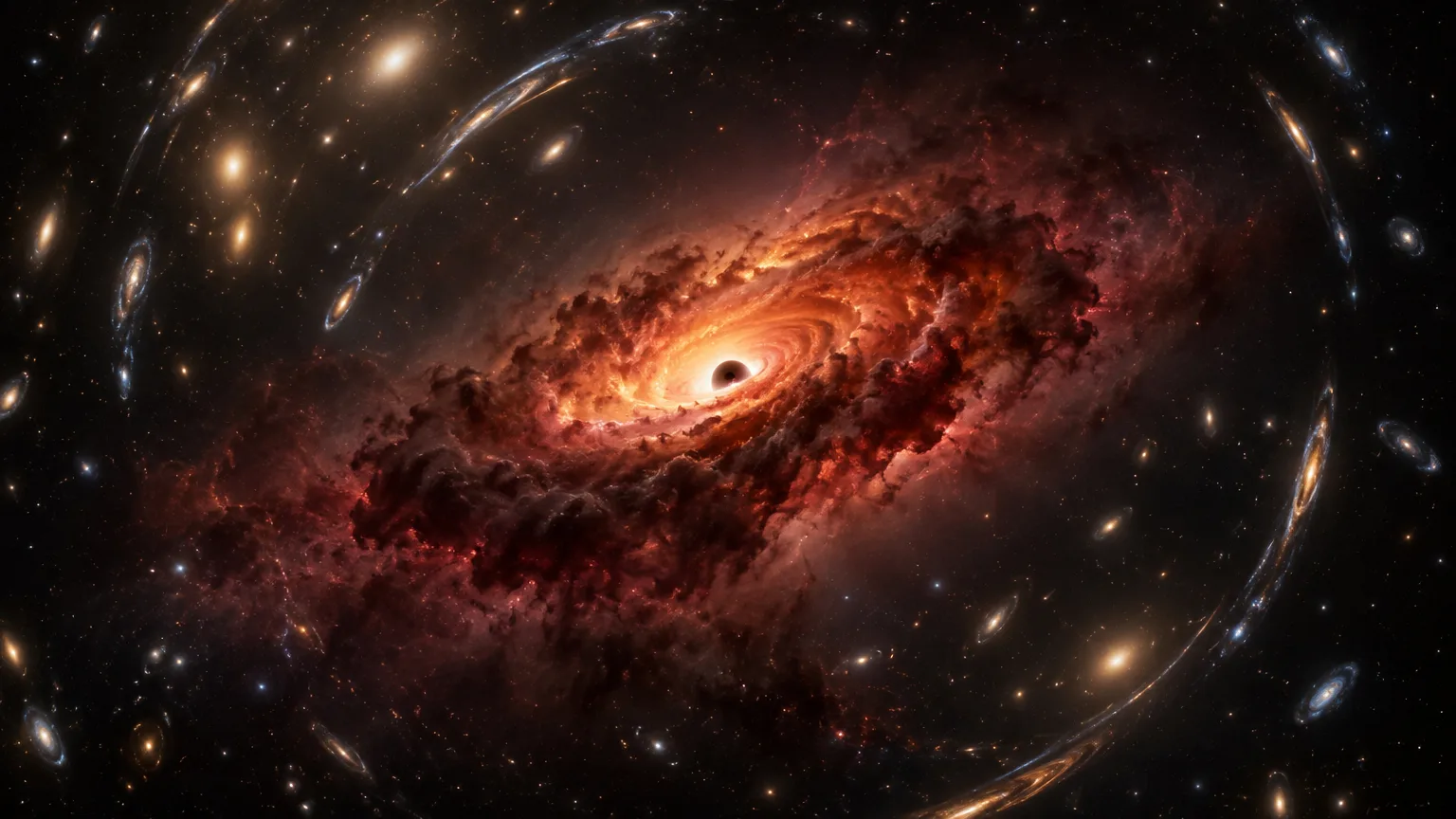
GLIMPSE-17775 lies behind, and farther away than, the galaxy cluster Abell S1063. The cluster’s gravity magnifies the object’s light through the effect of gravitational lensing. Webb’s observation was part of a project searching for Population III stars and faint galaxies in the cluster; GLIMPSE-17775 was included in the data.
Webb obtained a 30-hour spectrum. According to NASA, gravitational magnification made the observation equivalent to 80 hours of telescope time. The object has a cosmological redshift of 3.5, corresponding to an era when the universe was around 1.8 billion years old. NASA’s announcement described the spectrum as the most detailed obtained up to that point for a little red dot and noted that it contains more than 40 lines.
The signals supporting the BH* model
The lines examined by the team include signals from hydrogen, oxygen, and helium. Many do not fit a simple model in which the source is only a rotating cloud of gas. According to the analysis, the best-fitting model includes a broadening known as electron scattering, which the team interprets as evidence of a dense, layered gas envelope around the source.
In the BH* scenario, the gas surrounding the black hole reprocesses the light emitted close to it and contributes to producing the observed features. The interpretation is also supported by iron and oxygen lines: the team identified 16 iron lines, which it grouped under the name “iron forest.” The analysis assigns importance to the intensity and the ratios between certain iron and oxygen lines, which require a high-energy source such as a rapidly accreting black hole.
The spectrum also shows helium fluorescence and absorption. The team considers each of these clues to point to a dense medium enveloping a powerful source. Taken together, the line broadening, iron and oxygen signals, and helium features support the proposed interpretation of GLIMPSE-17775. The conclusion is not based on a single line, but on a combination of several observed features.
The host galaxy and the Balmer break
The BH* model also offers an explanation for why many little red dots are faint in X-rays: under this scenario, the emission could be absorbed by the dense gas envelope. In GLIMPSE-17775, another element considered by the team is the Balmer break, a sharp decrease in light that is considered characteristic of these objects.
The analyzed Webb spectrum does not include the region that would allow this break to be revealed directly. To expand the analysis, the team incorporated ancillary data from two programs that used the Hubble Space Telescope: Frontier Fields and BUFFALO (Beyond Ultra-deep Frontier Fields And Legacy Observations).
Combining the Webb and Hubble data helps explain why the Balmer break is weaker in GLIMPSE-17775 than in other little red dots. The analysis points to a large host galaxy around the object. Within the BH* model, stars in that galaxy contribute additional blue light, helping to explain the feature’s lower intensity. NASA notes that a host galaxy of this scale had not commonly been observed in little red dots, although it is compatible with the model of a dense gas envelope.
What this case makes it possible to study
NASA presented GLIMPSE-17775 as a case with an especially detailed spectrum for examining the BH* model. Gravitational lensing by Abell S1063 magnified its light, and Webb obtained more than 40 lines; the analysis found signals that the team considers consistent with a rapidly accreting supermassive black hole surrounded by partially ionized gas. Hubble data add information that helps interpret the host galaxy and the lower intensity of the Balmer break.
The interpretation is part of a wider debate about what powers the central sources of little red dots. NASA reports that other theories have been proposed. In this object, moreover, the spectral region that would show the Balmer break is not in the analyzed Webb spectrum, so the explanation for its weakness combines Hubble and Webb data with the host-galaxy model. Kokorev expressed the team’s interest in continuing to investigate what fuels these sources. The case brings together several signals in a single object and makes it possible to test the model, while research on little red dots continues.