

Key facts
- NASA describes supernovas as explosions at the end of certain stars’ lives that can shine billions of times brighter than the Sun.
- In stars with more than 8 solar masses, the exhaustion of fuel in the core allows gravity to trigger collapse; NASA classifies these events as types Ib, Ic, or II, depending on the elements present.
- According to NASA, the rebound of the compressed core drives a shock wave that heats and ejects the outer layers.
- After the explosion, the core may stabilize as a neutron star; if the remaining mass exceeds 3 solar masses, it may continue collapsing and form a black hole.
- An educational NASA answer presents neutrinos as one possible way to transfer energy and estimates that they would deliver about 1% of the collapse energy to the envelope.
- NASA considers the Cygnus Loop likely to be associated with a Type II supernova; it places it about 2,400 light-years away and describes a remnant that has expanded about 60 light-years from its center.
Related records
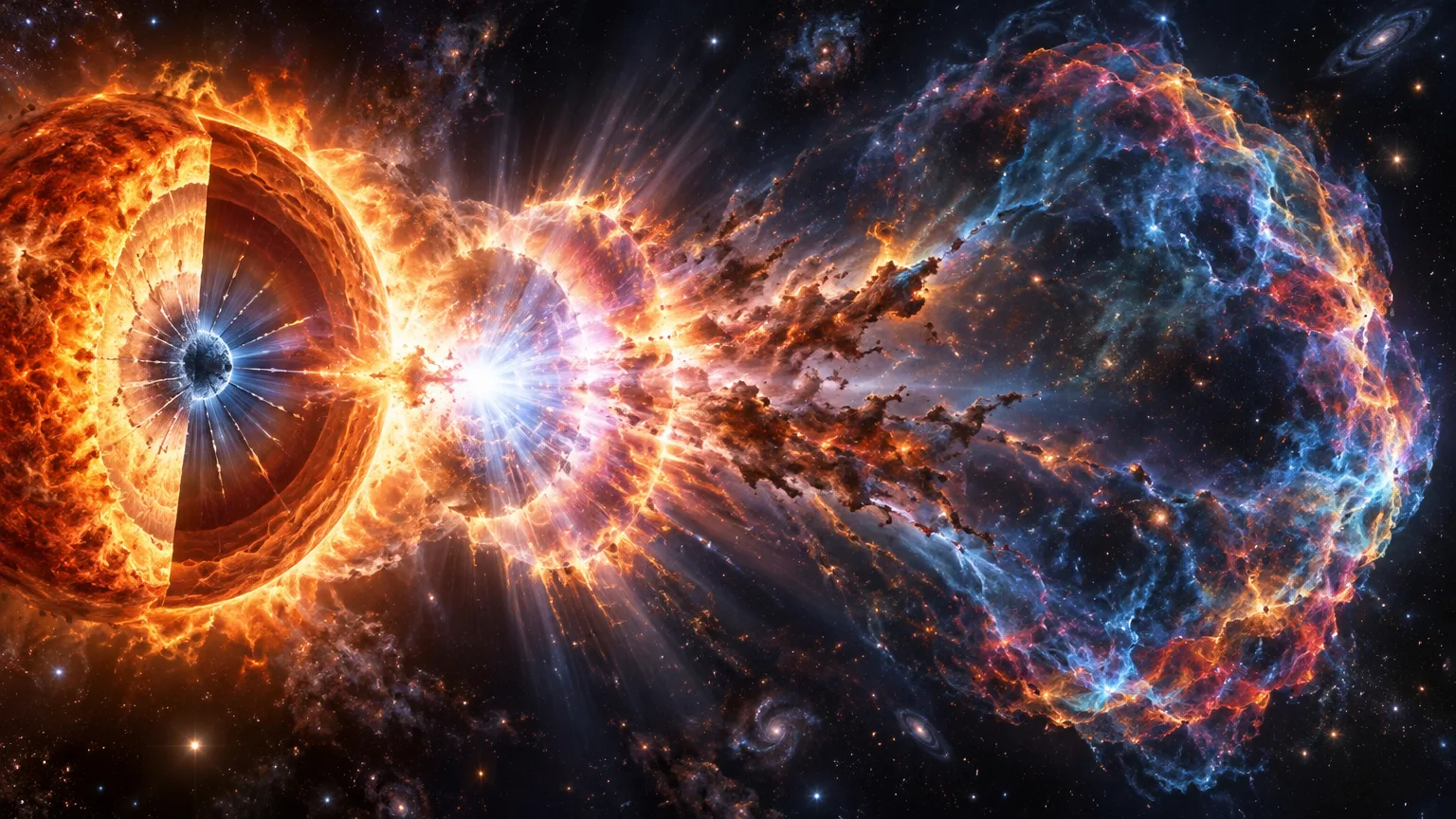
A supernova transforms the end of certain stars into an extraordinarily luminous explosion. NASA describes these events as capable of reaching a brightness billions of times greater than that of the Sun. In a core-collapse supernova, the physical story begins when a massive star can no longer support its layers against gravity. The explosion ejects material into space, and the core may leave behind a neutron star or, under certain conditions, a black hole.
The process does not end with the blast. The ejected material interacts with interstellar gas and forms a remnant that can continue evolving for a long time. The Cygnus Loop offers one example: NASA considers it likely to be associated with a Type II supernova and explains that its visible structure is due to interaction between the expelled matter and the interstellar medium swept up by the shock wave.
The balance a massive star loses
Inside a star, fusion generates outward pressure. According to NASA’s explanation of supernovas, when a star runs out of fuel in its core, that pressure can no longer support it in the same way. In a star with more than eight times the Sun’s mass, gravity can overcome radiation pressure and cause the core to collapse inward.
NASA classifies these core-collapse supernovas as types Ib, Ic, or II, depending on the elements present. The classification describes observable features related to the explosion’s material; it does not change the general sequence of collapse and rebound that leads to the shock wave.
As the atoms in the core are compressed, the temperature rises. NASA’s account says that the compressed core recoils and rebounds outward. This rapid change sets the next step in motion: the energy of the rebound reaches the outer layers and drives a shock wave through the star.
How the rebound drives the explosion
The shock wave heats the material it encounters in the outer layers, promotes the formation of new elements, and violently ejects that matter into the cosmos. The collapse of the center and the ejection of the outer layers are therefore part of the same sequence, although the explanation of how energy is transferred between the two regions is more complex than the basic outline.
An educational NASA answer about the source of a supernova’s energy explains that the gravitational energy released by the collapse is converted into heat and motion. The answer itself cautions that the detailed process is much more complicated and is an active field of research. In this context, it presents neutrinos as one possible way to carry energy from the core to the envelope: according to that explanation, they would transport most of the energy released in the collapse and deliver about 1% of it to the envelope, helping to drive its explosion.
NASA’s answer adds that a burst of seven neutrinos was detected shortly before SN 1987A was detected, and considers this an important confirmation of the theory it describes. The scope of that wording should be preserved: the source presents the role of neutrinos as one possible solution to the energy-transfer problem and notes that the complete description is more complex.
What can remain at the center
After the explosion, the core may stabilize as a neutron star. NASA explains that the immense pressure causes protons and electrons to fuse into neutrons. If the remaining mass exceeds three times the Sun’s mass, the core may continue collapsing and form a black hole. These are different possible outcomes for the central region after the outer layers have been ejected.
The expelled matter does not simply disappear: NASA notes that supernova material can form new elements and return to space, where it is recycled as a component of new stars. The explosion thus links a star’s death to the later evolution of the material around it.
The Cygnus Loop: a shock wave still in action
The Cygnus Loop is a supernova remnant in the northern constellation Cygnus, about 2,400 light-years away. NASA says it covers an area of the sky equivalent to 36 times the area of the full Moon. The agency considers that the shock wave that formed it may have come from a Type II supernova.
According to NASA’s account, the star that produced the remnant had about 20 solar masses and exploded between 10,000 and 20,000 years ago. Since then, the remnant has expanded about 60 light-years from its center. The veil-like structure seen in the Loop results from interaction between the expelled material and the low-density interstellar material swept up by the shock wave. The Hubble image cited by NASA shows only a small part of the whole structure.
This example helps distinguish the moment of the explosion from its prolonged evolution: collapse initiates the shock wave, but the remnant continues to grow and interact with its surroundings. Taken together, the sequence described by NASA connects the exhaustion of fuel in the core, the rebound, the ejection of the stellar layers, and the formation of structures that remain in interstellar space.
A physical explanation with explicit limits
The explanation of core collapse summarizes several stages, but it does not make simple the mechanism that carries energy from the center to the envelope. NASA emphasizes this in its educational answer and attributes a possible role in that transfer to neutrinos. It also relates the burst detected before SN 1987A to the theory described. Presenting that proposal with its attribution and qualifications makes it possible to understand both the general mechanism and the specific scope of the evidence cited.