

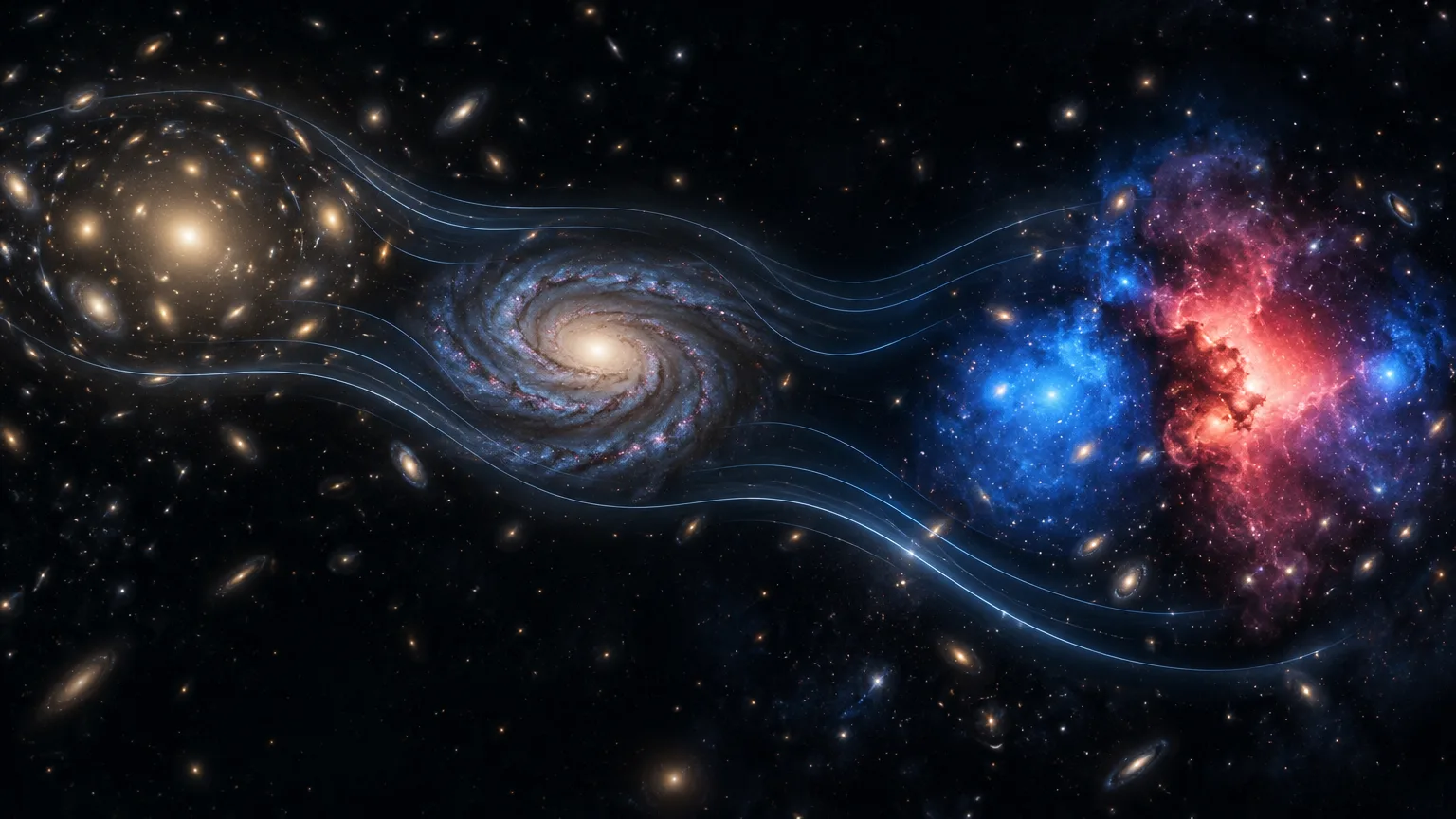
Key facts
- In 1933, Fritz Zwicky described an anomaly in the Coma Cluster: the galaxies were moving too fast for the gravity attributable to the observed ordinary matter.
- Zwicky proposed an invisible form of matter and called it “dunkle Materie.”
- In the 1970s, Vera Rubin studied stars at the outer edges of spiral galaxies and concluded that more matter than was observed was needed to hold them together.
- Gravitational lensing makes it possible to infer the distribution of mass by measuring how the light from background galaxies is distorted.
- In NASA’s descriptions of images of the Bullet Cluster, hot gas detected in X-rays appears in pink, and the mass map inferred through gravitational lensing appears in blue.
- NASA attributes to researchers the interpretation that the material associated with the blue regions is probably dark matter.
Related records
Dark matter is identified by what it does, not by light that we can observe. According to NASA’s description, it does not interact with the electromagnetic spectrum as ordinary matter does: it does not absorb, reflect or emit light. Its gravity nevertheless affects galaxies and the light travelling through the universe. The story of how the evidence was built is best understood by following three different signals: the motion of galaxies within clusters, the speed of stars in spiral galaxies, and the distortion of background light.
Coma: galaxies moving too fast
A galaxy cluster is a group of galaxies bound together by gravity. In 1933, astronomer Fritz Zwicky published a paper about an anomaly he had observed while studying the Coma Cluster. According to NASA’s historical account, the galaxies in that cluster were moving too fast for the gravity of the observed ordinary matter to be sufficient to hold them together. If only that visible matter counted, the galaxies should have dispersed; yet they remained bound to the cluster.
Zwicky proposed that an invisible form of matter supplied the gravity missing from that explanation and called it “dunkle Materie”, German for “dark matter.” The proposal named a possible explanation for the problem, but the early research was not enough at the time to make it a widely accepted idea. Its importance lies in the kind of clue it provided: the hypothetical matter was not observed directly; instead, researchers observed motion whose gravitational explanation seemed to require more mass than was visible.
Stars in spiral galaxies
In the 1970s, astronomer Vera Rubin studied a different case: stars located toward the outer edges of spiral galaxies. According to NASA, she found that they were moving too fast for the observed luminous matter in those galaxies, by itself, to explain how they remained in orbit. The discrepancy resembled the one in Coma, but the observation now concerned the motion of stars within individual galaxies, not that of entire galaxies within a cluster.
Rubin concluded that there had to be more matter than could be seen to keep those galaxies together. The proposed explanation was that dark matter supplied the additional gravity. The agreement between clues from different scales strengthened the idea: first, the motion of galaxies in Coma; then, that of stars at the edges of spirals. In NASA’s historical account, the evidence associated with Rubin’s work was decisive in leading the scientific community to adopt the concept more broadly.
Gravitational lensing turns gravity into a map
A third clue comes from light. The gravity of a concentration of mass can curve spacetime and thereby deflect the path of light from galaxies located behind it. This effect is called gravitational lensing. By measuring how those background galaxies appear distorted, astronomers can estimate how mass is distributed in the object in front of them.
The result is a map of mass inferred from the distortion of light, not a photograph of dark particles. The distinction matters: the observed image provides the shapes and positions of galaxies; the map is obtained by interpreting the distortions caused by gravity. As NASA explains when describing galaxy clusters, gravitational lensing makes it possible to map the distribution of mass and identify regions where a concentration is inferred that cannot be explained by visible matter.
The Bullet Cluster: gas and mass do not appear together
The Bullet Cluster, formally known as 1E 0657-56, formed when two large galaxy clusters collided in an event about 3.8 billion light-years from Earth. NASA describes observations of this system in 2006 as one of the clearest examples of evidence for dark matter. During the collision, the hot gas in one cluster interacted with the hot gas in the other.
In the composite images described by NASA, the hot gas—ordinary matter that emits X-rays and was detected by NASA’s Chandra observatory—appears in pink. The distribution of mass inferred through gravitational-lensing observations with NASA’s Hubble Space Telescope and the Magellan Telescope, operated by an international consortium, is shown in blue. According to NASA’s description, the blue regions are distributed differently from the hot gas and represent most of the clusters’ mass.
The scientific interpretation cited by the agency is that the material associated with this blue distribution is probably dark matter. The key point is not that blue is a direct image of this matter: it is a representation of mass reconstructed through gravitational lensing. The gas, in turn, is identified through its X-ray emission. Thus, the Bullet Cluster offers a comparison between two different observables: where the hot gas is located and where lensing indicates that mass is concentrated.
Evidence built from different clues
Coma, spiral galaxies and the Bullet Cluster do not provide the same kind of observation. The first focused attention on the speed of galaxies within a cluster; Rubin studied stars in the outer regions of galaxies; and the third made it possible to compare hot gas with the distribution of mass inferred from distorted light. In all three cases, dark matter enters the explanation through observed gravitational effects.
This account also helps clarify what is meant by evidence. In Coma and in spiral galaxies, the discrepancy between motion and visible matter prompted the inference of additional mass. In the Bullet Cluster, gravitational lensing provides a mass map that can be compared with the position of the gas. According to the interpretation reported by NASA, the material associated with the blue regions is probably dark matter. The strength of this story lies in the fact that different clues point to mass that is not identified by its light, although each does so through a different observation.