

Key facts
- NASA defines black holes as enormous concentrations of matter compressed into a very small space.
- NASA calls the surface associated with a black hole the event horizon in its public explanation.
- ESO reports conclusive evidence for a black hole at the Milky Way’s center after 15 years of regular monitoring.
- NASA and ESO describe research using telescopes and archival data to study black holes.
- NASA says Roman could broaden the study of events involving stars, galaxies, and black holes, with launch scheduled no later than 2027.
Related records
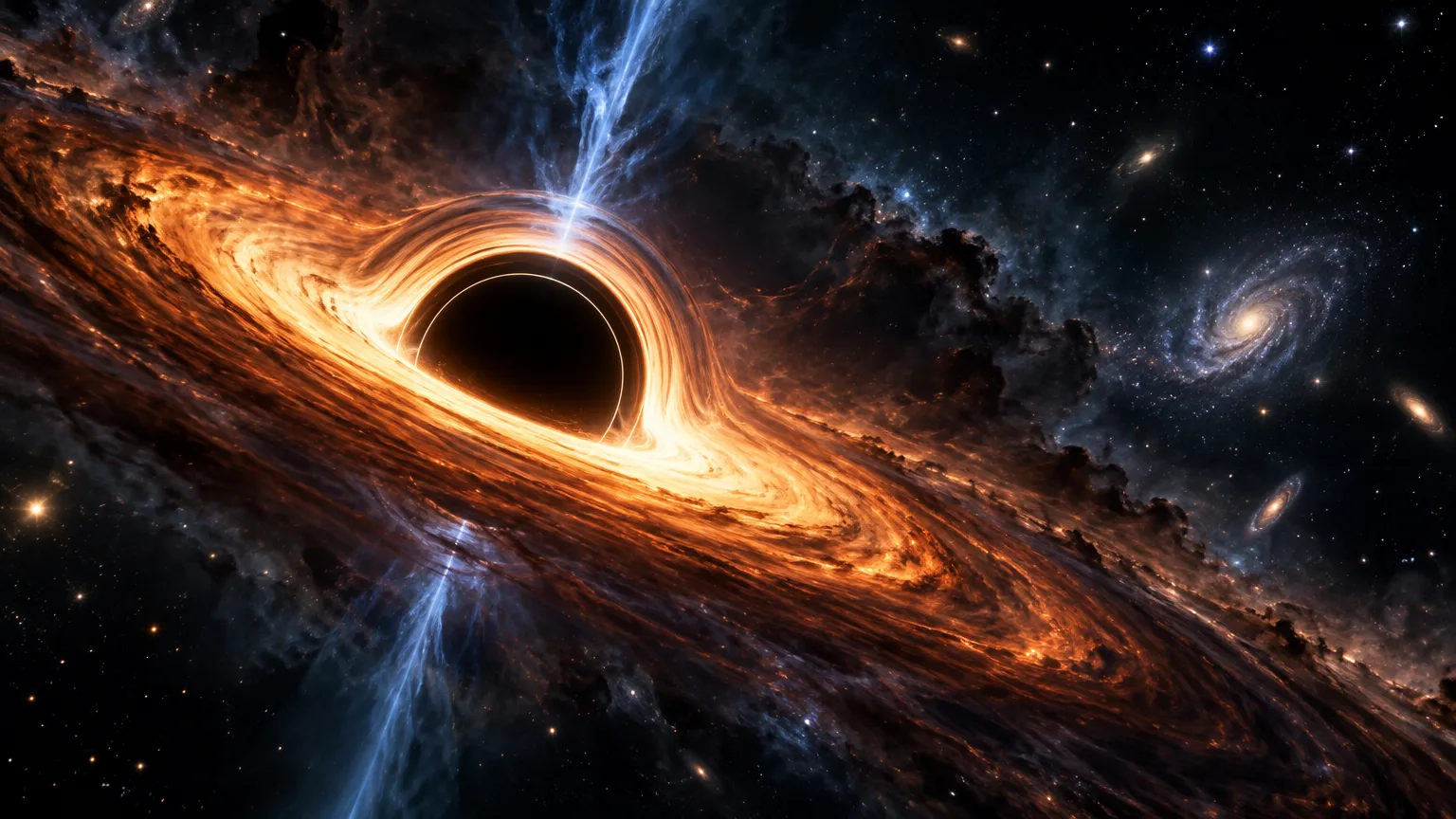
Black holes hold a distinctive place in astronomy because they combine extreme gravity, difficult observations, and questions that do not yet have definitive answers. Information published by NASA Science stresses a basic but important point: these objects are not literally holes. They are enormous concentrations of matter compressed into a very small space.
This distinction helps avoid a misleading picture. The scientific interest does not arise from emptiness, but from concentrated matter and its associated gravity. NASA says a black hole can be so dense that gravity immediately below its surface, called the event horizon, becomes extreme. That boundary is central to describing the object and to the difficulty of studying it.
What the term black hole refers to
In popular language, the name can suggest a cavity in space. NASA’s definition instead points to an extraordinarily compact concentration of matter. Studying black holes therefore requires separating the familiar metaphor from the physical description supported by the available evidence.
The event horizon is the name NASA gives to the surface associated with a black hole in this explanation. It should not be treated as a solid surface: the supplied evidence only supports saying that NASA identifies it as that boundary and places extreme gravity immediately beneath it.
The Milky Way’s center: from suspicion to evidence
The Milky Way is our galaxy. According to ESO, astronomers long suspected a black hole at its center without being certain. The situation changed after 15 years of regular monitoring of the Galactic Centre with ESO telescopes at the La Silla Paranal Observatory.
ESO says that program ultimately obtained conclusive evidence. The case illustrates a central feature of the field: conclusions need not come from viewing an object as an ordinary source of light, but can rest on sustained measurements of its surroundings. The supplied source does not detail the methods or quantitative properties of the central object, so no masses, distances, or additional mechanisms can be inferred from it here.
Telescopes and clues in other galaxies
Research is not confined to our galaxy. An ESO report describes detection, with the Very Large Telescope (VLT), of a stellar-mass black hole in another galaxy that was then the most distant known of its kind. The VLT is an ESO telescope facility; in this evidence, its role is as an observing instrument for searching beyond the Milky Way.
NASA also reports research on supermassive black holes. NASA Science’s topical archive says that, in 2025, different agency telescopes helped scientists search the sky for them. Another NASA publication presents Hubble findings connected to the origins of supermassive black holes. In this context, the Hubble Space Telescope and the Webb Space Telescope are observatories used to extend the available evidence.
NASA’s Webb page announces a strikingly framed result: a black hole said to have formed before its galaxy. This is a relevant research path for examining black hole–galaxy connections, but the supplied material provides no observational details, system identification, or uncertainty level. The headline should not be turned into a general explanation for all black holes.
Energetic events and existing data
NASA’s archive also mentions the first study of the physical environment of cyclic X-ray eruptions. In addition, NASA reports three black holes caught consuming massive stars in agency data. These references show that the field includes variable, energetic phenomena as well as searches for objects at rest or in galactic centers.
Another NASA study describes an apparently “sideways” black hole whose spin seems unexpectedly oriented relative to its surrounding galaxy. The finding is attributed to archival data and new techniques. Its importance is precisely that stored observations can gain new meaning when analytical tools change.
What remains open
The collected evidence does not justify one single answer about how all black holes formed, how supermassive ones grew, or how they evolved with galaxies. These are research fronts, not settled facts. NASA also says the Nancy Grace Roman Space Telescope, scheduled to launch by 2027 and potentially as early as fall 2026, could find many more dramatic events and provide another way to explore the formation and evolution of stars, galaxies, and black holes.
Temporal caution matters: that date is a projection, not a confirmed launch. Likewise, a result described as new or puzzling is not enough to generalize it to the entire black-hole population.