

Key facts
- NASA lists a 2026 article about Bennu samples.
- Its title links regolith production on near-Earth asteroids to collisional disruption.
- The citation is in The Planetary Science Journal, volume 7, article 87.
- The listed DOI is 10.3847/PSJ/ae4fad.
Related records
Planetary science examines Solar System bodies — and the processes that alter them — through observations, models, experiments and, when possible, direct examination of materials. In that context, an entry in NASA’s laboratory astrophysics publications list identifies a study focused on Bennu samples, from a near-Earth asteroid.
The citation is titled Physical analysis of Bennu samples reveals regolith production by collisional disruption on near-Earth asteroids. It is credited to R.-L. Ballouz, A. J. Ryan, R. J. Macke and additional authors, and was published in The Planetary Science Journal, volume 7, article 87, in 2026. The listing provides the digital identifier 10.3847/PSJ/ae4fad.
What the available record says
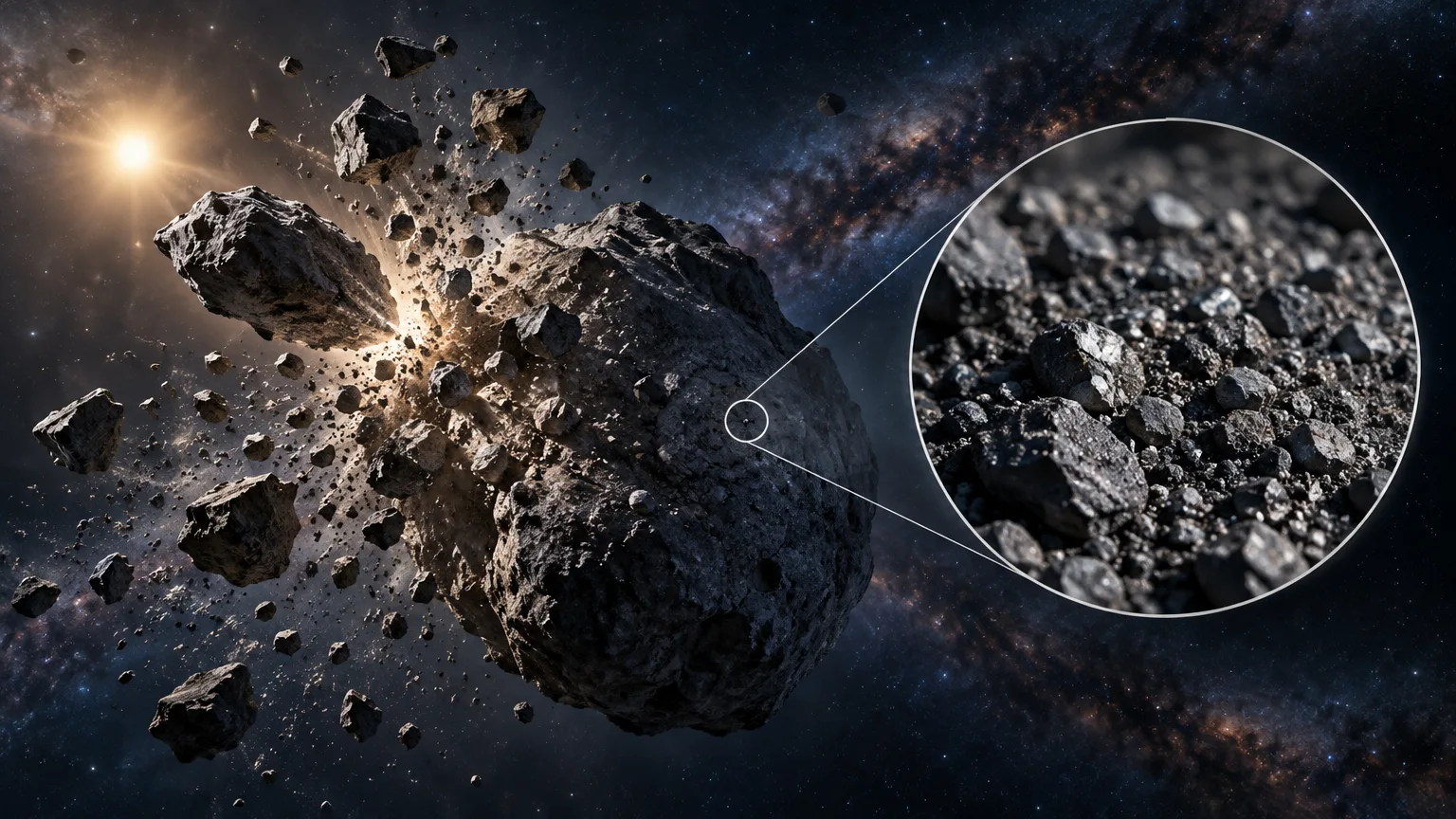
The main scientific point that can safely be drawn comes from the title itself: the work connects physical examination of Bennu material with an interpretation of regolith formation on near-Earth asteroids. Regolith is fragmented, loose material that covers or accumulates on a solid surface; it can include particles of different sizes and does not necessarily form a uniform layer.
Collisional disruption refers to material being broken, fractured or moved by impacts. The title therefore proposes that collisions take part in producing this surface material. It does not say that they are the only possible mechanism, nor does the supplied evidence establish which impacts, energies, frequencies or timescales were examined.
Why Bennu and regolith matter
Near-Earth asteroids are objects whose paths bring them into Earth’s orbital neighbourhood. Studying their surface material helps address a basic question: how small bodies change when they receive impacts, and when the resulting fragments remain on, redistribute across or escape from their surfaces.
Here Bennu is not only an astronomical object, but also a source of samples subjected to physical analysis. That distinction matters. Remote observations may describe visible or thermal properties, whereas a sample enables direct examination of material characteristics. Yet the consulted entry does not state which physical properties were measured, what instruments were used or how the measurements were connected to the collisional process.
NASA’s role and the source’s scope
NASA, the United States space agency, hosts the citation in its recent laboratory astrophysics publications list. The page functions as a bibliographic record: it identifies the work, its authors, journal, year, article number and DOI. Its inclusion makes the paper locatable, but does not replace reading the full scientific article.
The available evidence also identifies the European Space Agency, ESA, as an organisation offering space-science news and resources on exploration and discoveries. It provides no further information about this Bennu study, however. It would therefore be inappropriate to assign ESA a role in the research or to draw conclusions about the samples from its pages.
What remains unresolved
The bibliographic entry supplies no abstract, numerical results, figures, experimental description or discussion of limitations. It also does not specify the size or quantity of the samples, the precise origin of the studied fragments, comparisons with other asteroids or the confidence attached to the inferences. Those elements would be needed to assess the scope of the word reveals in the title.
- Established by the evidence: a 2026 publication concerns physical analysis of Bennu samples and regolith produced by collisional disruption on near-Earth asteroids.
- Not established here: the detailed mechanism, its importance relative to other processes, or any figures about impacts or particles.
- Cautious reading: the title signals a meaningful scientific connection, not a complete explanation of the surface evolution of Bennu or of all near-Earth asteroids.
A firm lead, not a complete verdict
The value of this record lies in linking physically analysed materials to a central planetary-science question: the origin of regolith. The available wording supports the view that collision-related fragmentation contributes to producing that material on near-Earth asteroids. At the same time, it sets a clear boundary: without the study’s full content, claims about magnitude, exclusive causation or broader consequences would be speculative.