

Key facts
- UNAM's Institute of Astronomy reported the sonification of multifrequency light curves.
- The research covered nine astronomical objects.
- Its stated goal was to increase human perception through sound.
- The evidence does not describe the data-to-sound mapping or identify the nine objects.
Related records
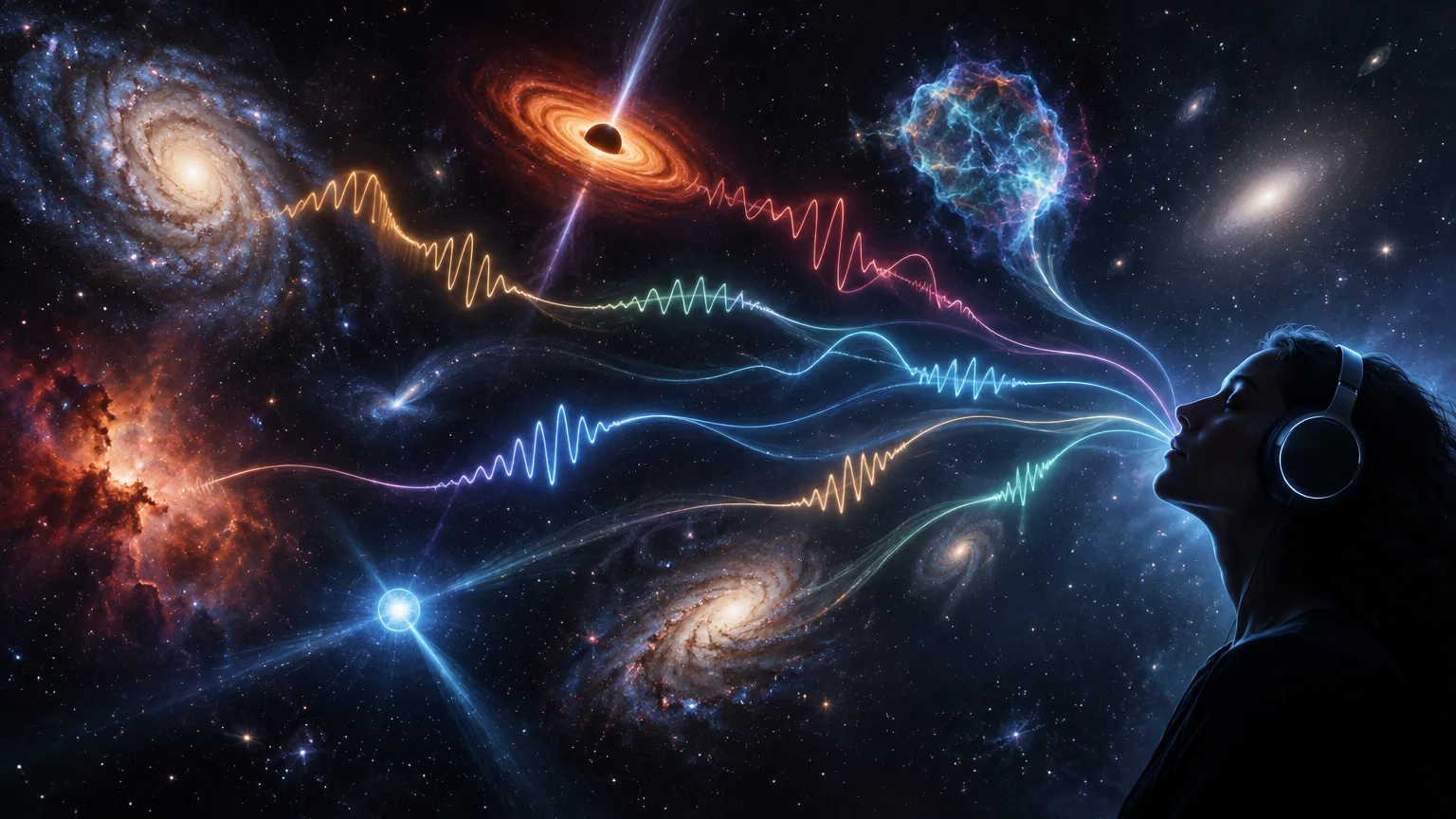
Astronomy is often communicated through images, graphs and figures, but data can also be arranged to be perceived through hearing. A report by the Institute of Astronomy at the National Autonomous University of Mexico (UNAM) describes research that sonified multifrequency light curves from nine astronomical objects. Its stated purpose is to increase human perception through the auditory dimension.
The term can invite a literal interpretation: it does not necessarily mean that a sound travelling through space was recorded. In the context described, sonification means taking information from observations into an auditory format. Audio therefore acts as a representation of the data. This distinction matters in a field in which an image, a graph or a sound may be different ways of presenting measurements rather than the phenomenon itself.
What sonification contributes
Light curves are records of how the light received from an object changes over time. UNAM's reference further specifies that the work used information at multiple frequencies. By transferring those variations into sound resources, the research seeks to bring hearing into the exploration of patterns in the data.
The available source does not detail which specific parameters were assigned to sound or how each piece was built. It is therefore not possible to say whether a given pitch, rhythm, intensity or timbre corresponds to a particular variable. What is supported is the central point: multifrequency light curves from nine objects were sonified to broaden human perception through an auditory dimension.
From observation to audible format
It is useful to distinguish three levels. First come observations and their data. Next comes a scientific representation, such as a light curve. Finally, an auditory representation of that information can be created. Sonification belongs to this last level: it does not replace the original record, but offers another route to approach it.
- Data: information obtained about the light from astronomical objects.
- Light curves: a way to display their variations over time.
- Sonification: conversion of that information into an auditory experience.
This sequence also helps avoid a conclusion the evidence does not support: listening to a piece alone does not establish an astrophysical result. The value conveyed by the source lies in extending human perception of data, not in claiming that audio replaces standard research tools.
Nine objects and an institutional source
The number reported by the Institute of Astronomy is nine. The report presents them in connection with highly energetic astronomical objects, but the available extract does not identify their names, classification, source observations, bands used, or the period covered by the light curves. It also provides no study date, linked academic publication, audio files, or comparative findings on the method's performance.
The body reporting the work is UNAM's Institute of Astronomy, a Mexican academic institution devoted to astronomy. An institutional source allows the initiative's description to be attributed precisely; it does not justify extending its claims beyond what is published in the supplied material.
Audio for communication and exploration, not stand-alone proof
The project's editorial interest lies in the possibility that sound can become a gateway to astronomical datasets. Compared with an exclusively visual explanation, an audible format may invite attention to changes and contrasts differently. It also positions audio as a possible medium for science communication, provided that the transformed data and the criteria used are explained.
The case sits within a wider information environment. The official Spanish-language NASA Science site gathers news, discoveries and material on planets, astronomy and exploration. That reference does not itself document UNAM's project, but it shows that public communication of space science spans different formats and subjects.
Uncertainties that must remain visible
The available evidence is limited to the description in an institutional report and general references on astronomy news. It cannot establish how each object sounds, reproduce the procedure, assess the conversion's quality, or compare auditory perception with visual analysis. Nor does it allow the conclusion that sonification produced a specific discovery, that the nine objects are a representative sample, or that the method applies in the same way to other data.
The most cautious wording is therefore also the most faithful: researchers connected with UNAM sonified multifrequency light curves from nine astronomical objects to increase human perception through sound. The project shows that scientific data can be represented in more than one way, but the meaning of each sound depends on the translation method, whose details are absent from the supplied evidence.